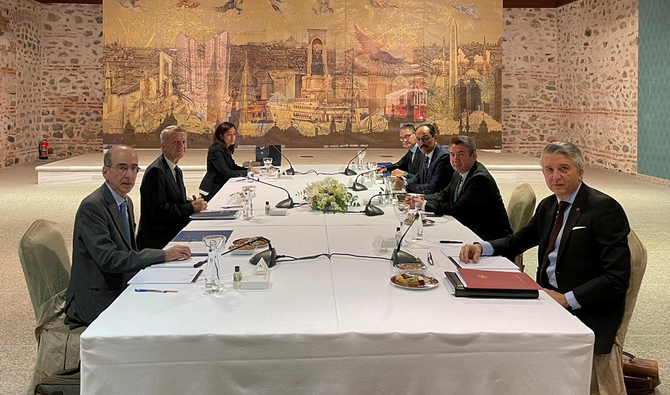
ISTANBUL: Turkey will no longer hold high-level talks with neighboring Greece, Turkish President Recep Tayyip Erdogan said Wednesday amid rising tensions between the traditional rivals.
Ankara resumed negotiations with Athens last year following a five-year break to address differences over a range of issues such as mineral exploration in the eastern Mediterranean and rival claims in the Aegean Sea.
“We broke off our high-level strategy council meetings with Greece,” Erdogan told a meeting of his party’s lawmakers in Ankara, adding: “Don’t you learn any lessons from history? Don’t try to dance with Turkey.”
The talks had made little headway, but were a means for the two countries to air out their grievances without resorting to a potential armed standoff as had occurred as recently as two years ago.
Erdogan’s pivot on the talks appeared to have been triggered last week when he signaled his displeasure at comments made by Greek Prime Minister Kyriakos Mitsotakis during a trip to the US
Erdogan said Mitsotakis “no longer exists” for him after accusing the Greek leader of trying to block Turkey’s acquisition of F-16 fighter planes.
Erdogan also commented on Turkey’s objection to Sweden and Finland joining NATO. Ankara has complained the Nordic states harbor terror suspects and arm a group in Syria it accuses of being an extension of the Kurdistan Workers’ Party, or PKK that has waged a 38-year insurgency inside Turkey.
“NATO is a security organization, not a support organization for terrorist organizations,” he said.
The US and EU have categorized the PKK as a terror group. However, its Syrian wing, the People’s Protection Units, or YPG, has played a leading role in the US-led fight against the Daesh group.
Erdogan said those who tried to legitimize the PKK with “letter tricks” were “deceiving themselves, not us.”
The president added that Turkey would not change its stance on the Swedish and Finnish NATO application without seeing “binding documents” demonstrating a hardened approach to those Ankara considers terrorists.
Swedish Prime Minister Magdalena Andersson told a news conference in Stockholm that she’s looking forward to “further constructive meetings” with Turkey to “sort out any issues or misunderstandings that there might be.”
Sweden has a significant Kurdish diaspora and most of Ankara’s complaints about support for “terrorists” seem directed there. Finland, meanwhile, has a Kurdish-speaking population of around 15,000.
Regarding a new cross-border military operation in Syria, Erdogan said Turkey was “entering a new phase” in its goal to create a 30-kilometer (19-mile) buffer zone south of the frontier.
The territory is controlled by a Syrian Kurdish administration and Ankara says it has been used to launch attacks on Turkey.
Erdogan singled out the towns of Tall Rifat and Manbij as targets Turkey will be “clearing of terrorists.” Both lie west of the Euphrates river while the main Kurdish-controlled region is to the east.

Turkey breaks off high-level talks with Greece as rift grows
Short Url
https://arab.news/z4kt7
Turkey breaks off high-level talks with Greece as rift grows
- Ankara resumed negotiations with Athens last year following a five-year break to address differences
- “We broke off our high-level strategy council meetings with Greece,” Erdogan told a meeting of his party’s lawmakers in Ankara
Khartoum markets back to life but ‘nothing like before’
- The hustle and bustle of buyers and sellers has returned to Khartoum’s central market, but “it’s nothing like before,” fruit vendor Hashim Mohamed told AFP, streets away from where war first broke out
KHARTOUM: The hustle and bustle of buyers and sellers has returned to Khartoum’s central market, but “it’s nothing like before,” fruit vendor Hashim Mohamed told AFP, streets away from where war first broke out nearly three years ago.
On April 15, 2023, central Khartoum awoke to battles between the Sudanese army and the paramilitary Rapid Support Forces (RSF), who had been allies since 2021, when they ousted civilians from a short-lived transitional government.
Their war has since killed tens of thousands and displaced millions.
In greater Khartoum alone, nearly four million people — around half the population — fled the city when the RSF took over.
Hashim Mohamed did not.
“I had to work discreetly, because there were regular attacks” on businesses, said the fruit seller, who has worked in the sprawling market for 50 years.
Like him, those who stayed in the city reported having lived in constant fear of assaults and robberies from militiamen roaming the streets.
Last March, army forces led an offensive through the capital, pushing paramilitary fighters out and revealing the vast looting and destruction left behind.
“The market’s not what it used to be, but it’s much better than when the RSF was here,” said market vendor Adam Haddad, resting in the shade of an awning.
In the market’s narrow, dusty alleyways, fruits and vegetables are piled high on makeshift stalls or tarps spread on the ground.
Two jobs to survive
Khartoum, where entire neighborhoods have been damaged by the fighting, is no longer threatened by the mass starvation that stalks battlefield cities and displacement camps elsewhere in Sudan.
But with the economy a shambles, a good living is still hard to provide.
“People complain about prices, they say it’s too expensive. You can find everything, but the costs keep going up: supplies, labor, transportation,” said Mohamed.
Sudan has known only triple-digit annual inflation for years. Figures for 2024 stood at 151 percent — down from a 2021 peak of 358 percent.
The currency has also collapsed, going from trading at 570 Sudanese pounds to the US dollar before the war to 3,500 in 2026, according to the black market rate.
One Sudanese teacher, who only a few years ago could provide comfortably for his two children, told AFP he could no longer pay his rent with a monthly salary of 250,000 Sudanese pounds ($71).
To feed his family, pay for school and cover health care, he “works in the market or anywhere” on his days off.
“You have to have another job to pay for the bare minimum of basic needs,” he said, asking for anonymity to protect his privacy and to avoid “problems with security services.”
Beyond Khartoum, the war still rages, with the RSF in control of much of western and southern Sudan and pushing into the central Kordofan region.
For Adam Haddad, the road to recovery will be a long one.
“We don’t have enough resources or workers or liquidity going through the market,” he said, adding that reliable electricity was still a problem.
“The government is striving to restore everything, and God willing, in the near future, the power will return and Khartoum will become what it once was.”
On April 15, 2023, central Khartoum awoke to battles between the Sudanese army and the paramilitary Rapid Support Forces (RSF), who had been allies since 2021, when they ousted civilians from a short-lived transitional government.
Their war has since killed tens of thousands and displaced millions.
In greater Khartoum alone, nearly four million people — around half the population — fled the city when the RSF took over.
Hashim Mohamed did not.
“I had to work discreetly, because there were regular attacks” on businesses, said the fruit seller, who has worked in the sprawling market for 50 years.
Like him, those who stayed in the city reported having lived in constant fear of assaults and robberies from militiamen roaming the streets.
Last March, army forces led an offensive through the capital, pushing paramilitary fighters out and revealing the vast looting and destruction left behind.
“The market’s not what it used to be, but it’s much better than when the RSF was here,” said market vendor Adam Haddad, resting in the shade of an awning.
In the market’s narrow, dusty alleyways, fruits and vegetables are piled high on makeshift stalls or tarps spread on the ground.
Two jobs to survive
Khartoum, where entire neighborhoods have been damaged by the fighting, is no longer threatened by the mass starvation that stalks battlefield cities and displacement camps elsewhere in Sudan.
But with the economy a shambles, a good living is still hard to provide.
“People complain about prices, they say it’s too expensive. You can find everything, but the costs keep going up: supplies, labor, transportation,” said Mohamed.
Sudan has known only triple-digit annual inflation for years. Figures for 2024 stood at 151 percent — down from a 2021 peak of 358 percent.
The currency has also collapsed, going from trading at 570 Sudanese pounds to the US dollar before the war to 3,500 in 2026, according to the black market rate.
One Sudanese teacher, who only a few years ago could provide comfortably for his two children, told AFP he could no longer pay his rent with a monthly salary of 250,000 Sudanese pounds ($71).
To feed his family, pay for school and cover health care, he “works in the market or anywhere” on his days off.
“You have to have another job to pay for the bare minimum of basic needs,” he said, asking for anonymity to protect his privacy and to avoid “problems with security services.”
Beyond Khartoum, the war still rages, with the RSF in control of much of western and southern Sudan and pushing into the central Kordofan region.
For Adam Haddad, the road to recovery will be a long one.
“We don’t have enough resources or workers or liquidity going through the market,” he said, adding that reliable electricity was still a problem.
“The government is striving to restore everything, and God willing, in the near future, the power will return and Khartoum will become what it once was.”
© 2026 SAUDI RESEARCH & PUBLISHING COMPANY, All Rights Reserved And subject to Terms of Use Agreement.


