French World Cup winner Pogba to leave Man Utd

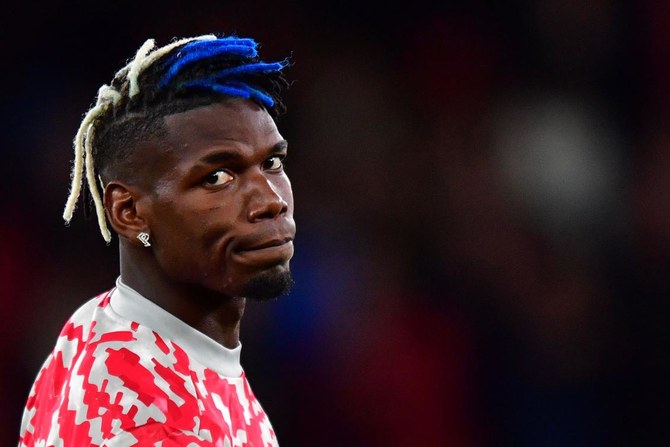
French World Cup-winning midfielder Paul Pogba is to leave Manchester United at the end of June, the club said bringing the curtain down on a largely disappointing second spell there. (AFP)
Short Url
Updated 01 June 2022
Follow

French World Cup winner Pogba to leave Man Utd

  • New United manager Erik ten Hag has clearly decided Pogba's chances at the club have come and gone
  • A second spell at Juventus -- where he won four Serie A titles -- may well be on Pogba's menu

MANCHESTER: French World Cup-winning midfielder Paul Pogba is to leave Manchester United at the end of June, the club said Wednesday, bringing the curtain down on a largely disappointing second spell.
The 29-year-old’s departure at the end of his contract will see United recoup none of the then record £89 million ($112 million) he cost them when they bought him from Juventus in 2016.
However, new United manager Erik ten Hag has clearly decided Pogba’s chances at the club have come and gone.
A second spell at Juventus — where he won four Serie A titles — may well be on Pogba’s menu as Italian media have suggested he has given a verbal agreement to return and accepted a lower salary.
French champions Paris Saint-Germain have also been mentioned as a possibility as they are due for an overhaul and built round his fellow World Cup winner Kylian Mbappe.
Ten Hag wishes to refresh a side that has seen their city rivals Manchester City become the powerhouse they once were under Alex Ferguson. United have rarely threatened to repeat those days since he retired in 2013.
Pogba flourished initially under Jose Mourinho — who also brought in the since departed Zlatan Ibrahimovic and Romelu Lukaku — and was part of the sides that won the League Cup and Europa League in 2017.
His subsequent performances rarely matched those he produced for France in their 2018 World Cup campaign.
He did show glimpses of his abundant talent especially in their run to the 2021 Europa League final — scoring goals against AC Milan and Roma in the knockout stages.
However, he was then anonymous in the final as United lost to Villarreal on penalties.
Fitness problems limited him to 27 appearances last season in an unimpressive campaign for both player and club as United had to be content with a Europa League spot.
The fans had lost patience with his inconsistent displays and booed him off the pitch when he was substituted in a victory over Norwich in April.
“The club can announce that Paul Pogba will leave Manchester United at the end of June, upon the expiry of his contract,” read the club statement.
“The last of his 233 United games ended in the 10th minute of a defeat at Anfield in April 2022.
“It was a low-key end to a United career that brought so many individual high moments.
“So many beautiful goals, assists and pieces of skill.
“For a boy that joined the Academy at 16 to make over 200 United appearances and lift the Youth Cup, along with two major pieces of silverware, is something that should be applauded and celebrated.”


MESIF 2026 wraps up in Riyadh with spotlight on legacy, fans and sustainable sports growth

Updated 6 sec ago
Follow

MESIF 2026 wraps up in Riyadh with spotlight on legacy, fans and sustainable sports growth

  • A recurring theme in panel discussions was the importance of moving beyond siloed planning toward connected strategies
  • Abdullah Aldrees: I believe Saudi is a sleeping giant within the football ecosystem because of the high demand that exists

RIYADH: The sixth edition of the Middle East Sports Investment Forum concluded on Jan. 28 in Riyadh, reinforcing the need for long-term legacy planning, integrated infrastructure development and fan-centric strategies as the region’s sports ecosystem continues to mature.

Held over two days — Jan. 27-28 — at the ministry of investment headquarters and the Kingdom Arena, the forum brought together senior government officials, global sports executives, investors and technology leaders to assess how the Middle East — and Saudi Arabia in particular — can translate major event hosting and increased investment into sustainable impact.

A recurring theme in panel discussions was the importance of moving beyond siloed planning toward connected strategies that link infrastructure, finance, fan engagement and legacy from the earliest stages of project development.

Dr. Sakis Batsilas, deputy CEO of FIFA World Cup Qatar 2022, stressed that while international expertise has played a key role in the region’s rapid progress, long-term success depends on knowledge transfer and talent development.

“Yes, we do need experts and consultants and expatriates to help,” he said. “But the main, I would say, focus, is how we ensure that we transfer this knowledge and we build talent … to make sure we have the right talent.”

Drawing on his experience delivering major global events, Batsilas highlighted the need to embed legacy considerations during the bidding phase.

“Talking now from an operational point of view … I think everything starts with a bidding phase,” he said, adding that stronger legacy metrics would encourage greater long-term planning from host nations and rights holders alike.

Fan experience and commercialization also featured prominently, particularly as Saudi Arabia continues to expand its domestic leagues and host major international competitions. David Davies, chief experience officer of Catapult, said the Kingdom’s challenge lies in converting strong digital fandom into sustained in-stadium engagement.

“Saudi Arabia is … ranked consistently in the highest in the world” in terms of football fandom, Davies said. “However, attendance in-stadium is still developing.” He noted that younger, digitally native audiences require tailored engagement strategies. “The days of being able to ask them to come to you have gone,” he said.

From a government and delivery perspective, Abdullah Aldrees, chief of staff at the vice minister’s executive office at the ministry of sport, said MESIF highlighted the scale of opportunity ahead — and the importance of a joined-up approach.

“I believe Saudi is a sleeping giant within the football ecosystem because of the high demand that exists, the government support and the anchor IPs that we’re hosting,” Aldrees said. “So all of this can create a lot of opportunities for football to grow in Saudi.”

He said the Kingdom has entered a critical preparation phase as it gears up for a packed calendar of major events. “We are now living in the preparation phase. We’re preparing for all these IPs, we’re preparing for all these big events coming up,” Aldrees said. “So how do you make sure that you really reap the right benefit from them and have the right legacy?”

Pointing to upcoming milestones such as the AFC Asian Cup Saudi Arabia 2027 and the FIFA World Cup 2034, Aldrees emphasized the need to think beyond hosting.

“Yes, we’re hosting World Cup. We’re hosting Asia 2027, but how do you make sure that they have a long, lasting impact on the ecosystem?” he said.

Echoing a key message from the forum, Aldrees concluded: “The effective strategy is to be looking at these things together. We no longer can be looking at them as silos and test cycles.”

The transformation of Saudi football was also highlighted as a reflection of broader cultural and structural change. Juan Esteban Gomez, a football expert specializing in digitalization and artificial intelligence, said the shift has been tangible in recent years. “The people here are breathing football,” he said, describing the Saudi league as “one of the most enjoyable competitions in the world.”

As MESIF 2026 drew to a close, participants agreed that the next phase of sports investment in the Middle East will be defined by execution — ensuring that capital, policy and innovation align to deliver measurable legacy, deeper fan engagement and resilient ecosystems capable of sustaining growth well beyond headline events.