

Pakistan announces Rs150,000 subsidy for Hajj pilgrims

Worshippers circumambulate the Kaaba, Islam's holiest shrine, at the Grand mosque in the holy Saudi city of Mecca, on the first day of the al-Adha feast celebrated by Muslims worldwide, on July 20, 2021. (AFP/File)
Short Url
Updated 31 May 2022
Follow

Pakistan announces Rs150,000 subsidy for Hajj pilgrims

  • The subsidy will be granted to over 32,000 pilgrims going for Hajj under government scheme
  • Religious minister says cannot force private operators about choice of currency for airfares

ISLAMABAD: Pakistan’s Minister for Religious Affairs Mufti Abdul Shakoor on Tuesday said the government had approved a Rs150,000 ($750) subsidy for Hajj pilgrims traveling to Saudi Arabia under the government scheme. 

Pakistan has been allotted a quota of 81,132 pilgrims for this year’s Hajj, where over 32,000 would go under the government scheme and above 48,000 would go through private operators. 

After a two-year hiatus due to the COVID-19 pandemic, Saudi Arabia this year allowed the Hajj pilgrimage for all Muslims across the globe, but restricted the maximum age of pilgrims to 65 years. 

“Today, the federal cabinet has approved a subsidy of Rs150,000 per person for the government Hajj scheme,” Shakoor told reporters in Islamabad. 

“This subsidy will reduce Hajj expenses from Rs860,000 to around Rs710,000.” 
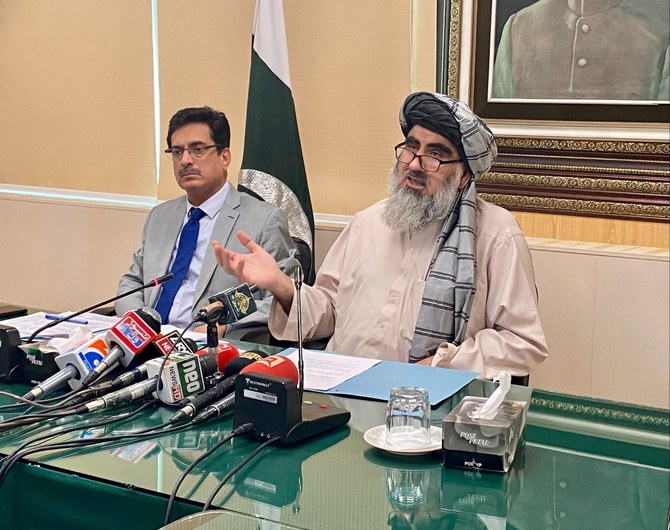


Pakistan’s Minister for Religious Affairs Mufti Abdul Shakoor (right) addresses a press conference in Islamabad, Pakistan, on May 31, 2022. (AN Photo)

Hajj expenses would have gone over a million rupees per person due to depreciation in the value of Pakistani currency, Shakoor said, adding his ministry succeeded in reducing them through better negotiations for residential buildings and catering services in Saudi Arabia. 

“We have brought rates of per bed accommodation in Makkah from SR2,400 to SR2,100 and in Medina, from SR1,100 to SR720,” the minister said. 

He said the government had convinced private Hajj operators to reduce their basic package from Rs1.2 million ($5,997) to Rs950,000 ($4747). 

“We cannot force private Hajj operators about the [choice of] currency for airfare, but it has been fixed at Rs181,000 [return ticket] in the government scheme,” he said, when told some private operators were asking pilgrims to pay their airfares in dollars. 

The religious minister thanked the Saudi government for starting Hajj operations despite the fact that coronavirus was not completely eliminated from the world. 

“I am grateful to the Custodian of the Two Holy Mosques for allowing and managing Hajj this year even though the whole world is still fighting COVID-19,” he said. 

“The Saudi government has digitalized Hajj services, providing better transportation and air-conditioned tent residences at the Mina valley this year.” 

Shakoor also expressed his gratitude to Saudi Arabia’s ambassador to Pakistan Nawaf bin Said Al-Malki for facilitating the visa service on a short notice. 

The minister said his government had received over 63,000 applications for the government scheme for around 32,000 pilgrims. 

“We have completed all Hajj arrangements within one month which normally requires six months,” he said, adding the first Hajj flight will depart on June 6. 


Pakistan explores new food export routes, protections for farm supply amid Middle East conflict

Updated 10 March 2026
Follow

Pakistan explores new food export routes, protections for farm supply amid Middle East conflict

  • Senior ministers review alternative sea routes, new markets amid the war in Iran
  • Pakistan relies heavily on Middle Eastern sea lanes for its imports and exports

ISLAMABAD: Pakistan reviewed the supply of perishable food items and fertilizer stocks on Monday, according to the state media, as the escalating conflict in the Middle East threatens to disrupt shipping routes and energy supplies critical to the country’s trade and agriculture.

The meetings, chaired separately by Deputy Prime Minister and Foreign Minister Ishaq Dar and Food Security Minister Rana Tanveer Hussain, came as tensions following US-Israeli strikes on Iran have raised concerns about the security of key maritime routes and energy markets that underpin Pakistan’s economy.

Pakistan relies heavily on Middle Eastern sea lanes for both fuel imports and exports of agricultural and food products, making disruptions in the region particularly sensitive for the country.

Dar chaired a meeting of the PM’s Committee to review the supply and export of perishable food items, examining steps to maintain domestic availability while ensuring timely exports of surplus produce.

“In the light of evolving regional trade dynamics and disruptions to some traditional routes, the committee explored alternative export pathways, sea routes, and potential new markets,” Radio Pakistan reported after the meeting.

Officials also discussed proposals from exporters and emphasized improving storage facilities, logistics and market access while assessing global demand and pricing trends to support export competitiveness.

In a separate meeting in Islamabad, Food Security Minister Rana Tanveer Hussain said the government would ensure stable fertilizer availability despite regional uncertainties.

“Agricultural productivity and food security will remain protected despite external challenges,” he said while chairing a meeting of the Fertilizer Review Committee.

He stressed the need for close coordination among manufacturers, distributors and provincial authorities to maintain uninterrupted fertilizer supply across the country.

The committee also reviewed fertilizer pricing and distribution mechanisms to prevent artificial shortages and hoarding, officials said, adding that authorities would monitor prices closely to ensure farmers have access to affordable inputs.