

Pakistan government says forming judicial commission to probe arrest of ex-PM Khan aide

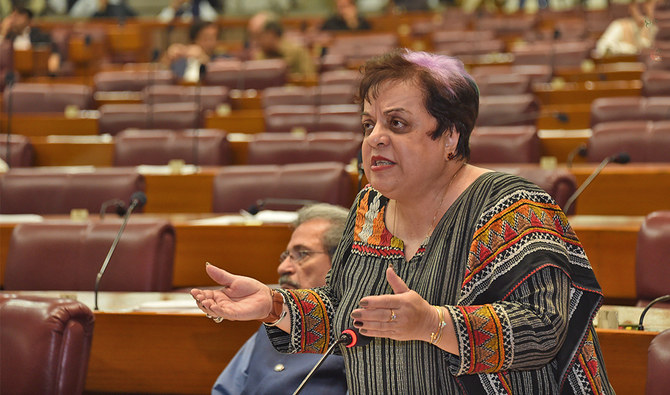
Pakistan's former human right minister and ex-PM Imran Khan aide, Shireen Mazari, is addressing National Assembly in Islamabad, Pakistan, on October 30, 2018. (@NAofPakistan/Twitter)
Short Url
Updated 30 May 2022
Follow

Pakistan government says forming judicial commission to probe arrest of ex-PM Khan aide

  • Islamabad High Court has ordered investigation into arrest of former human rights minister Shireen Mazari
  • Mazari, who served in PM Khan’s cabinet, was detained by police near her Islamabad residence on May 22

ISLAMABAD: A lawyer representing the government of Pakistan told the Islamabad High Court on Monday a judicial commission would be set up to investigate the controversial arrest earlier this month of a former human rights minister over a decades-old land dispute, local media reported.

Shireen Mazari, who served in a cabinet-level position under former Prime Minister Imran Khan, was detained by police near her Islamabad home on May 22.

Khan’s party, the Pakistan Tehreek-e-Insaf, has said Mazari was being politically targeted by the new administration of Prime Minister Shehbaz Sharif under the guise of a land dispute dating back to 1972.

Hours after Mazari’s arrest, Chief Minister of Punjab province Hamza Shahbaz ordered her release and she was brought to the Islamabad court for an urgent hearing the same day and subsequently released. A petition against the arrest has been filed by Mazari’s daughter.

During a hearing in the case on Monday, the additional attorney-general told the court a summary had been sent for the formation of a commission to probe the arrest.

“Hopefully, the commission will be formed today [Monday],” he was quoted by Geo News as telling the court.

The government has not officially notified the formation of the body.

Mazari has been critical of Sharif’s government, as well as the all-powerful army, on Twitter since Khan’s government was toppled in a no-confidence vote in parliament in April. Khan’s party lawmakers resigned from the body’s lower house in protest and Khan has since been mobilizing supporters through public rallies across the country to pressure the government into an early election.


Pakistan parliament calls for national response against ‘external sponsors’ of terror after Balochistan attacks

Updated 41 min 47 sec ago
Follow

Pakistan parliament calls for national response against ‘external sponsors’ of terror after Balochistan attacks

  • Militants killed 50 people, including 17 law enforcers, in coordinated attacks across Balochistan last week
  • Resolution follows government accusations that India backed the assaults, a charge New Delhi denies

ISLAMABAD: Pakistan’s National Assembly on Tuesday adopted a resolution condemning a wave of militant attacks in the southwestern province of Balochistan and called for an immediate, coordinated national response against what it described as “external sponsors” of terrorism.

The resolution came days after separatist militants carried out coordinated gun and bomb attacks across multiple districts in Balochistan, targeting security installations and government facilities, in one of the deadliest flare-ups of violence in the province in recent months.

Pakistan’s State Minister for Interior Tallal Chaudry said the attacks on Friday and Saturday killed 50 people, including 33 civilians and 17 law enforcement personnel. State media reported on Monday that security forces had killed 177 militants since the assaults began.

Interior Minister Mohsin Naqvi said last week that the attacks, claimed by the separatist Baloch Liberation Army (BLA), were planned from India. New Delhi rejected the allegation as “baseless,” saying Islamabad was attempting to deflect attention from its internal challenges. Pakistan has long accused India of backing militant groups in Balochistan and the northwestern province of Khyber Pakhtunkhwa, charges India has consistently denied.

The parliamentary resolution, tabled by Minister for Parliamentary Affairs Dr. Tariq Fazal Chaudhry, said evidence from several militant incidents had highlighted “external patronage” of armed groups and raised “serious concerns, particularly regarding the role of India.”

“This house demands that an immediate, comprehensive, coordinated and multi-dimensional national response be ensured against these external sponsors and internal facilitators, including funding, smuggling, and propaganda networks, bringing together the political, diplomatic, military, intelligence, legal and narrative fronts,” the resolution stated, according to a copy seen by Arab News.

It said terrorism in Pakistan was being facilitated through logistical and operational support, financial assistance, training, medical treatment, and propaganda networks originating from certain neighboring countries.

The resolution expressed solidarity with victims and their families and praised Pakistan’s security forces for what it described as effective action against militants. It also voiced concern over militant networks increasingly involving women in attacks.

“This house expresses profound grief, sorrow, and concern over the fact that terrorist networks are attempting to exploit women and use them against the state and society through coercion, psychological pressure and blackmail,” it said.

Lawmakers called for national unity and urged political forces to rise above differences, vowing that the state would not compromise on the protection of its citizens or national security.

Balochistan, Pakistan’s largest province by land area, has long faced a separatist insurgency that has intensified in recent years. Militants frequently target security forces, government officials, infrastructure projects, foreigners, and non-local workers.

The province holds vast reserves of minerals and hydrocarbons and is central to the multibillion-dollar China-Pakistan Economic Corridor (CPEC), a flagship component of China’s Belt and Road Initiative.

Separatist groups such as the BLA accuse Islamabad of exploiting Balochistan’s natural resources while denying locals a fair share. Pakistan’s civilian and military leadership reject the claim and say they are investing in the province’s development.

Balochistan is home to vast reserves of minerals and hydrocarbons, and also to the multibillion-dollar China-Pakistan Economic Corridor (CPEC), a flagship component of China’s Belt and Road Initiative.

Separatist militant groups such as the BLA blame Islamabad for exploiting Balochistan’s natural resources and denying locals a share in them. The military and civilian government reject these allegations and say they are investing in the province’s development.