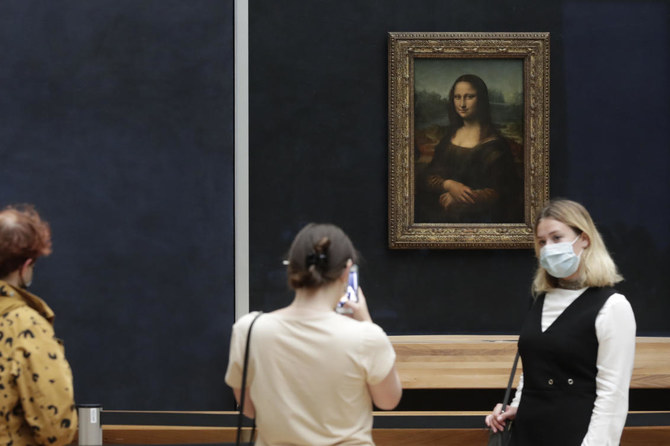
PARIS: A 36-year-old man has been arrested and placed in psychiatric care after he smeared a glass screen encasing the Mona Lisa with cake, prosecutors said Monday, in a purported protest against artists not focusing enough on “the planet.”
Officials at the Louvre Museum in Paris, where the enigmatic portrait holds pride of place, declined to comment on the bizarre incident on Sunday, which was captured on several phones and circulated widely on social media.
The treasured work by Leonardo da Vinci, which has been the target of vandalism attempts in the past, was unharmed thanks to its bulletproof glass case.
A Twitter user identified as Lukeee posted a video showing a museum employee wiping a mess off the glass and another showing a man dressed in white being escorted away by security guards.
“A man dressed as an old lady jumps out of a wheelchair and attempted to smash the bulletproof glass of the Mona Lisa. Then proceeds to smear cake on the glass and throws roses everywhere, all before being tackled by security,” Lukeee wrote.
Speaking French, the man says: “There are people who are destroying the Earth... All artists, think about the Earth. That’s why I did this. Think of the planet.”
No image have emerged showing the actual incident.
An inquiry into “an attempt to vandalize a cultural work” has been opened, the Paris prosecutor’s office said.
The Mona Lisa has been behind glass since a Bolivian man threw a rock at the painting in December 1956, damaging her left elbow. In 2005, it was placed in a reinforced case that also controls temperature and humidity.
In 2009, a Russian woman threw an empty teacup at the painting, which slightly scratched the case.
The Louvre is the largest museum in the world, housing hundreds of thousands of works that attracted some 10 million visitors a year before the Covid-19 pandemic.

Man arrested after smearing Mona Lisa with cake at Louvre
https://arab.news/9s4f3
Man arrested after smearing Mona Lisa with cake at Louvre
Archeologists discover world’s oldest artwork in Indonesia’s Sulawesi
- Newly dated artworks are believed to have been created by ancestors of indigenous Australians
- Discovery shows Sulawesi as one of world’s oldest centers of artistic culture, researcher says
JAKARTA: Hand stencils found in a cave in Indonesia’s Sulawesi are the world’s oldest known artworks, Indonesian and Australian archeologists have said in a new study that dates the drawings back to at least 67,800 years ago.
Sulawesi hosts some of the world’s earliest cave art, including the oldest known example of visual storytelling — a cave painting depicting human-like figures interacting with a wild pig. Found in 2019, it dates back at least 51,200 years.
On Muna, an island off the province’s southeast, researchers have discovered new artworks which are faint and partially obscured by a more recent motif on the wall. They used a new dating technique to determine their age.
The cave art is of two faded hand stencils, one at least 60,900 years old and another dating back at least 67,800 years. This makes it the oldest art to be found on cave walls, authors of the study, which was published this week, said in the journal Nature.
Adhi Agus Oktaviana, a researcher at the National Research and Innovation Agency, or BRIN, and co-author, said this hand stencil was 16,600 years older than the rock art previously documented in the Maros-Pangkep caves in Sulawesi, and about 1,100 years older than stencils found in Spain believed to have been drawn by Neanderthals.
The discovery “places Indonesia as one of the most important centers in the early history of symbolic art and modern human seafaring. This discovery is the oldest reliably dated rock art and provides direct evidence that humans have been intentionally crossing the ocean since almost 70,000 years ago,” Oktaviana said on Wednesday.
The stencils are located in Liang Metanduno, a limestone cave on Muna that has been a tourist destination known for cave paintings that are about 4,000 years old.
“This discovery demonstrates that Sulawesi is one of the oldest and most continuous centers of artistic culture in the world, with roots dating back to the earliest phases of human habitation in the region,” said Prof. Maxime Aubert of Australia, another of the study’s co-authors.
To figure out the stencils’ ages, researchers used a technique called laser-ablation uranium-series dating, which allows for the accurate dating of ocher-based rock art. The method uses a laser to collect and analyze a tiny amount of mineral crusts that had formed on top of the art.
The study also explored how and when Australia first became settled, with the researchers saying the stencil was most likely created by the ancestors of indigenous Australians.