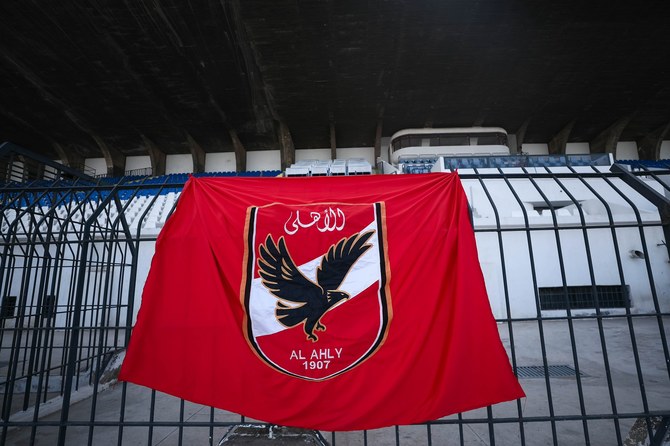
5 talking points ahead of African Champions League final between Al-Ahly, Wydad Casablanca

CAF Champions League defending champions Al-Ahly of Egypt face Morocco’s Wydad AC in Casablanca. (Twitter: @AlAhly)
Short Url
Updated 30 May 2022
Follow

5 talking points ahead of African Champions League final between Al-Ahly, Wydad Casablanca

  • Egyptian giants will look to emulate Real Madrid’s supremacy, but hosting of finale at Moroccans’ home ground remains point of contention

RIYADH: Forget Real Madrid’s win over Liverpool for now, on Monday night Africa takes center stage as the CAF Champions League final sees defending champions Al-Ahly of Egypt face Morocco’s Wydad AC in Casablanca. Here are five talking points ahead of the big game.

1. Al-Ahly channeling Real Madrid

Al-Ahly are by far the most successful team in the competition’s history with an impressive 10 titles. There is something that the Egyptians have not managed however: To lift the trophy three years in a row. Even the all-conquering team of the first decade of the 21st century never did that.

It really would be a special feat, but it will be far from easy. The game is taking place at the Casablanca home of their opponents, and it is going to be a hostile atmosphere.

Yet the Red Giants have a special pedigree in this competition and are able to pull something out of the bag when it matters. There were struggles in the group stage with back-to-back defeats against Mamelodi Sundowns that had the team on the brink of elimination, but everyone knew that Al-Ahly would bounce back and that is exactly what happened.

The team from Cairo are similar to Real Madrid. They believe that, in their continental competition, they will find a way to win in the end.

2. Mbenza could give Wydad fans perfect goodbye gift

Guy Mbenza is one of the brightest prospects in African football and the 22-year-old is the leading scorer in the Moroccan league. He has also netted three times in the Champions League and has the ability to decide the game, though with Wydad the top scorers in this year’s competition with 20 goals, there are other threats.

On loan from Belgium’s Royal Antwerp, the Congolese star is unlikely to be in Casablanca for much longer and it could well be that shining on this big stage will pave the way for a move to a bigger European league.

There is plenty of motivation then for the Brazzaville native, who scored in the semi-final win over Petro de Luanda, to put Al-Ahly to the sword.

Fans in Casablanca are not going to be able to enjoy the sight of the youngster in action for too long but leaving after helping to deliver the Champions League trophy will help lessen the sorrow of goodbye.

3. Al-Ahly’s injury issues clearing up but there are domestic struggles

There is some good news for the holders in the fact that their midfield trio of Amr El-Sulya, Hamdi Fathy, and Aliou Dieng have all been passed fit for the big game. The three players missed last week’s Egyptian league clash at ENPPI but will be ready to take on Wydad.

Unlike the Moroccans, who are sitting pretty at the top of their league, Al-Ahly are now in catch-up mode at home. Similar to last year when their continental and global commitments meant that they fell too far behind Zamalek and had to concede the title, the Reds have won just one of their last five games to slip into third in the league and are now seven points behind the leaders. They may have four games in hand over their Cairo rivals, but Al-Ahly know that points on the board are what matters.

This is an issue for after the final, but the sacrifice on the home front feels a lot easier when there is a continental trophy.

4. Other history can be made

Wydad may not have quite the prestigious record in this competition as Al-Ahly – no team does – but they are going for a third continental title, and this is the third final in the space of five years.

If they can win on Monday, they will join Raja Casablanca as the most successful Moroccan team in the history of the competition.

After the 4-2 win over Petro de Luanda in the semi-finals, Wydad returned to domestic duties and approach the final in the knowledge that they have a four-point cushion at the top of the domestic league.

And then there is Pitso Mosimane. The Al-Ahly coach could become the first tactician to win three African titles in a row and the second ever to win four (club legend Manuel Jose is the other).

Mosimane said that he can be compared to Jose after five years, not now. He is wrong. Another trophy would make the South African, who also led Mamelodi Sundowns to the 2016 championship, one of the most successful managers in the world game.

5. Stadium is an issue

The decision by the Confederation of African Football to give the final to the home stadium of Wydad in between the first and second leg of the semi-finals, when it looked odds-on that the Moroccans and the Egyptians would win through, was a controversial one.

If the home team end up winning, it is sure to be a point of contention for Al-Ahly. The Red Giants are hoping that the pressure and expectations from the home fans will create a burden for Wydad but there is no doubt that they would prefer a home and away situation or, at least, a neutral venue. They will receive 10,000 tickets but it remains to be seen how many of their fans make the trip.

Al-Ahly chief executive officer, Amr Shaheen, told the BBC: “The decision to play one single match instead of two legs was wrong in the first place. Africa is different to Europe – we do not have open borders, free circulation, same currency, or common laws.

“The vast majority of African fans cannot fly to attend matches, enjoy a meal, and tour the city they are flying to on the same day, have access to the game and return back to their office desk the next morning to tell their colleagues about the wonderful experience they had.”

Lessons need to be learned for the future. The final venue needs to be announced much earlier in the competition or it should be a two-legged affair.


Injuries a blessing in disguise for Australia as new Ashes heroes emerge

Updated 15 January 2026
Follow

Injuries a blessing in disguise for Australia as new Ashes heroes emerge

  • The absence of key bowlers did not hamper the home team’s determination to win the series

LONDON: Before the recently concluded Ashes series between Australia and England began, I mused on the potential impact which injuries to two of Australia’s fast bowlers may have on the outcome.

There was a sense, at least amongst England’s supporters, that they had a chance of winning the series or, at least, running Australia very close. As those supporters are now well aware, any such hopes were dashed in disappointing fashion.

England’s performances have been raked over ad infinitum in the media and on social media. It seems almost unnecessary to add to this welter of views and analyses.

However, it is worth going back to my pre-series thoughts about the potential impact of injuries and whether they did have an impact on the outcome.

One of the triumvirate of Australian quicks, Josh Hazlewood, was ruled out of the series before it began. Doubts over a second member, Pat Cummins, the team captain, were confirmed before the first Test. Ongoing back problems restricted him to one Test, the third.

This placed significant responsibility on the third member, Mitchell Starc, as well as the replacements for Hazlewood and Cummins and the stand-in captain, Steve Smith. Starc rose to the occasion magnificently.

At lunch on the second day, England sat in the box seat, 100 runs ahead and nine second innings wickets standing. By the end of the day, Australia had won the match. This was thanks to a seven-wicket haul by Starc and a swashbuckling 123 by Travis Head that left England “shellshocked,” according to its captain, Ben Stokes.

Head had been promoted to open because of injury to regular opener, Usman Khawaja. In the second Test at Brisbane, Starc reduced England to five for two in its first innings, going on to claim six wickets. It was a replacement quick bowler, Michael Nesser, who took the honors in the second innings with five wickets in Australia’s victory.

At Adelaide in the third Test, Starc was relatively quiet, claiming four wickets, as Cummins returned to claim six, along with spinner Nathan Lyon, who added five to take his total Test wickets to 567. He would not add more because of a hamstring injury. Cummins also sat out the rest of the series.

Although England won the fourth Test at Melbourne, in another two-day contest, Australia claimed the fifth Test at Sydney, where Starc took five wickets to take his series total to 31 and become player of the series. It may be safely concluded that injuries to key Australian bowlers did not hamper Australia’s determination to win the series.

One English broadcaster of considerable experience opined that England had played Australia’s second XI for most of the time. Although, in addition to key bowlers, Australia was without opening batter, Khawaja, for 1.5 Tests, this seems to be pushing the impact of injuries too far.

It also begs the question of why England could not take advantage. Three quick bowlers left the series due to injury, dealing a blow to a strategy based on fast bowlers.

Both Mark Wood and Jofra Archer have had their careers blighted by injury in recent years and it was little surprise that Wood’s tour ended after the first Test and Archer’s after the third.

Gus Atkinson followed them in Melbourne, whilst the super-human efforts to which Ben Stokes insisted on subjecting his body, finally got the better of him in the final Test. None of the batters got physically injured sufficiently to cause them to miss a Test.

The postmortems on where it all went wrong for England have intensified since the fifth Test was concluded. There are myriad views ranging from ex-players, to broadcasters, print and press media and anyone who loves the game.

The England and Wales Cricket Board will conduct an internal review. It will not be the first one and probably not the last. At the heart of any review should be a central question: If the two teams were judged to be close in ability prior to the series, as they were by most pundits, how did that judgement translate into a 4-1 advantage for Australia?

All manner of accusations have been levelled at England’s players and management.

Amongst these are inadequate preparation, poor technique, inferior mental toughness, arrogance, an unwavering belief in the aggressive, fearless, strategy adopted over the last three years, a laissez-faire culture that has led to a lack of discipline, and a drinking culture. This is a long charge sheet.

There is an old saying that cricket is played in the head. The strategy adopted by England over the last three years has put into the players’ heads the need to be positive and aggressive. Some have been confused by this mantra and have moved away from playing their natural game.

Joe Root has been an example. His class and technique do not need him to be any more aggressive than his talent naturally facilitates. The best opponents — India and Australia — have prepared themselves for England’s approach.

In this last series Australia effectively nullified it, except for several sessions. One of these was at Adelaide, where England made a bold attempt to chase down a target of 424 runs. The consensus view is that Australia outplayed England in the basics of the game.

Glenn McGrath, who took 563 Test wickets for Australia between 1993 and 2007, said that he “bored” people out. He aimed to hit the top of off stump with every delivery, saying that “it is pretty simple stuff, but the complicated thing is to keep it simple.”

This requires a combination of mental discipline and technical skill. Australia’s bowlers followed this approach more successfully than England’s. Australia’s batters scored faster than England when they needed to do so. When conditions changed, they adapted, as in the first innings in Brisbane where they ground out a total of 511 to gain a lead of 177 runs.

In the aftermath of the series defeat, Stokes reflected that “we’re at an interesting place as a team. What we managed to achieve in the first two-and-a-half years was very good.

“We wanted to grow as a team and we wanted to be even more consistent. If anything, we’ve done the opposite. We've started losing more. When that is happening on a consistent basis … you need to look at the drawing board and make some adjustments to get you back on the path of success.”

This suggests an acceptance that there is a problem and that a revised strategy may be implemented in which a return to the basics of the game and an acceptance that the match situation needs to be better assessed might be expected.

It also suggests that Stokes is thinking along different lines to the coach, who has said that he is “open to progress, open to evolution and some nipping and tucking,” but wants “ultimately to be able to steer the ship.”

In the first innings on day two of the third Test at Adelaide, with England reeling on 71 for four, Stokes played an innings which was the antithesis of the team’s attacking strategy.

In 41 degrees Celsius, he was targeted relentlessly by Australia’s attack, taking blows to his body and head, scoring 45 from 151 by the close of play. The following day he was finally dismissed for 83 from 198 deliveries. It was as if he was saying to his fellow batters, there are times when it is acceptable to adopt a different approach, according to the circumstance of the match.

It remains to be seen if there will be a change of approach or personnel when England’s next Test series is played against New Zealand in June. The next action is the T20 World Cup in India and Sri Lanka, a format which demands attacking approaches.

A failed campaign will place even greater pressure on England’s management. They are low on credit, having left behind a feeling of disappointment and anti-climax in Australia, for whom injuries proved to be a blessing in disguise.