

KAEC gears up to become the automotive capital of the region, CEO says

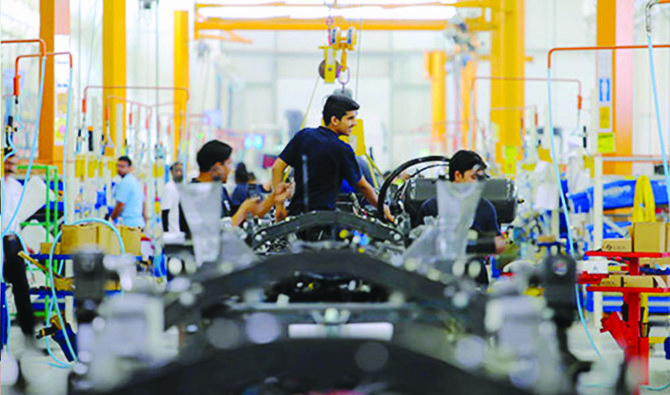
The megacity has been finalizing deals with car manufacturers after Lucid Motors signed an agreement to build a production factory. (Supplied)
Short Url
Updated 29 May 2022
Follow

KAEC gears up to become the automotive capital of the region, CEO says

  • Car companies are evincing interest in setting manufacturing facilities in the city, says CEO Cyril Piaia

JEDDAH: The King Abdullah Economic City is all poised to become the automotive capital of the region, with car companies evincing interest in setting manufacturing facilities in the city, said its CEO Cyril Piaia.

The megacity has been finalizing deals with car manufacturers after the US-based electric vehicle manufacturer Lucid Motors signed an agreement to build a production factory with an annual capacity of 150,000 zero-emission EVs.

Early this year, we signed a deal with Juffali Automotive Co. to move its facility from Jeddah to here. The company assembles Mercedes trucks.

Majid Matbouly, Head of the industrial valley at KAEC

“Those deals are very active; they might be announced very soon,” Piaia told Arab News in an exclusive interview.

An industry in making
Lucid Motors, backed by the Public Investment Fund, is delivering its first factory outside the US, which will make up half of the Kingdom’s plan to produce 300,000 vehicles annually by 2030.
“All focus today is to position the industrial valley as the automotive capital of the region,” Majid Matbouly, head of the industrial valley at KAEC, told Arab news.
The EV manufacturer aims to export 85 percent of its production outside the Kingdom, benefiting from the city’s port located on the Red Sea.
The megacity has a ready-built residential infrastructure for the future employees of Lucid Motors, which includes schools and recreational and entertainment avenues.

HIGHLIGHT

KAEC has a ready-built residential infrastructure for the future employees of Lucid Motors, which includes schools and recreational and entertainment avenues.

“The work on the Lucid facility has commenced. We already have people who have started to look for properties and accomodation here at KAEC to be located closer to their workplace,” Matbouly added.
KAEC is also strategically placed for auto companies, given its full-service commercial port and growing connectivity with other parts of the world.
“We believe that we are very well positioned. We have the King Abdullah port that can facilitate export and import. We are also connected to the rail that will link KAEC to Riyadh and Dammam,” said Piaia on the sidelines of Lucid Motor’s signing ceremony.
The soon-to-be megapolis is already home to a host of big names in the truck assembly sector, including Renault, Volvo and Rosenbauer.
“Early this year, we signed a deal with Juffali Automotive Co. to move its facility from Jeddah to here. The company assembles Mercedes trucks,” pointed out Matbouly.

Sustainable economic zones
Last year, Saudi Minister of Investment Khalid Al-Falih announced the Kingdom’s plan to launch special economic zones, including many logistics plants, one of them is in KAEC.
The city has also heavily invested in sustainability which could be a destination of choice for companies conscious of their environmental commitments.
“We welcome high-tech companies looking into sustainability; we are working toward providing green energy for their factories,” Piaia said.
KAEC is working with several partners to develop renewable energy sources, including solar and wind farms.
“We believe in environmental, social and governance and are applying to become a member of the United Nations Global Compact for sustainability as part of the Saudi Green initiative,” added Piaia.



US allows countries to buy Russian oil stranded at sea for 30 days

Updated 13 March 2026
Follow

US allows countries to buy Russian oil stranded at sea for 30 days

  • US issues 30-day license for stranded Russian oil purchases
  • Measure the latest by Trump administration to calm energy markets jolted by Iran war

The United States issued ​a 30-day license for countries to buy Russian oil and petroleum products currently stranded at sea in what Treasury Secretary Scott Bessent said was a step to stabilize global energy markets roiled by the Iran war.
The announcement comes a day after the US Energy Department said that the US would be releasing 172 million barrels of oil from the strategic petroleum reserve in an effort to curb sky-rocketing oil prices in the wake of the war in Iran. That release was part of a broader commitment by the 32-nation International Energy Agency to release 400 million barrels of oil. The agency said earlier on Thursday that he war in the Middle East ‌was creating the ‌biggest oil supply disruption in history. Bessent, in a statement on X ​released ‌hours ⁠after benchmark ​oil prices ⁠shot above $100 a barrel, said the measure was “narrowly tailored” and “short-term” and would not provide significant financial benefit to the Russian government.
“The temporary increase in oil prices is a short-term and temporary disruption that will result in a massive benefit to our nation and economy in the long-term,” Bessent said in the statement, echoing President Donald Trump.
Thursday’s license, which authorizes the delivery and sale of Russian crude oil and petroleum products loaded on vessels as of March 12, will remain valid through midnight Washington time on April 11, according to the text of the license posted on ⁠the Treasury Department’s website. The US Treasury previously issued a 30-day waiver on March ‌5 specifically for India, allowing New Delhi to buy Russian oil stuck ‌at sea. Among other measures to tame energy prices, Trump has already ordered ​the US International Development Finance Corporation to provide political ‌risk insurance and financial guarantees for maritime trade in the Gulf and said the US Navy ‌could escort ships in the region. In another attempt to control prices, the Trump administration is considering temporarily waiving a shipping rule known as the Jones Act to ensure energy and agricultural products can move freely between US ports, the White House said. Waiving the rule would allow foreign ships to carry fuel between US ports, potentially lowering costs and speeding deliveries.
“The president ‌is taking every action he can to lower prices ... unsanctioned oil that’s at sea to get that into the market, continuing to push our own ⁠producers to drill and ⁠expand production as fast and as far as they can, providing regulatory relief, and you’re going to see more and more in the days to come,” White House Deputy Chief of Staff Stephen Miller told Fox News’ “Primetime” program on Thursday.
There were about 124 million barrels of Russian-origin oil on water across 30 different locations globally as of Thursday, Fox News reported, adding that the US license would provide around five to six days of supply when taking into account the daily loss of oil from the Strait. Trump said earlier on Thursday the United States stood to make significant money from oil prices driven higher by the war, prompting criticism from some lawmakers who accused him of caring only about rich people.
US and Israeli strikes on Iran and the subsequent response by Tehran have widened regional tensions and paralyzed shipping through the Strait of Hormuz, disrupting vital ​Middle East oil and gas flows and sending energy ​prices higher.
Raising the stakes for the global economy, Iran’s Islamic Revolutionary Guard Corps says it will block oil shipments from the Gulf unless the US and Israeli attacks cease.