Cannes Film Festival: Egyptian thriller nabs screenplay prize, ‘Triangle of Sadness’ wins Palme d’Or

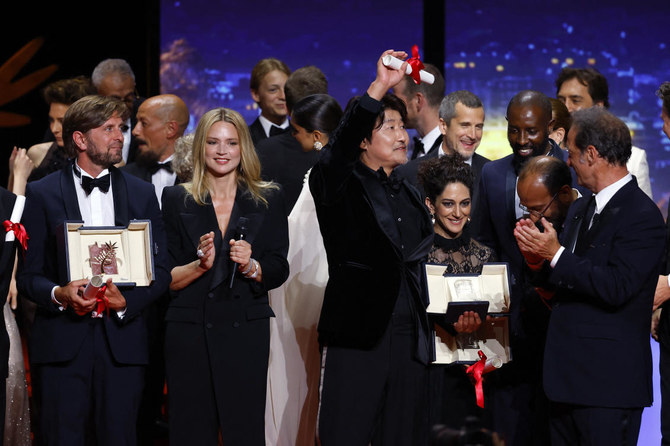
The 75th Cannes Film Festival - Closing ceremony - Cannes, France on Saturday. (Reuters)
Short Url
Updated 29 May 2022
Follow

Cannes Film Festival: Egyptian thriller nabs screenplay prize, ‘Triangle of Sadness’ wins Palme d’Or

  • Swedish-Egyptian filmmaker Tarik Saleh's 'Boy From Heaven' wins best screenplay award
  • Zar Amir Ebrahimi selected as best actress for her performance as a journalist in Ali Abbasi’s 'Holy Spider”
  • Korean star Song Kang Ho wins best actor for his performance in Hirokazu Kore-eda’s 'Broker'

CANNES, France: Ruben Ostlund’s social satire “Triangle of Sadness” won the Palme d’Or at the 75th Cannes Film Festival on Saturday, handing Ostlund one of cinema’s most prestigious prizes for the second time. Meanwhile, Swedish-Egyptian filmmaker Tarik Saleh took best screenplay at Cannes for “Boy From Heaven,” a thriller set in Cairo’s Al-Azhar Mosque.
The festival also named Korean star Song Kang Ho best actor for his performance in Japanese director Hirokazu Kore-eda’s film “Broker,” about Korean family seeking a home for an abandoned baby.
“I’d like to thank all those who appreciate Korean cinema,” said Song, who also starred in Bong Joon Ho’s Palme d’Or winning film “Parasite” in Cannes three years ago.
Best actress went to Zar Amir Ebrahimi for her performance as a journalist in Ali Abbasi’s “Holy Spider,” a true-crime thriller about a serial killer targeting sex workers in the Iranian religious city of Mashhad. Violent and graphic, “Holy Spider” wasn’t permitted to shoot in Iran and instead was made in Jordan. Accepting the award, Ebrahimi said the film depicts “everything that’s impossible to show in Iran.”
The awards were selected by a nine-member jury headed by French actor Vincent Lindon.
The jury prize was split between friendship tale “The Eight Mountains,” by Charlotte Vandermeersch and Felix Van Groeningen, and Polish director Jerzy Skolimowski’s “EO,” about a donkey’s journey across a pitiless modern Europe.
“I would like to thank my donkeys,” said Skolimowski, who used six donkeys while making the film.
This year’s award for best first film, the Camera d’Or, went to Riley Keough and Gina Gammell for “War Pony,” a drama about the Pine Ridge Reservation made in collaboration with Oglala Lakota and Sicangu Lakota citizens.
Saturday’s closing ceremony brings to a close a Cannes that has attempted to fully resuscitate the annual France extravaganza which was canceled in 2020 by the pandemic and saw modest crowds last year. This year’s festival also unspooled against the backdrop of the war in Ukraine, which sparked red-carpet protests and a dialogue about the purpose of cinema in wartime.
Last year, the French body horror thriller “Titane” took the top prize at Cannes, making director Julia Decournau only the second female filmmaker ever to win the Palme. In 2019, Bong Joon Ho’s “Parasite” triumphed in Cannes before doing the same at the Academy Awards.
This year, the biggest Hollywood films at Cannes — “Elvis,”“Top Gun: Maverick,”“Three Thousand Years of Longing” — played outside Cannes’ competition lineup of 21 films. But their presence helped restore some of Cannes’ glamor after the pandemic scaling down the festival for the last two years.


Nationalist Bollywood hit ‘Dhurandhar’ ignites India-Pakistan controversy

Updated 08 January 2026
Follow

Nationalist Bollywood hit ‘Dhurandhar’ ignites India-Pakistan controversy

  • Movie stars Ranveer Singh as an Indian intelligence agent who infiltrates alleged criminal networks in Karachi
  • Film has drawn sharp criticism from Pakistani officials while becoming one of the year’s biggest hits in India

A Bollywood spy thriller set in Pakistan has sparked heated debate across both countries over its portrayal of cross-border tensions, even as the film breaks box office records in India amid a surge in nationalist cinema.

“Dhurandhar,” starring Ranveer Singh as an Indian intelligence agent infiltrating criminal networks in Pakistan’s Karachi, has drawn sharp criticism from Pakistani officials and some international critics while becoming one of the year’s biggest commercial hits in India.

The 3.5-hour film, directed by Aditya Dhar, weaves real historical events including the 1999 plane hijacking, the 2001 Parliament attack, and the 2008 Mumbai attacks into a fictional narrative about an Indian spy’s mission to dismantle alleged links between Karachi gangs and terror networks.

Released Dec. 5 with minimal publicity, “Dhurandhar” has grossed more than 12.15 billion rupees ($134.76 million) in ticket sales, making it the highest-grossing Bollywood film last year. 

“It is a unique thing. Most films are set in India, but in this film, a RAW agent infiltrates Pakistan and is living there, hiding his identity, and the film portrays all of that through this setup, about Karachi and everything. That’s why it is such a good film. I mean, it is very important to watch this film,” said movie-goer Naresh Kumar.

The film represents a growing trend in Indian cinema toward nationalist blockbusters that align with Prime Minister Narendra Modi’s policies, following controversial hits like “The Kashmir Files” and “The Kerala Story” that sparked debates over historical accuracy while achieving commercial success.

In India, some film critics faced online harassment for negative reviews, prompting the Film Critics Guild to condemn “targeted attacks” against reviewers.

“Films that evoke patriotic fervor among audiences generally do well, but that is not to say that any film with this kind of subject would have done well,” said Bollywood film analyst Komal Nahta. “Everything seems to have gone right with the film.” 

The controversy highlights how cinema continues to reflect decades-old tensions between the nuclear-armed neighbors, who have fought four wars since partition in 1947. Fighting erupted between the countries in May following an attack on tourists in Kashmir that India blamed on Pakistan-backed militants.

In Pakistan’s Lyari neighborhood, which was depicted in the film, residents criticized the portrayal as inaccurate.

“It is a completely baseless movie because our neighboring country doesn’t know anything about our country,” said Mohammad Zohaib, a Lyari resident and burger shop owner. “They don’t know anything about Lyari, so how can they make a completely realistic film about someone?” 

The Pakistan Peoples Party filed legal action in a Karachi court last month over the film’s unauthorized use of assassinated former Prime Minister Benazir Bhutto’s image and its portrayal of party leaders as terrorist sympathizers.

“About 10 percent of what has been shown in the movie is reality, 90 percent is not real,” said Khizer Abdul Wahid, a Lyari resident and beauty salon owner.

Pakistan banned Indian films in 2019, but Bollywood remains popular there with audiences using VPNs or illegal downloads to watch new releases.

Theatre admissions in India have fallen 45 percent since their 2018 peak of 1.58 billion, according to Ernst and Young, as streaming services offer content that complements cheap mobile data available to most Indians.

Even global hits like the latest Avatar film struggled to secure screens due to “Dhurandhar’s” strong showing, analysts said.