TEHRAN/DUBAI: Iran said Saturday the crews onboard two Greek oil tankers it has seized in the Gulf are in “good health” and not under arrest.
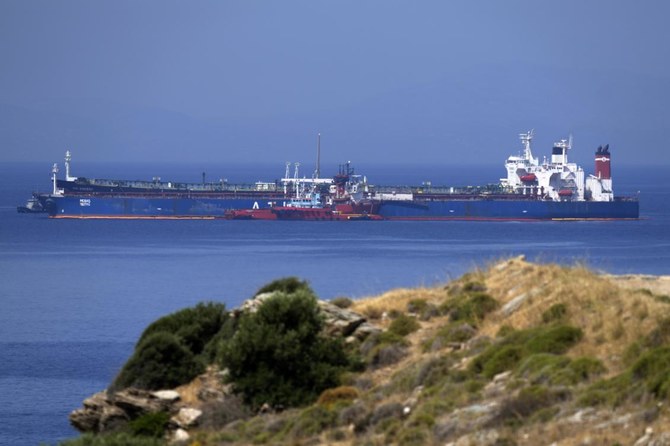
Iranian forces seized two Greek tankers in the Gulf on Friday, shortly after Tehran warned it would take “punitive action” against Athens over the confiscation of Iranian oil by the US from a tanker held off the Greek coast.
“The crew of the two Greek tankers have not been arrested, and all crew members ... are in good health and are being protected, and provided with necessary services while on board, in accordance with international law,” Iran’s Ports and Maritime Organization said in a statement carried by state media.
The two vessels were stopped over unspecified “maritime violations,” the body said.
Greece has condemned Tehran’s detention of the two ships as “tantamount to acts of piracy” and warned its citizens not to travel to Iran.
Iranian foreign ministry spokesman Saeed Khatibzadeh said in a tweet that the crews were “safe and in good health.”
He described ties between the two countries as having “always been based on mutual respect,” adding that they “must not be hampered by deeply shortsighted miscalculations, including highway robbery on the command of a third party.”
Separately, Nour News, affiliated to an Iranian state security body, said: “Iran will not remain passive in the face of any threat to its interests, and testing Iran’s will is a strategic error that will entail heavy costs for the United States and its entourage.”
The Revolutionary Guards — the ideological arm of Iran’s military — had said it seized the tankers “due to violations,” without elaborating further.
Greece said on Friday an Iranian navy helicopter landed on Greek-flagged vessel Delta Poseidon in international waters, and took the crew hostage. It said a similar incident took place on another Greek-flagged vessel near Iran, without naming the ship. Athens said both actions violated international law.
Nine Greeks are among the crews, the Greek foreign ministry said, without specifying the number of other sailors on board.
Iran’s action against the Greek-flagged tankers marks a sharp escalation in a diplomatic row that has raged since Greece seized a Russian-flagged oil tanker and its Iranian cargo last month.
Athens has linked the tanker seizure in Greece to sanctions imposed on Russia following its invasion of Ukraine in February.
Iran’s foreign ministry demanded Friday that Greece release the vessel, saying the planned transfer of its cargo to the US was a “clear violation” of international law.
The US reimposed crippling sanctions on Iran in 2018, after then president Donald Trump pulled out of a nuclear agreement between Tehran and major powers. Its once-lucrative oil exports are a major target.
(With AFP and Reuters)


Iran says crew of two seized Greek tankers ‘in good health,’ not arrested
https://arab.news/mwn8a
Iran says crew of two seized Greek tankers ‘in good health,’ not arrested

- Iran’s ports authority said they were being ‘protected... in accordance with international law’
- 9 Greeks are among the crews, the Greek foreign ministry said, without specifying the number of other sailors on board


US and Iran slide towards conflict as military buildup eclipses nuclear talks
- Washington building up one of its biggest military deployments in the region since the invasion of Iraq in 2003
- Iran is expected to submit a written proposal in the coming days, a US official says
Iran and the United States are sliding rapidly towards military conflict as hopes fade for a diplomatic solution to their standoff over Tehran’s nuclear program, officials on both sides and diplomats across the Gulf and Europe say.
Iran’s Gulf neighbors and its enemy Israel now consider a conflict to be more likely than a settlement, these sources say, with Washington building up one of its biggest military deployments in the region since the invasion of Iraq in 2003.
Israel’s government believes Tehran and Washington are at an impasse and is making preparations for possible joint military action with the United States, though no decision has been made yet on whether to carry out such an operation, said a source familiar with the planning.
It would be the second time the US and Israel have attacked Iran in less than a year, following US and Israeli airstrikes against military and nuclear facilities last June.
Regional officials say oil-producing Gulf countries are preparing for a possible military confrontation that they fear could spin out of control and destabilize the Middle East.
Two Israeli officials told Reuters they believe the gaps between Washington and Tehran are unbridgeable and that the chances of a near‑term military escalation are high.
Some regional officials say Tehran is dangerously miscalculating by holding out for concessions, with US President Donald Trump boxed in by his own military buildup - unable to scale it back without losing face if there is no firm commitment from Iran to abandon its nuclear weapons ambitions.
“Both sides are sticking to their guns,” said Alan Eyre, a former US diplomat and Iran specialist, adding that nothing meaningful can emerge “unless the US and Iran walk back from their red lines - which I don’t think they will.”
“What Trump can’t do is assemble all this military, and then come back with a ‘so‑so’ deal and pull out the military. I think he thinks he’ll lose face,” he said. “If he attacks, it’s going to get ugly quickly.”
Two rounds of Iran-US talks have stalled on core issues, from uranium enrichment to missiles and sanctions relief.
When Omani mediators delivered an envelope from the US side containing missile‑related proposals, Iranian Foreign Minister Abbas Araghchi refused even to open it and returned it, a source familiar with the talks said.
After talks in Geneva on Tuesday, Araghchi said the sides had agreed on “guiding principles,” but the White House said there was still distance between them.
Iran is expected to submit a written proposal in the coming days, a US official said, and Araghchi said on Friday he expected to have a draft counterproposal ready within days.
But Trump, who has sent aircraft carriers, warships and jets to the Middle East, warned Iran on Thursday it must make a deal over its nuclear program or “really bad things” will happen.
He appeared to set a deadline of 10 to 15 days, drawing a threat from Tehran to retaliate against US bases in the region if attacked. The rising tensions have pushed up oil prices.
US officials say Trump has yet to make up his mind about using military force although he acknowledged on Friday that he could order a limited strike to try to force Iran into a deal.
“I guess I can say I am considering that,” he told reporters.
The possible timing of an attack is unclear. US Secretary of State Marco Rubio is due to meet Israeli Prime Minister Benjamin Netanyahu on February 28 to discuss Iran. A senior US official said it would be mid-March before all US forces were in place.


