

Bouwman rules Giro 19th mountain stage, Carapaz keeps leader’s pink jersey

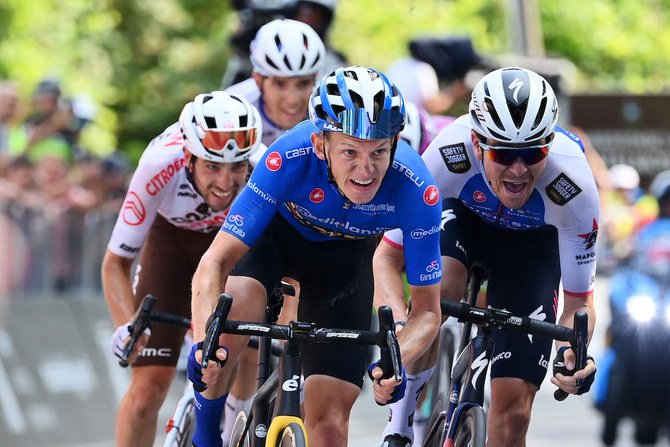
Dutch rider Koen Bouwman, foreground, pedals on his way to victory in the 19th stage of the Giro D’Italia cycling race, from Marano Lagunare to Santuario di Castelmonte, Italy, on Friday. (AP)
Short Url
Updated 28 May 2022
Follow

Bouwman rules Giro 19th mountain stage, Carapaz keeps leader’s pink jersey

  • Bouwman negotiated the jostling on a sharp final bend to beat his four breakaway companions for his second stage win after Potenza in southern Italy two weeks ago
  • The Giro will go down to the wire with Saturday’s stage in the Dolomites now looking crucial to the outcome

CIVIDALE DEL FRIULI, Italy: Dutch rider Koen Bouwman won a sprint finish in the mountains for stage 19 of the Giro d’Italia at Santuario di Castelmonte on Friday as Richard Carapaz held the leader’s pink jersey.

Ecuador’s 2019 Giro winner Carapaz holds a slim three-second advantage on Australian Jai Hindley two days before the race finishes with a time-trial in Verona.

Bouwman negotiated the jostling on a sharp final bend to beat his four breakaway companions for his second stage win after Potenza in southern Italy two weeks ago.

Quick Step’s Mauro Schmid of Switzerland was just behind with Italian Alessandro Tonelli of Bardiani three seconds off the pace.

“After I won one stage I said anything else would be a bonus,” said Jumbo-Visma’s Bouwman who is assured of the top climber’s blue jersey providing he finishes the race.

“Today I rode for the Maglia Azzurra and I’m glad I secured it.

“I knew about the last corner but I didn’t expect it to be that sharp.

“I had to break but it’s great that I was in the best position there. That gave me the win. I’m delighted.”

Carapaz survived the setback of losing his key mountain lieutenant Richie Porte early in the 178km stage from Marano Lagunare which included four climbs and crossed into neighboring Slovenia.

Ineos Grenadiers rider Porte was dropped from the peloton on the first climb of the day, the third-category Villanova Grotte, after 70km of racing. Organizers later confirmed the 37-year-old Australian had withdrawn from the Giro.

“It’s been a pretty hard stage,” said Carapaz.

“It’s a pity that we lost Richie Porte early in the race but the team has done a great job and Pavel Sivakov is in a great shape.

“All top three riders, we’re together. It’s fine with me. Whatever happens tomorrow will be fine with me too.”

A 12-man breakaway approached the main climb of the day, the Kolovrat over 10.3 km and with a 9.2 percent gradient, with more than nine minutes on the peloton.

The four survivors only lost a little over a minute on this climb near Caporetto, the site of a historic defeat for the Italians in the First World War.

Neither Carapaz nor Hindley tried to pull ahead in the final climb having made several attempts earlier along with Spaniard Mikel Landa, third in the standings.

The Giro will go down to the wire with Saturday’s stage in the Dolomites now looking crucial to the outcome.

The 20th stage, the last in the mountains, includes three great climbs — the San Pellegrino, the Pordoi for the highest point of this year’s race at 2,239 meters above sea level concluding at the Fedaia, with a spectacular steep climb in the last 5,400 meters.

Sunday’s final stage is a 17.4km individual time-trial into Verona where Ecuadorian Carapaz claimed overall victory three years ago.


With 100 days to go, World Cup faces new challenges with Iran war and Mexico violence

Updated 04 March 2026
Follow

With 100 days to go, World Cup faces new challenges with Iran war and Mexico violence

  • It’s not unusual for international politics to overshadow a global sports event like the World Cup
  • Iran is set to play two group stage games in Inglewood, California, and one in Seattle

GENEVA: With 100 days to go until the World Cup, the Iran war has added a new layer of complexity to the tournament co-hosted by the United States, Mexico and Canada.
How the conflict will affect the world’s most watched sporting event is the latest issue facing organizers already grappling with cartel violence in one of Mexico’s host cities, scaled-back plans for fan festivals in the US and criticism from fans against soaring ticket prices.
Officials of the qualified teams are meeting with FIFA staff in Atlanta this week. The tournament kicks off on June 11 when Mexico plays South Africa in Mexico City. It will be the biggest World Cup ever with 48 participating teams, up from 32 at the previous tournament in Qatar.
Here’s a look at some of the issues drawing scrutiny as the countdown began.
A backdrop of geopolitical tension
It’s not unusual for international politics to overshadow a global sports event like the World Cup — at least in the early stages before the soccer action takes over the headlines.
In 2022, Qatar’s treatment of migrant workers and others matters drew headlines off the field.
Pride community rights, the annexation of Crimea and the poisoning of a spy in Britain were in focus when Russia hosted the tournament in 2018.
In Brazil in 2014 and South Africa in 2010 there were concerns about crime and security.
The 2026 tournament looks set to kick off amid a backdrop of political tensions involving the US and the participating nations.
Many have been hit by tariffs. Some are facing travel restrictions. Denmark, which can still qualify through playoffs in March, has been shaken by President Donald Trump’s calls for the US to take over Greenland. And with 100 days to go, the US was in a military conflict with Iran, one of the first teams to qualify.
Iran’s status at the World Cup is unclear
Iran is set to play two group stage games in Inglewood, California, and one in Seattle.
However, whether the Iranian team will come to the US is uncertain.
“What is certain is that after this attack, we cannot be expected to look forward to the World Cup with hope,” Iran’s top soccer official, Mehdi Taj, said last weekend as the US and Israel launched coordinated attacks that killed Supreme Leader Ayatollah Ali Khamenei and dozens more senior officials.
Still, Iran has not announced it is withdrawing from the tournament, which no team that qualified has done in the past 75 years. Iran, the second-highest ranked team in Asia, was drawn in a group with Belgium, Egypt and New Zealand.
“I really don’t care,” if Iran participates, Trump told Politico on Tuesday. “I think Iran is a very badly defeated country. They’re running on fumes.”
FIFA did not immediately respond to a request on whether Iran federation officials attended the Atlanta workshop.
Fan festivals are being slimmed down
Fan festivals have been a key part of the World Cup experience in the past two decades. They offer a chance for thousands of fans without match tickets to take part in the World Cup atmosphere by coming together to watch games on a big screen.
Some of those plans are now being scaled back in the US
New York/New Jersey eliminated its Fan Fest in Jersey City, New Jersey, even though it had started selling tickets for an event scheduled to be open every day of the tournament.
Planning to sell tickets was itself unprecedented for World Cup fan zones, which were free to enter since being launched at the 2006 edition in Germany.
Seattle cut down its original plan and rescheduled it for smaller venues and Boston trimmed its event to 16 days.
The chief operating officer of Miami’s FIFA World Cup host committee said during a congressional hearing on Feb. 24 that it might cancel its event if it did not receive federal funding within 30 days. Kansas City, Missouri, Police Deputy Chief Joseph Maybin said the city had an immediate need for federal funds to prepare security.
House Republicans said federal money may be held up by the partial government shutdown of the Department of Homeland Security, caused by Democrats insisting restrictions be placed on Immigration and Customs Enforcement agents.
Foxborough games threatened
The New England Patriots’ stadium in Foxborough, Massachusetts, is due to host seven World Cup games, starting with Haiti-Scotland on June 13 and ending with a quarterfinal on July 9. That is FIFA’s plan.
The Select Board of Foxborough has refused to issue a permit for World Cup matches at the stadium and set a March 17 deadline to be paid $7.8 million — what the town estimates will be the cost of police and other expenses. Foxborough said it was not part of FIFA’s hosting agreement with Boston.
Pushback against FIFA’s ticket prices
FIFA has about 7 million seats to fill for the World Cup matches and said last month it received 500 million ticket requests. FIFA president Gianni Infantino has proclaimed all 104 games are sold out and yet some fans received emails last week offering an extra 48-hour window for tickets sales.
FIFA’s prices in December ranged up to $8,680 per ticket. After criticism, FIFA said it will offer a few hundred $60 tickets for every game to the 48 national federations in the tournament. Those federations will decide how to distribute them to their most loyal fans who attended previous games.
Most seats on FIFA’s ticket resale platform — seeking to cut out the secondary market and earn FIFA extra 15 percent fees from buyers and sellers — are well past the $1,000 mark.
Cartel violence in Mexico
Mexico’s ability to co-host the World Cup has been under scrutiny after a surge in violence last week in the state of Jalisco following the military’s killing of a powerful cartel boss.
The state’s capital, Guadalajara, is set to host four matches during the group stage.
Mexico’s government insists the World Cup won’t be affected and President Claudia Sheinbaum said there’s no risk for fans coming to the tournament.
Infantino told Sheinbaum that he has full confidence in Mexico as a World Cup host.
The FIFA leader has repeatedly promised the 2026 World Cup will be the greatest and most inclusive.