

Israel deliberately killed Al Jazeera reporter, Palestinian Authority says

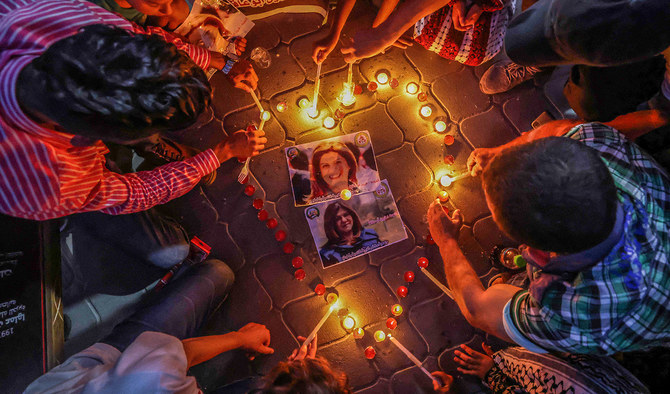
Gazans light candles during a vigil in honor of slain Palestinian Al-Jazeera journalist Shireen Abu Akleh in Gaza City on May 26, 2022. (AFP)
Short Url
Updated 27 May 2022
Follow

Israel deliberately killed Al Jazeera reporter, Palestinian Authority says

  • Shireen Abu Akleh was shot in the head on May 11 during Israeli military raid in Jenin in the occupied West Bank
  • Palestinian Attorney General says there were no militants in immediate area, "only shooting was by occupation forces"

RAMALLAH: The Palestinian Authority on Thursday announced the results of its investigation into the shooting death of Al Jazeera journalist Shireen Abu Akleh, saying it had proven she was deliberately killed by Israeli forces as she tried to flee.

The conclusion echoed the results of a preliminary investigation announced nearly two weeks ago and were widely expected. Israel rejected the findings, with Defense Minister Benny Gantz calling them, “a blatant lie.”

Abu Akleh, a veteran Palestinian-American reporter for Al Jazeera’s Arabic service, was shot in the head on May 11 during an Israeli military raid in the city of Jenin in the occupied West Bank.

Witnesses and Palestinian officials have said she was hit by Israeli fire. Israel says she was shot during a battle between Israeli soldiers and Palestinian militants. It says that only a ballistic analysis of the bullet — which is held by the Palestinian Authority — and the soldiers’ guns can determine who fired the fatal shot.

Announcing the results of his probe at a news conference in the West Bank city of Ramallah, Palestinian Attorney General Akram Al Khateeb said he had determined there were no militants in the immediate area where Abu Akleh was located.

“The only shooting was by the occupation forces, with the aim of killing,” he said.

Abu Akleh was in a group of journalists wearing helmets and protective vests marked “press.” Al Khateeb said the army saw the journalists and knew they were journalists.

He accused Israel of shooting Abu Akleh “directly and deliberately” as she tried to escape. He also repeated the Palestinian position that the bullet will not be handed over to the Israelis for study. He said they decided not even to show images of the bullet “to deprive (Israel) of a new lie.”

Al Khateeb said his investigation was based on interviews with witnesses, an inspection of the scene and a forensic medical report.

In a speech later Thursday, Lt. Gen. Aviv Kohavi said it was impossible to know who fired the bullet and once again called on the Palestinians to cooperate to “get to the bottom” of what happened.

“But there is one thing that can be determined with certainty,” the military chief said. “No soldier fired intentionally at a journalist. We investigated that. We checked it. That is the conclusion. There is no other.”

Israel denies targeting journalists and has offered two possible scenarios, saying Abu Akleh was either shot by Palestinian militants who were firing at an Israeli army convoy or that she was hit by Israeli gunfire aimed at a nearby militant. The military has identified the rifle that may have been used in that scenario, but says it needs to test the bullet to make any final determination.

An AP reconstruction of events has lent support to eyewitnesses who say she was shot by Israeli troops. But a weapons expert interviewed by the AP as part of the reconstruction said that it was impossible to reach a conclusive finding without further forensic analysis.

Palestinian witnesses say there were no militants or clashes anywhere near Abu Akleh. The only known militants in the area were on the other side of the convoy, some 300 meters (yards) from her position. They did not have a direct line of sight, unlike the convoy itself, which was some 200 (meters) away on a long straight road.

Israel has publicly called for a joint investigation with the PA, with US participation, and has asked the PA to hand over the bullet for testing. But the State Department said Wednesday that it had received no formal request for assistance from either side two weeks after her death.

The PA has refused to hand over the bullet to Israel or cooperate with it in any way, saying Israel cannot be trusted to investigate its own conduct. Rights groups say Israel has a poor record of investigating when security forces shoot Palestinians, with cases often languishing for months or years before being quietly closed.

The PA administers parts of the Israeli-occupied West Bank. Hussein Al Sheikh, a top Palestinian official, said Thursday’s report would be shared with the US administration. Copies will also be delivered to Abu Akleh’s family and to Al Jazeera, he said.

The Palestinians say they will also share their results with international parties, including the International Criminal Court, which launched an investigation into possible Israeli war crimes last year. Israel has rejected that probe as being biased against it and is not cooperating with it.

The severe distrust means the Israeli and Palestinian investigations into Abu Akleh’s death are unfolding separately, with neither likely to accept any conclusions reached by the other.

Each side is in sole possession of potentially crucial evidence. Ballistic analysis could match the bullet to a specific firearm based on a microscopic signature, but only if investigators have access to both. Lt. Col. Amnon Shefler, a military spokesman, told the AP the military has additional footage from that day, but declined to say what it shows or when it would be released, citing the ongoing investigation.

Palestinians are still mourning Abu Akleh, a widely known and respected on-air correspondent who rose to fame two decades ago, during the second Palestinian intifada, or uprising, against Israeli rule. The 51-year-old documented the harsh realities of life under Israeli military rule — now well into its sixth decade with no end in sight — for viewers across the Arab world.

Israel captured the West Bank in the 1967 war and has built settlements where nearly 500,000 Israelis live alongside nearly 3 million Palestinians. The Palestinians want the territory to form the main part of their future state, but peace talks broke down more than a decade ago, and Israel’s dominant right-wing parties are opposed to Palestinian statehood.


NGOs fear ‘catastrophic impact’ of new Israel registration rules

Updated 3 sec ago
Follow

NGOs fear ‘catastrophic impact’ of new Israel registration rules

  • NGOs working in Israel and occupied Palestinian territories have until December 31 to register under the new framework
  • Save the Children is among the charities already barred under the new rules
PARIS: New rules in Israel for registering non-governmental organizations, under which more than a dozen groups have already been rejected, could have a catastrophic impact on aid work in Gaza and the West Bank, relief workers warn.
The NGOs have until December 31 to register under the new framework, which Israel says aims not to impede aid distribution but to prevent “hostile actors or supporters of terrorism” operating in the Palestinian territories.
The controversy comes with Gaza, which lacks running water and electricity, still battling a humanitarian crisis even after the US-brokered October ceasefire in the war between Israel and Hamas, sparked by the Palestinian militant group’s October 7, 2023 attack on Israel.
Israel’s Ministry of Diaspora Affairs and Combating Antisemitism told AFP that, as of November 2025, approximately 100 registration requests had been submitted and “only 14 organization requests have been rejected... The remainder have been approved or are currently under review.”
Requests are rejected for “organizations involved in terrorism, antisemitism, delegitimization of Israel, Holocaust denial, denial of the crimes of October 7,” it said.

‘Very problematic’

The amount of aid entering Gaza remains inadequate. While the October 10 ceasefire agreement stipulated the entry of 600 trucks per day, only 100 to 300 are carrying humanitarian aid, according to NGOs and the United Nations.
The NGOs barred under the new rules include Save the Children, one of the best known and oldest in Gaza, where it helps 120,000 children, and the American Friends Service Committee (AFSC).
They are being given 60 days to withdraw all their international staff from the Gaza Strip, the occupied West Bank and Israel, and will no longer be able to send humanitarian supplies across the border to Gaza.
In Gaza, Save the Children’s local staff and partners “remain committed to providing crucial services for children,” such as psychosocial support and education, a spokeswoman told AFP.
The forum that brings together UN agencies and NGOs working in the area on Thursday issued a statement urging Israel to “lift all impediments,” including the new registration process, that “risk the collapse of the humanitarian response.”
The Humanitarian Country Team of the Occupied Palestinian Territory (HCT) warned that dozens of NGOs face deregistration and that, while some had been registered, “these NGOs represent only a fraction of the response in Gaza and are nowhere near the number required just to meet immediate and basic needs.”
“The deregistration of NGOs in Gaza will have a catastrophic impact on access to essential and basic services,” it said.
NGOs contacted by AFP, several of whom declined to be quoted on the record due to the sensitivity of the issue, say they complied with most of Israel’s requirements to provide a complete dossier.
Some, however, refused to cross what they described as a “red line” of providing information about their Palestinian staff.
“After speaking about genocide, denouncing the conditions under which the war was being waged and the restrictions imposed on the entry of aid, we tick all the boxes” to fail the registration, predicted the head of one NGO.
“Once again, bureaucratic pressure is being used for political control, with catastrophic consequences,” said the relief worker.
Rights groups and NGOs including Amnesty International and Human Rights Watch have accused Israel of carrying out a genocide against Palestinians in Gaza, a term vehemently rejected by the Israeli government.
“If NGOs are considered to be harmful for passing on testimonies from populations, carrying out operational work and saying what is happening and this leads to a ban on working, then this is very problematic,” said Jean-Francois Corty, president of French NGO Medecins du Monde.

- ‘Every little criticism’ -

The most contentious requirement for the NGOs is to prove they do not work for the “delegitimization” of Israel, a term that appears related to calling into question Israel’s right to exist but which aid workers say is dangerously vague.
“Israel sees every little criticism as a reason to deny their registration... We don’t even know what delegitimization actually means,” said Yotam Ben-Hillel, an Israeli lawyer who is assisting several NGOs with the process and has filed legal appeals.
He said the applications of some NGOs had already been turned down on these grounds.
“So every organization that operates in Gaza and the West Bank and sees what happens and reports on that could be declared as illegal now, because they just report on what they see,” he told AFP.
With the December 31 deadline looming, concerns focus on what will happen in early 2026 if the NGOs that are selected lack the capacity and expertise of organizations with a long-standing presence.
Several humanitarian actors told AFP they had “never heard of” some of the accredited NGOs, which currently have no presence in Gaza but were reportedly included in Trump’s plan for Gaza.
“The United States is starting from scratch, and with the new registration procedure, some NGOs will leave,” said a European diplomatic source in the region, asking not to be named. “They might wake up on January 1 and realize there is no-one to replace them.”