

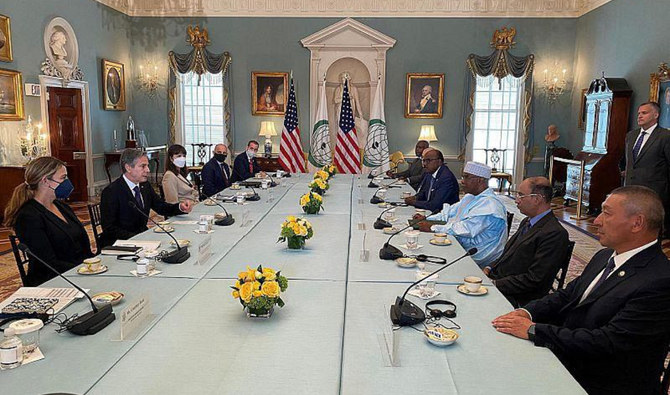
Organization of Islamic Cooperation chief, US state secretary discuss bilateral ties

1 / 2
They discussed the outcome of the first round of the strategic dialogue between the OIC and the US held May 23-24 in Washington. (SPA)
2 / 2
(SPA)
Short Url
Updated 26 May 2022
Follow

Organization of Islamic Cooperation chief, US state secretary discuss bilateral ties

  • The two sides agreed on the importance of consolidating relations in various fields, in light of the challenges facing the world, foremost of which are the situations in the Middle East, Africa and Asia

WASHINGTON: During his official visit to the US, Secretary-General of the Organization of Islamic Cooperation Hissein Brahim Taha met US Secretary of State Anthony Blinken at the headquarters of the State Department in Washington, DC.

During the meeting, the two sides discussed bilateral relations between the OIC and the US and ways to enhance them, as well as the outcome of the first round of the strategic dialogue between the OIC and the US held May 23-24 in Washington.

The two sides agreed on the importance of consolidating relations in various fields, in light of the challenges facing the world, foremost of which are the situations in the Middle East, Africa and Asia.

They also concurred on the importance of continuing consultations on various issues that top the agenda of the OIC and the US, foremost of which is the fight against terrorism, extremism and Islamophobia, and international efforts to combat COVID-19 and its health, economic and social implications.

Recently, the OIC has spoken of how highly it values the social, cultural and economic achievements of the African continent. The OIC indicated it will spare no effort directing its various development projects to serve Africa. 


Saudi border security foil attempt to smuggle thousands of captagon pills from Yemen

Updated 6 sec ago
Follow

Saudi border security foil attempt to smuggle thousands of captagon pills from Yemen

  • Col. Osama Al-Assad, commander of the battalion, said the seizure was made during routine inspection procedures at the land crossing
  • Security personnel grew suspicious of an incoming vehicle and, after a thorough search, discovered the pills

RIYADH: The “Al-Wadiah Port Security and Protection Battalion” thwarted an attempt to smuggle 4,925 Captagon pills bound for Saudi Arabia from areas under Houthi control in Yemen.

Col. Osama Al-Assad, commander of the battalion, said the seizure was made during routine inspection procedures at the land crossing.

Security personnel grew suspicious of an incoming vehicle and, after a thorough search, discovered the pills professionally concealed in an apparent attempt to evade detection.

In remarks to Asharq Al-Awsat, Al-Assad said the confiscated drugs were documented in line with legal procedures and the suspects were referred to the competent authorities for further investigation.

He stressed that coordination with the Saudi side remains strong and ongoing at the highest levels, expressing appreciation to the Kingdom for its continued support to Yemen in general and to the battalion in particular, helping bolster border security between the two neighbors.

In a recent interview with Asharq Al-Awsat, Al-Assad revealed that most drug smuggling networks operating from Yemen into Saudi territory are directly linked to the Houthi militants.

He noted that the battalion had previously arrested a Houthi leader attempting to enter Saudi Arabia using a forged passport and Umrah visa, suggesting the motives were security-related rather than religious.

Regarding the latest operation, Al-Assad said preliminary investigations indicate that most drug shipments intercepted at the crossing originate from Houthi-controlled areas.

He accused the group of relying on drug trafficking as a source of funding for its activities, posing a threat to Yemen’s national security, neighboring countries, and regional stability.

The battalion’s mission includes securing and protecting the Al-Wadiah crossing, combating various forms of smuggling, including drugs, human trafficking, forged documents, and unidentified individuals, and arresting wanted suspects, including members of al-Qaeda and fugitives evading court rulings.