Normalcy returns to Pakistani capital as ex-PM Khan calls off protest

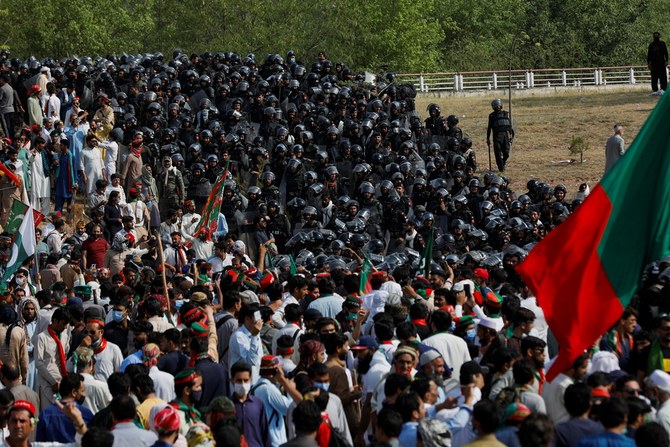
Police officers in riot gears stand guard to stop the supporters of the Pakistan Tehreek-e-Insaf political party after they broke in to the Red Zone, during a protest march called by ousted PM Imran Khan, in Islamabad on Thursday. (Reuters)
Short Url
Updated 26 May 2022
Follow

Normalcy returns to Pakistani capital as ex-PM Khan calls off protest

  • Khan addresses rally after clashes between demonstrators and police, hundreds of arrests
  • Ex-PM had urged supporters to march on Islamabad, stay there until government dissolved

ISLAMABAD: Normalcy resumed in the Pakistani capital Islamabad on Thursday after Imran Khan, the ousted former prime minister, called off a protest march, giving the government six days to dissolve assemblies and announce fresh elections.
On Thursday morning, thousands of supporters of Khan’s Pakistan Tehreek-e-Insaf party who had gathered at D-Chowk in front of Parliament from different parts of the country, especially the Khyber Pakhtunkhwa and Punjab provinces, dispersed peacefully following Khan’s address.
This followed a long day of political drama that included clashes between demonstrators and police, and the arrests of hundreds of Khan supporters nationwide.
“We are leaving for our homes now, but will come back again on Khan’s call to topple the government,” Hassan Shirazi, a demonstrator from Pakpattan city, told Arab News.
Shortly after the protest ended, the Islamabad’s district administration started removing shipping containers to unblock all roads in the federal capital and adjoining Rawalpindi. Police and other law enforcement personnel requisitioned from other provinces were also seen packing up and boarding buses to return to their stations.
The administration also reopened Jinnah Avenue, the main protest venue, and all other roads in Islamabad, including Srinagar Highway and Islamabad Expressway. The main Murree Road in Rawalpindi has also been reopened for both sides of traffic, according to the Islamabad Traffic Police.
Entry into the Red Zone, which houses important buildings like Parliament and the Supreme Court, is still restricted.
Meanwhile, the federal government filed a petition in the Supreme Court seeking contempt of court proceedings against Khan for what it says was a violation of the court’s directions.
The Supreme Court had on Wednesday ordered the government and the PTI to constitute negotiating committees and meet at 10 p.m. to finalize modalities for the peaceful and safe conduct of Khan’s long march to the capital. Negotiations were not held as both sides claimed the other’s representatives did not show up.
The court had also ordered the government to designate a spot where the protesters could rally. However, protesters converged at D-Chowk instead and Khan held his rally on Jinnah Avenue.
Police fired teargas, baton-charged and detained supporters of Khan on Wednesday to stop them from reaching the capital to demand fresh elections. Clashes were also reported in multiple other cities, including the southern port city of Karachi and the eastern city of Lahore, and the government called in the army to maintain law and order in the capital.
Khan, ousted in a no-confidence vote last month, had urged supporters to march on Islamabad and alleges he was pushed from power in a foreign conspiracy orchestrated by the US, refusing to accept the new government.
“I am giving you (the government) six days; if you don’t announce elections I will come back to Islamabad again with all Pakistanis,” he said as he addressed supporters before ending his protest.
“(The) government has tried every method to crush our Azadi (freedom) March; they used teargas on peaceful protest, our homes were raided and privacy of the homes were violated,” Khan said.
“However, I have seen the nation free itself of fear of slavery.”
Khan started his anti-government march from Peshawar on Wednesday morning while the government blocked all roads leading to the capital and rounded up supporters.
Videos shot by an Arab News reporter on Wednesday evening showed thousands of Khan supporters walking down the capital’s Blue Area business zone toward D-Chowk while police fired tear gas at them, before charging them with batons.
Supporters had lit fires all the way down the road to D-Chowk in an apparent bid to neutralize the effects of the tear gas, but police said on Twitter they had set fire to trees and vehicles.
“Police called the fire brigade. Some places were set on fire while the protesters again set the trees on the Express Chowk,” the police said. “Security in the Red Zone has been beefed up.”
Other video clips on social media platforms also showed a burning metro station in the city surrounded by hundreds of PTI supporters, while a mob torched a prison van in Karachi after clashing with police.
Local TV footage showed police fighting with Khan’s supporters in Lahore, beating them and, in some places, breaking vehicle windscreens and bundling people into police vans.
Interior Minister Rana Sanaullah later said police had carried out a total of 4,417 raids on Khan supporters’ homes, offices and rallies, and had arrested nearly 1,700 people. Of those, 250 were later freed.
“We haven’t stopped anyone from exercising their constitutional and legal right to hold a rally or take part in democratic politics,” Sanaullah said, “but we can’t allow anyone to sow violence and chaos.”



Uganda’s presidential election experiences hours of delays at some polling stations

Updated 7 sec ago
Follow

Uganda’s presidential election experiences hours of delays at some polling stations

  • Some polling stations remained closed for up to four hours after the scheduled 7 a.m. start time due to “technical challenges“
  • The East African country of roughly 45 million people has 21.6 million registered voters

KAMPALA, Uganda: Uganda’s presidential election was plagued by widespread delays Thursday in addition to a days-long Internet shutdown that has been criticized as an anti-democratic tactic in a country where the president has held office since 1986.
Some polling stations remained closed for up to four hours after the scheduled 7 a.m. start time due to “technical challenges,” according to the nation’s electoral commission, which asked polling officers to use paper registration records to ensure the difficulties did not “disenfranchise any voter.”
President Yoweri Museveni, 81, faces seven other candidates, including Robert Kyagulanyi, a musician-turned-politician best known as Bobi Wine, who is calling for political change.
The East African country of roughly 45 million people has 21.6 million registered voters. Polls are expected to close at 4 p.m. Thursday, according to the electoral commission. Results are constitutionally required to be announced in 48 hours.
Impatient crowds gathered outside polling stations expressing concerns over the delays Thursday morning. Umaru Mutyaba, a polling agent for a parliamentary candidate, said it was “frustrating” to be waiting outside a station in the capital Kampala.
“We can’t be standing here waiting to vote as if we have nothing else to do,” he said.
Wine alleged there was electoral fraud occurring, noting that biometric voter identification machines were not working at polling places and claiming there was “ballot stuffing.”
“Our leaders, including Deputy President for Western Region, arrested. Many of our polling agents and supervisors abducted, and others chased off polling stations,” Wine wrote in a post on social media platform X.
Museveni told journalists he was notfied biometric machines were inoperable at some stations and he supported the electoral body’s decision to revert to paper registration records. He did not comment on the allegation of fraud.
Ssemujju Nganda, a prominent opposition figure and lawmaker seeking reelection in Kira municipality, told The Associated Press he had been waiting in line to vote for three hours.
Nganda also noted biometric machines were malfunctioning, in addition to the late arrival of balloting materials, and predicted the delays likely would lead to apathy and low turnout in urban areas where the opposition has substantial support.
“It’s going to be chaos,” he said Thursday morning.
Nicholas Sengoba, an independent analyst and newspaper columnist, said delays to the start of voting in urban, opposition areas favored the ruling party.
Museveni serving Africa’s third-longest presidential term
Uganda has not witnessed a peaceful transfer of presidential power since independence from British colonial rule six decades ago.
Museveni has served the third-longest term of any African leader and is seeking to extend his rule into a fifth decade. Some critics say removing him through elections remains difficult, but the aging president’s authority has become increasingly dependent on the military led by his son, Muhoozi Kainerugaba.
Museveni and Wine are reprising their rivalry from the previous election in 2021, when Wine appealed to mostly young people in urban areas. With voter turnout of 59 percent, Wine secured 35 percent of the ballots against Museveni’s 58 percent, the president’s smallest vote share since his first electoral campaign three decades ago.
The lead-up to Thursday’s election produced concerns about transparency, the possibility of hereditary rule, military interference and opposition strategies to prevent vote tampering at polling stations.
Uganda’s Internet was shut down Tuesday by the government communications agency, which cited misinformation, electoral fraud and incitement of violence. The shutdown has affected the public and disrupted critical sectors such as banking.
Heavy security deployed
There has been heavy security leading up to voting, including military units deployed on the streets this week.
Amnesty International said security forces are engaging in a “brutal campaign of repression,” citing a Nov. 28 opposition rally in eastern Uganda where the military blocked exits and opened fire on supporters, killing one person.
Museveni urged voters to come out in large numbers during his final rally Tuesday.
“You go and vote, anybody who tries to interfere with your freedom will be crushed. I am telling you this. We are ready to put an end to this indiscipline,” he said.
The national electoral commission chairperson, Simon Byabakama, urged tolerance among Ugandans as they vote.
“Let us keep the peace that we have,” Byabakama said late Wednesday. “Let us be civil. Let us be courteous. Let’s be tolerant. Even if you know that this person does not support (your) candidate, please give him or her room or opportunity to go and exercise his or her constitutional right.”
Authorities also suspended the activities of several civic groups during the campaign season. That Group, a prominent media watchdog, closed its office Wednesday after the interior ministry alleged in a letter that the group was involved in activities “prejudicial to the security and laws of Uganda.”
Veteran opposition figure Kizza Besigye, a four-time presidential candidate, remains in prison after he was charged with treason in February 2025.