

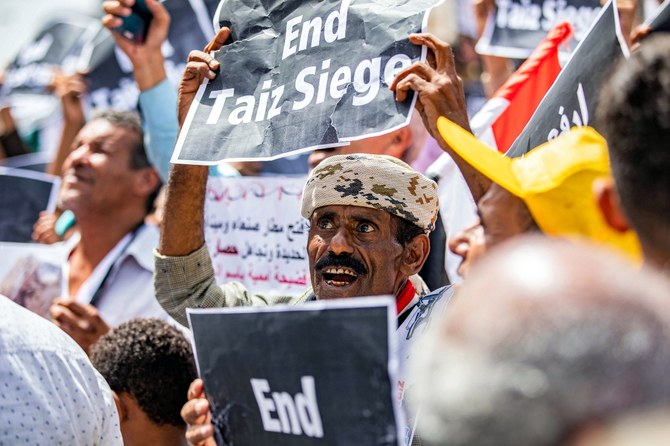

AL-MUKALLA: Discussions between the Yemeni government and the Iran-backed Houthis on opening roads in the city of Taiz and other provinces started on Wednesday as thousands gathered in the streets of Taiz to demand an immediate end to the Houthis’ siege.
Hans Grundberg, the UN’s Yemen envoy, said his office would sponsor the meeting between both sides in the Jordanian capital to discuss opening roads in Taiz and the provinces as part of the two-month truce.
“The meeting between Government of Yemen & Ansar Allah representatives on opening roads in #Taiz & other governorates as per the truce agreement starts today in Amman under the auspices of the UN Envoy for #Yemen,” Grundberg tweeted, using the official name of the Houthis.
The Yemeni government delegation said they held a meeting with Grundberg shortly after landing in Amman, adding that they might engage in direct talks with the Houthis over the coming days.
“We would be pushing for opening roads to pre-war time and resuming the flow of water and power supplies to the city,” Ali Al-Ajar, a member of the government delegation, told Arab News by telephone from Amman.
The truce, which came into effect on April 2 and is the longest since the beginning of the war, called for a pause in fighting on all fronts, resuming flights from Sanaa airport, allowing fuel ships to enter Hodeidah port and forming a joint committee to discuss opening roads in Taiz, Abyan, Al-Bayda, Marib and the other provinces.
The meeting was delayed many times as the Houthis refused to name their representatives, despite constant demands from international mediators.
Meanwhile, hundreds of citizens rallied in the streets of Taiz on Wednesday to demand international action to force the Houthis to end their siege on the city.
The protesters carried posters and slogans demanding action from Yemeni negotiators in Amman, the UN Yemen envoy and the international community in ending the siege that has cut off the city from the rest of the country.
“The complete lifting of the siege is an inalienable human right,” read one of the posters.
This week, people in Taiz challenged the Houthi siege by arranging rallies near the heavily mined checkpoints on the edges of the city, drawing attention to their suffering under the siege. These rallies are rare and reflect the desperation felt by the people living under siege.
During the past seven years, the Houthis have blocked the city’s main entrances and roads that link it with Sanaa, Hodeidah and Aden. The Iran-backed terrorists have planted landmines and deployed snipers in the surrounding areas after failing to seize control of the city’s downtown due to resistance from government troops.
The siege has pushed thousands of people into famine as the Houthis prevent aid and vital goods from reaching the city, forcing people into using dangerous mountain roads.
Mohammed Al-Mekhlafi, a Yemeni political analyst, criticized the international community for not mounting enough pressure on the Houthis to lift the siege on Taiz as they did with the Yemeni government and the Coalition to Restore Legitimacy in Yemen over Sanaa airport and Hodeidah port.
“The UN and the international community did not use serious and active pressure on the Houthis to open humanitarian corridors in Taiz. The Houthis got many concessions concerning Sanaa airport and Hodeidah seaport without offering anything in return,” Al-Mekhlafi told Arab News.
The Houthis, who usually deny that they are laying a siege on Taiz, said on Tuesday that they closed some roads in Taiz to protect people from clashes.
“The procedures in Taiz were imposed following military necessities to preserve the lives of citizens,” said Abdul Malik Al-Ajri, a Houthi negotiator, according to the Houthi media. He said the movement has not discussed the truce extension with the UN.


