Putin won’t be allowed to dictate Ukraine peace terms: German chancellor

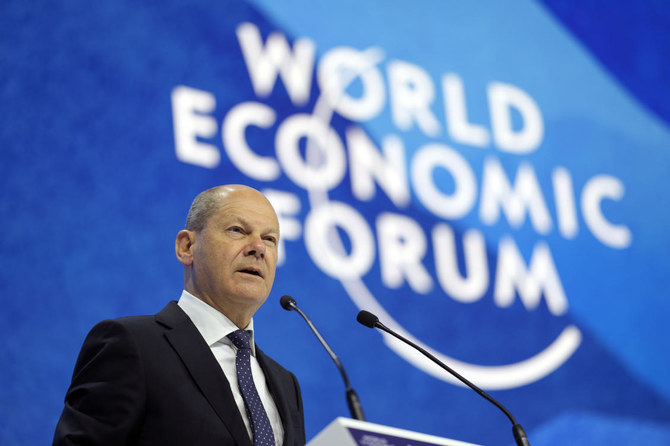
Vladimir Putin will not be allowed to dictate peace in Ukraine, Germany’s Chancellor Olaf Scholz said. (AP)
Short Url
Updated 27 May 2022
Follow

Putin won’t be allowed to dictate Ukraine peace terms: German chancellor

  • Vladimir Putin will not be allowed to dictate peace in Ukraine, Germany’s Chancellor Olaf Scholz said

DAVOS, Switzerland: Russia will not win its war in Ukraine and President Vladimir Putin must not dictate the terms of any peace agreement, German Chancellor Olaf Scholz said on Thursday.
After failing to seize Ukraine’s capital Kyiv or its second city Kharkiv in its three-month-old war, Russian forces are trying to wrest full control of the eastern Donbas region and have also advanced in the south despite stiff Ukrainian resistance and tough Western sanctions on Moscow.
“Putin must not win his war, and I am convinced he will not win,” Scholz said in a speech at the World Economic Forum in the Swiss resort of Davos. “A capture of the whole of Ukraine seems further away now than at the beginning of the war.”
Although some have suggested that Ukraine should negotiate with Putin and consider ceding territory, Scholz rejected the idea of letting Putin dictate the terms of an agreement.
“There will be no dictated peace,” Scholz added. “Ukraine will not accept this, and neither will we.”
Putin is only likely to seriously negotiate once he accepts that the war cannot be won, making continued Western support for Ukraine essential, he said.
Scholz, however, did not address Ukrainian demands for the delivery of more heavy weapons to Kyiv, despite concrete requests by Ukraine’s Foreign Minister Dmytro Kuleba in Davos on Wednesday.
Kyiv has been seeking to acquire German Marder infantry fighting vehicles and ideally also Leopard main battle tanks but has not made significant headway with the government in Berlin, Kuleba said.
Hoping to weaken Russia’s economy and thus its ability to wage war, Scholz said Germany would end imports of Russian oil by the end of 2022 and also reduce its reliance on Russian gas.


US allows oil majors to broadly operate in Venezuela, new energy investments

Updated 53 min 59 sec ago
Follow

US allows oil majors to broadly operate in Venezuela, new energy investments

  • Treasury Department issues general license allowing Chevron, BP, Eni, Shell and Repsol to operate oil and gas operations in Venezuela
  • Move is the most significant relaxation of sanctions on Venezuela since US forces captured and removed President Nicolas Maduro

WASHINGTON: The US ​eased sanctions on Venezuela’s energy sector on Friday, issuing two general licenses that allow global energy companies to operate oil and gas projects in the OPEC member and for other companies to negotiate contracts to bring in fresh investments. The move was the most significant relaxation of sanctions on Venezuela since US forces captured and removed President Nicolas Maduro last month.
The Treasury Department’s Office of Foreign Assets Control issued a general license allowing Chevron, BP, Eni, Shell and Repsol to operate oil and gas operations in Venezuela. Those companies still have offices in the country and stakes in projects, and are among the main partners of state-run ‌company PDVSA.
The authorization ‌for the oil majors’ operations requires payments for royalties and Venezuelan ​taxes ‌to ⁠go through ​the US-controlled ⁠Foreign Government Deposit Fund.
The other license allows companies around the world to enter contracts with PDVSA for new investments in Venezuelan oil and gas. The contracts are contingent on separate permits from OFAC.
The authorization does not allow transactions with companies in Russia, Iran, or China or entities owned or controlled by joint ventures with people in those countries.
The licenses “invite American and other aligned companies to play a constructive role in supporting economic recovery and responsible investment, ” the US State Department said in a release. Additional authorizations may be issued “as necessary,” it said.
A spokesperson for Chevron, ⁠the only US oil firm currently operating in Venezuela, said the company welcomed ‌the new licenses.
“The new General Licenses, coupled with recent changes ‌in Venezuela’s Hydrocarbons Law, are important steps toward enabling the further development ​of Venezuela’s resources for its people and for advancing ‌regional energy security,” the spokesperson said in a statement.
Eni said it is assessing the opportunities in ‌Venezuela that the authorization opens up.

Oil law reform

The US licenses follow a sweeping reform of Venezuela’s main oil law approved last month, which grants autonomy for foreign oil and gas producers to operate, export and cash sale proceeds under existing joint ventures with PDVSA or through a new production-sharing contract model.
The US has had sanctions on Venezuela since ‌2019 when President Donald Trump imposed them during his first administration. Trump is now seeking $100 billion in investments by energy companies in Venezuela’s oil and gas sector. ⁠US Energy Secretary Chris Wright ⁠said on Thursday, during his second day of a trip to Venezuela, that oil sales from the country since Maduro’s capture have hit $1 billion and would hit another $5 billion in months.
Wright said the US will control the proceeds from the sales until Venezuela stands up a “representative government.” Since last month, the Treasury issued several other general licenses to facilitate oil exports, storage, imports and sales from Venezuela. It also authorized the provision of US goods, technology, software or services for the exploration, development or production of oil and gas in Venezuela.
The Venezuelan government expropriated assets of Exxon Mobil and ConocoPhillips in 2007 under then-President Hugo Chavez. The Trump administration is trying to get those companies to invest in Venezuela as well. At a meeting at the White House with Trump last month, Exxon Mobil CEO Darren Woods said Venezuela was “uninvestable” at ​the moment.
Wright said on Thursday that Exxon, ​which no longer has an office in Venezuela, is in talks with the government there and gathering data about the oil sector. Exxon did not immediately comment.