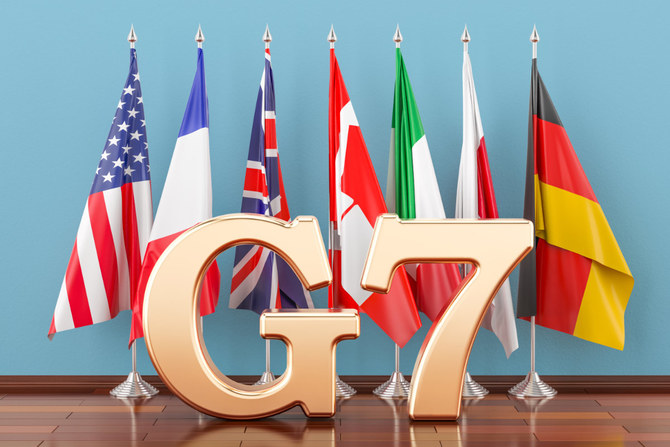
BERLIN: Ministers from the world’s wealthiest democracies will wrangle over how to keep climate change goals on track as they meet in Berlin on Thursday for talks overshadowed by spiralling energy costs and fuel supply worries sparked by the war in Ukraine.
Energy, climate and environment ministers from the Group of Seven (G7) countries want to reaffirm a commitment to cap global warming at 1.5 degrees Celsius and protect biodiversity at the May 25-27 meeting.
The group will also consider committing to a phase-out of coal power generation by 2030, according to a draft communique seen by Reuters, though sources suggested that opposition from the United States and Japan could derail such a pledge.
The draft, which could change considerably by the time talks conclude on Friday, would also commit G7 countries to have a “net zero electricity sector by 2035” and to start reporting publicly next year on how they are delivering on a past G7 commitment to end “inefficient” fossil fuel subsidies by 2025.
The invasion of Ukraine by Russia has triggered a scramble among some countries to buy more non-Russian fossil fuels and burn coal to cut their reliance on Russian supplies, raising fears that the energy crisis triggered by the war could undermine efforts to fight climate change.
Campaigners urged the ministers of the G7 to make clear commitments that the fallout of the Ukraine war would not derail their targets.
“We have a new reality now. The G7 need to respond to that, and they should respond through renewables, and not through fossil fuel infrastructure,” said David Ryfisch, climate policy expert at non-profit Germanwatch.
While seeking consensus on an oil embargo on Russia, the European Union is pushing to accelerate the bloc’s pivot to renewable energy while finding fossil fuel alternatives to Russian supplies.
Alden Meyer, senior associate at climate think-tank E3G, said tackling climate change was the best and quickest way for countries to achieve energy security.
“Climate impacts are worse than scientists originally predicted and there’s far worse ahead if we don’t cut emissions rapidly,” Meyer said. “Delivering on climate promises really becomes even more vital in this tense geopolitical environment.”
Ahead of the meeting, the B7 group of leading business and industry federations of the G7 states called on the group to back a plan along the lines of German Chancellor Olaf Scholz’s “climate club” to harmonize standards on emissions and CO2 pricing.
Scholz had suggested the idea to try to avoid trade friction in areas including green tariffs, the development of markets for decarbonized products, carbon pricing and removal methods.

G7 scrambles to keep climate agenda on track as Ukraine war roils energy supplies
https://arab.news/zy55k
G7 scrambles to keep climate agenda on track as Ukraine war roils energy supplies
Kosovo voters cast ballots in a second attempt this year to elect a government and avoid more crisis
- The prime minister’s party is again the favorite in the race, but it is unclear whether it will manage to muster a majority this time in the 120-member parliament
PRISTINA: Voters in Kosovo cast ballots on Sunday in an early parliamentary election in hopes of breaking a political deadlock that has gripped the small Balkan nation for much of this year.
The snap vote was scheduled after Prime Minister Albin Kurti’s governing Vetevendosje, or Self-Determination, party failed to form a government despite winning the most votes in a Feb. 9 election.
The deadlock marked the first time Kosovo could not form a government since it declared independence from Serbia in 2008 following a 1998-99 war that ended in a NATO intervention.
The prime minister’s party is again the favorite in the race, but it is unclear whether it will manage to muster a majority this time in the 120-member parliament, after other mainstream parties refused an alliance.
According to Kosovo’s election laws, 20 parliamentary seats are automatically assigned to ethnic Serb representatives and other minority parties.
Another inconclusive vote would further deepen the crisis. Kosovo has already not approved a budget for next year, sparking fears of possible negative effects on the already poor economy in the country of 2 million people.
Lawmakers are set to elect a new president in March as current President Vjosa Osmani’s mandate expires in early April. If this fails too, another snap election must be held.
The main opposition parties are the Democratic League of Kosovo and the Democratic Party of Kosovo. They have accused Kurti of authoritarianism and of alienating Kosovo’s US and European Union allies since he came to power in 2021.
A former political prisoner during Serbia’s rule in Kosovo, the 50-year-old Kurti has taken a tough stand in talks mediated by the European Union on normalizing relations with Belgrade. In response, the EU and the United States imposed punitive measures.
Kurti has promised to buy military equipment to boost security.
No reliable pre-election polls have been published. Kurti’s party at the previous election won around 42 percent of the votes while the two main rival parties had together around 40 percent.
Analysts say that even the slightest changes in numbers on Sunday could prove decisive for the future distribution of power but that nothing is certain.
Tensions with restive ethnic Serbs in the north exploded in clashes in 2023 when scores of NATO-led peacekeepers were injured. In a positive step, ethnic Serb mayors this month took power peacefully there after a municipal vote.
Kurti has also agreed to accept third-country migrants deported from the United States as part of tough anti-immigration measures by the administration of President Donald Trump. One migrant has arrived so far, authorities have told The Associated Press.
Kosovo is one of the six Western Balkan countries striving to eventually join the EU, but both Kosovo and Serbia have been told they must first normalize relations.


