

Pakistan’s top court instructs government to allow opposition rally near H-9 sector

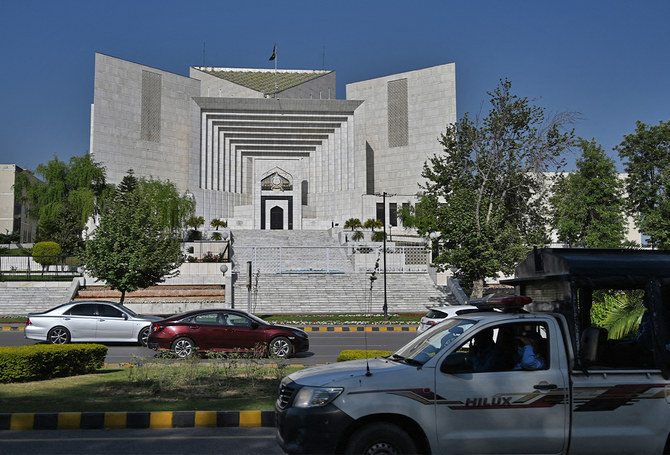
Motorists drive past Pakistan's Supreme Court in Islamabad, Pakistan, on April 5, 2022. (AFP/File)
Short Url
Updated 25 May 2022
Follow

Pakistan’s top court instructs government to allow opposition rally near H-9 sector

  • The Supreme Court tells the government not to arrest Khan supporters in police raids
  • Government and Khan representatives have been instructed to hold consultations tonight

ISLAMABAD: Pakistan’s top court on Wednesday instructed the government to provide former prime minister Imran Khan’s political party a ground between Islamabad’s H-9 and G-9 sectors, reported the local media, to hold a protest demonstration while hearing a petition for the removal of road blocks in the federal capital.

The petition was filed by the Islamabad High Court Bar Association after the government blocked several roads in and around the capital to prevent the anti-government march initiated by Khan’s Pakistan Tehreek-e-Insaf (PTI) party which has been seeking dissolution of assemblies along with a date for fresh elections in the country.

The government also detained several PTI leaders and supporters in different Pakistani cities ahead of their scheduled march to Islamabad, making the court prevent the relevant authorities from making excessive use of force.

“The Supreme Court on Wednesday allowed the PTI to hold its Azadi March protest in the H-9 area of Islamabad and restrained the government from arresting party chairman Imran Khan,” reported Dawn newspaper.

It quoted the court as saying that it was “playing the role of the arbitrator,” adding the judges said no raids should be conducted on the homes of PTI workers.”

Pakistan’s Geo news channel said the three-member bench headed by Justice Ijazul Ahsan demanded a plan that would allow PTI workers and followers to peacefully converge in the capital to register their protest before returning home.

The bench said it did not want the protesters to shut down places like Faizabad and the Motorway like in the past.

The court also instructed the government and PTI representatives to hold a meeting at the chief commissioner’s office tonight to work out the modalities of the protest demonstrations.


‘Look ahead or look up?’: Pakistan’s police face new challenge as militants take to drone warfare

Updated 14 January 2026
Follow

‘Look ahead or look up?’: Pakistan’s police face new challenge as militants take to drone warfare

  • Officials say militants are using weapons and equipment left behind after allied forces withdrew from Afghanistan
  • Police in northwest Pakistan say electronic jammers have helped repel more than 300 drone attacks since mid-2025

BANNU, Pakistan: On a quiet morning last July, Constable Hazrat Ali had just finished his prayers at the Miryan police station in Pakistan’s volatile northwest when the shouting began.

His colleagues in Bannu district spotted a small speck in the sky. Before Ali could take cover, an explosion tore through the compound behind him. It was not a mortar or a suicide vest, but an improvised explosive dropped from a drone.

“Now should we look ahead or look up [to sky]?” said Ali, who was wounded again in a second drone strike during an operation against militants last month. He still carries shrapnel scars on his back, hand and foot, physical reminders of how the battlefield has shifted upward.

For police in the northwestern Khyber Pakhtunkhwa (KP) province, the fight against militancy has become a three-dimensional conflict. Pakistani officials say armed groups, including the Tehreek-e-Taliban Pakistan (TTP), are increasingly deploying commercial drones modified to drop explosives, alongside other weapons they say were acquired after the US military withdrawal from neighboring Afghanistan.

Security analysts say the trend mirrors a wider global pattern, where low-cost, commercially available drones are being repurposed by non-state actors from the Middle East to Eastern Europe, challenging traditional policing and counterinsurgency tactics.

The escalation comes as militant violence has surged across Pakistan. Islamabad-based Pakistan Institute for Conflict and Security Studies (PICSS) reported a 73 percent rise in combat-related deaths in 2025, with fatalities climbing to 3,387 from 1,950 a year earlier. Militants have increasingly shifted operations from northern tribal belts to southern KP districts such as Bannu, Lakki Marwat and Dera Ismail Khan.

“Bannu is an important town of southern KP, and we are feeling the heat,” said Sajjad Khan, the region’s police chief. “There has been an enormous increase in the number of incidents of terrorism… It is a mix of local militants and Afghan militants.”

In 2025 alone, Bannu police recorded 134 attacks on stations, checkpoints and personnel. At least 27 police officers were killed, while authorities say 53 militants died in the clashes. Many assaults involved coordinated, multi-pronged attacks using heavy weapons.

Drones have also added a new layer of danger. What began as reconnaissance tools have been weaponized with improvised devices that rely on gravity rather than guidance systems.

“Earlier, they used to drop [explosives] in bottles. After that, they started cutting pipes for this purpose,” said Jamshed Khan, head of the regional bomb disposal unit. “Now we have encountered a new type: a pistol hand grenade.”

When dropped from above, he explained, a metal pin ignites the charge on impact.

Deputy Superintendent of Police Raza Khan, who narrowly survived a drone strike during construction at a checkpoint, described devices packed with nails, bullets and metal fragments.

“They attach a shuttlecock-like piece on top. When they drop it from a height, its direction remains straight toward the ground,” he said.

TARGETING CIVILIANS

Officials say militants’ rapid adoption of drone technology has been fueled by access to equipment on informal markets, while police procurement remains slower.

“It is easy for militants to get such things,” Sajjad Khan said. “And for us, I mean, we have to go through certain process and procedures as per rules.”

That imbalance began to shift in mid-2025, when authorities deployed electronic anti-drone systems in the region. Before that, officers relied on snipers or improvised nets strung over police compounds.

“Initially, when we did not have that anti-drone system, their strikes were effective,” the police chief said, adding that more than 300 attempted drone attacks have since been repelled or electronically disrupted. “That was a decisive moment.”

Police say militants have also targeted civilians, killing nine people in drone attacks this year, often in communities accused of cooperating with authorities. Several police stations suffered structural damage.

Bannu’s location as a gateway between Pakistan and Afghanistan has made it a security flashpoint since colonial times. But officials say the aerial dimension of the conflict has placed unprecedented strain on local forces.

For constables like Hazrat Ali, new technology offers some protection, but resolve remains central.

“Nowadays, they have ammunition and all kinds of the most modern weapons. They also have large drones,” he said. “When we fight them, we fight with our courage and determination.”