Pakistan’s first Cannes film a ‘dream come true’

The movie, “Joyland,” seeks to break gender stereotypes in the country. (AFP)
Short Url
Updated 25 May 2022
Follow

Pakistan’s first Cannes film a ‘dream come true’

CANNES: The debut screening of Pakistan’s first entry to the Cannes Film Festival felt like “a dream has come true,” one of its stars, Sarwat Gilani, said after the film received a prolonged standing ovation.

The movie, “Joyland,” seeks to break gender stereotypes in the country.

“It felt like the hard work that people do, the struggles that we face as artists in Pakistan, they’ve all come to be worth it,” Gilani told Reuters this week.

Gilani, a film and TV starplay, plays Nucchi in “Joyland,” which competes in the “Un Certain Regard” section, a competition focused on more art-house films that runs parallel to the main “Palme d’Or” prize.
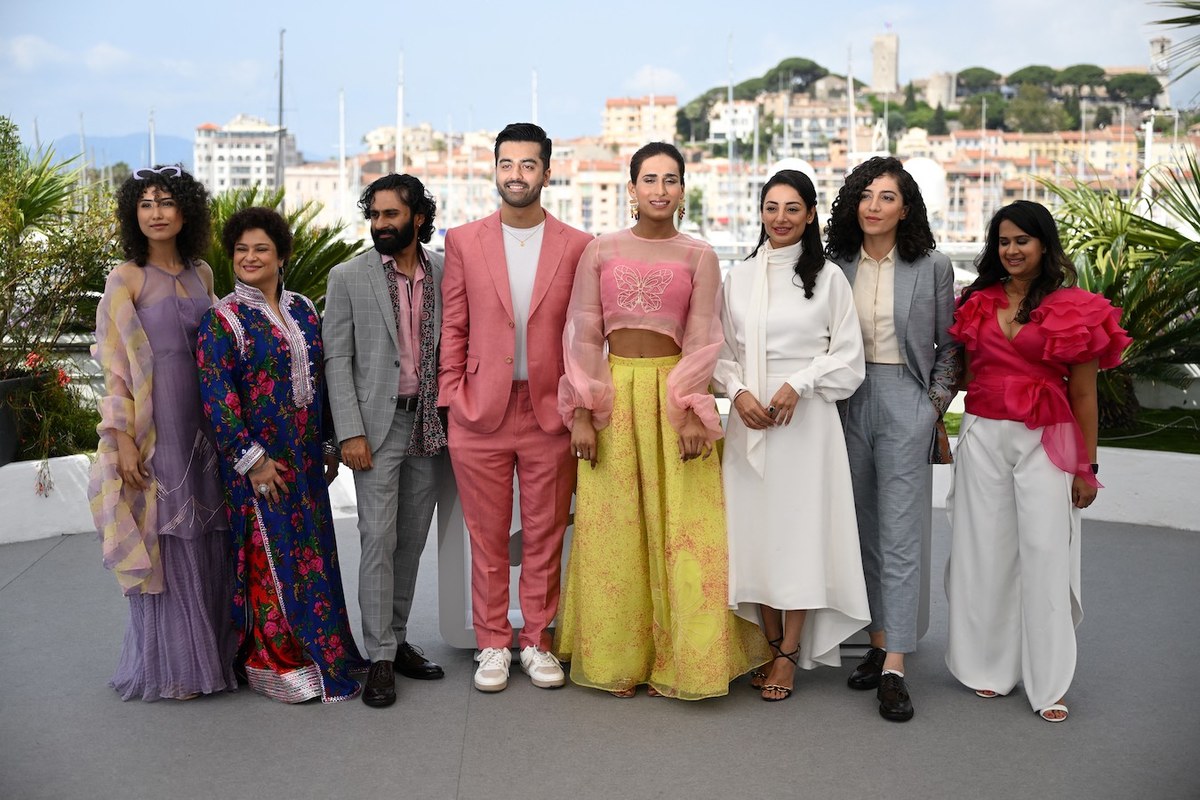


(FromL) Pakistani actress Sana Jafri, Pakistani actress Sania Saeed, actor Ali Junejo, director Saim Sadiq, actor Alina Khan, Pakistani actor and model Sarwat Gilani, actress Rasti Farooq and film producer Apoorva Charan attend a photocall for the film “Joyland” at the 75th edition of the Cannes Film Festival. (AFP)

Nucchi belongs to a household that has long hoped for the birth of a son to continue the family line, with the consecutive birth of her three daughters not enough to please her conservative father-in-law.

And her brother-in-law Haider secretly falls in love with a transgender woman Biba, who fights for her right to work as a performer.
“Joyland” also explores the frustration of women seeking to pursue a profession, when Haider’s wife Mumtaz falls into a depression for being forced to stay at home and do household chores and stop working as a make-up artist.
“It’s not just about a love story anymore. It’s about real-time issues, real life issues that we all go through,” Gilani said. 
She said she hoped Pakistani movie-goers and critics would give “Joyland” as warm a reception as it received in Cannes.
“I’m very positive that at least our people will understand that this is also a kind of cinema that can be successful. If worldwide, then why not locally, nationally,” she said.
The Cannes Film Festival runs from May 17 to 28, with the prizes awarded on the last day. 


Why this year’s Golden Globes race feels so unpredictable

Updated 09 January 2026
Follow

Why this year’s Golden Globes race feels so unpredictable

  • No dominant frontrunner and openness among voters
  • ‘Hamnet,’ ‘Sinners,’ ‘Sentimental Value’ in contention

LOS ANGELES: With the Golden Globes approaching, this awards season has taken on an unusually fluid shape. Instead of a single dominant frontrunner, the race is being defined by range, taste, and a noticeable openness among voters.

Prestige dramas are sharing space with ambitious studio films, while several contenders have built momentum quietly rather than through aggressive campaigns. The result is a season that feels unpredictable — in the best possible way.

Recently announced presenters include a wide cross section of film, television, and music figures. (Supplied)

That sense of openness is reflected not only in the awards race itself, but also in the broader tone surrounding this year’s ceremony. The 83rd Annual Golden Globes will air live on CBS on Sunday, Jan. 11, 2026, with comedian and actress Nikki Glaser returning as host.

Recently announced presenters include a wide cross section of film, television, and music figures.

Among them are Julia Roberts, George Clooney, Jennifer Garner, Kevin Hart, Miley Cyrus, Snoop Dogg, Amanda Seyfried, Ana de Armas, Ayo Edebiri, Colman Domingo, Dakota Fanning, Kathryn Hahn, Queen Latifah, Zoe Kravitz, and Pamela Anderson.

The 83rd Annual Golden Globes will air live on CBS on Sunday, Jan. 11, 2026, with comedian and actress Nikki Glaser returning as host. (Supplied)

The diversity and generational range of the presenter lineup mirrors the season itself, blending established icons with contemporary voices and signaling a ceremony that leans into variety rather than predictability.

In the drama categories, “Hamnet” has emerged as a serious presence, earning steady respect across critics’ groups and industry conversations. Its restrained approach and emotional weight have resonated with audiences and awards watchers who value craft over spectacle.

At the same time, “Sinners” and “Sentimental Value” remain firmly in contention, particularly if voters gravitate toward character-driven storytelling rather than formal experimentation.

Among them are Julia Roberts, George Clooney, Jennifer Garner, Kevin Hart, Miley Cyrus, Snoop Dogg, Amanda Seyfried, Ana de Armas, Ayo Edebiri, Colman Domingo, Dakota Fanning, Kathryn Hahn, Queen Latifah, Zoe Kravitz, and Pamela Anderson. (Supplied)

On the musical or comedy side, “One Battle After Another” appears especially well-positioned, carried by strong ensemble work and a level of sustained buzz that has followed it throughout the season.

The acting races are no less competitive. Wagner Moura has placed himself near the front of the Best Actor, Drama conversation for his performance in “The Secret Agent,” a role widely praised for its restraint and complexity.

Michael B. Jordan continues to generate strong support for “Sinners,” reinforcing his position as a consistent awards presence.

In the musical or comedy field, Timothee Chalamet has become a frequent prediction for “Marty Supreme,” a performance many see as both charismatic and strategically timed.

The actress races are equally open, with Jessie Buckley and Rose Byrne widely cited as leading figures, while the supporting categories continue to spotlight standout work from Stellan Skarsgard and Inga Ibsdotter Lilleaas.

In directing, momentum appears to favor Paul Thomas Anderson for “One Battle After Another,” reflecting both critical admiration and industry confidence.

Screenplay and score conversations have included “Sinners” and “KPop Demon Hunters,” underscoring a year that balances artistic ambition with broader appeal.

However the night ultimately unfolds, this year’s Golden Globes feels less about safe consensus choices and more about recognizing work that lingered long after the credits rolled.

From the nominees to the presenters taking the stage, the ceremony reflects a film year defined by confidence, creative risk, and a refreshing absence of certainty.