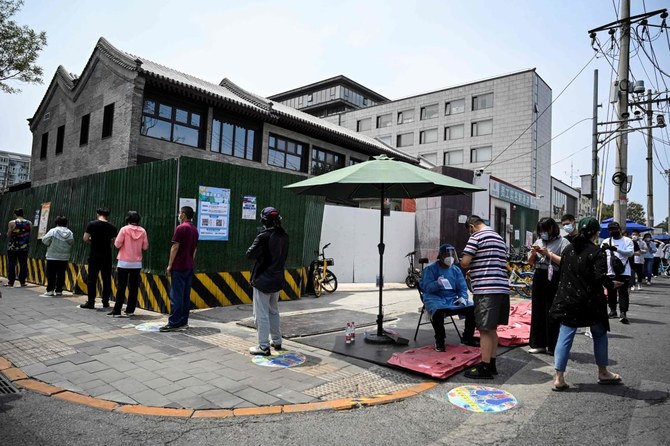
BEIJING/SHANGHAI: Beijing stepped up quarantine efforts to end its month-old COVID-19 outbreak as fresh signs of frustration emerged in Shanghai, where some bemoaned unfair curbs with the city of 25 million preparing to lift a prolonged lockdown in just over a week.
Even as China’s drastic attempts to eradicate COVID-19 entirely — its “zero-COVID” approach — bite into prospects for the world’s second-biggest economy, new reported infection numbers remain well below levels seen in many Western cities. The capital reported 48 new cases for Monday among its population of 22 million, with Shanghai reporting fewer than 500.
Still, Chinese Vice Premier Sun Chunlan called for more thorough measures to cut virus transmission and adhere to the nation’s zero-COVID-19 policy during an inspection tour in Beijing, state agency Xinhua reported on Tuesday.
The situation in Beijing was manageable, but containment efforts cannot ease, she said, according to Xinhua.
In one example of the stringency of Beijing’s approach, around 1,800 people in one city neighborhood were relocated to Zhangjiakou city in the nearby Hebei province for quarantine, the state-backed Beijing Daily reported.
Still in place are instructions for residents in six of the capital’s 16 districts to work from home, while a further three districts encouraged people to follow such measures, with each district responsible for implementing its own guidelines.
Beijing had already reduced public transport, requesting some shopping malls and other venues to close and sealing buildings where new cases were detected.
In Shanghai, authorities plan to keep most restrictions in place this month, before a more complete lifting of the two-month-old lockdown from June 1. Even then, public venues will have to cap people flows at 75 percent of capacity.
With Shanghai officially declared to be a zero-COVID-19 city, some authorities allowed more people to leave their homes for brief periods over the past week, and more supermarkets and pharmacies were authorized to reopen and provide deliveries.
But other lower-level officials separately tightened restrictions in some neighborhoods, ordering residents back indoors to cement progress achieved so far during the city’s final lap toward exiting the lockdown.
That has led to frustration and complaints of uneven treatment among some residents.
While the zero-COVID-19 status describes the entire city, and residents in some compounds have been allowed to move in and out of their homes freely, others have been told they can only go out for a few hours, and many of those stuck indoors were told nothing.
Videos circulating on social media this week showed residents arguing with officials to be let out of their residential compounds.
The Shanghai government did not immediately respond to a request to comment.
One resident said people in his compound decided on the WeChat social media platform to go out in groups.
“Let’s strike at our gate tonight to demand that we be allowed to go out like many of other compounds in the neighborhood,” he quoted one of his neighbors as saying in the group chat.
A video he shared then showed a group of people arguing at the entrance of the compound with a man who described himself as a sub-district official, who asked the residents to go back inside and discuss the situation.
“Don’t bother with him,” one person said as some people were socialising outside the compound.
People in at least two other compounds were planning to try going outside despite not being told they were allowed to do so, residents said.


![]()

Beijing ramps up COVID-19 quarantine, Shanghai residents decry uneven rules
Short Url
https://arab.news/vesjq
Beijing ramps up COVID-19 quarantine, Shanghai residents decry uneven rules
- Chinese vice premier: Situation in Beijing manageable, but containment efforts cannot ease


Latest updates





Recommended


© 2026 SAUDI RESEARCH & PUBLISHING COMPANY, All Rights Reserved And subject to Terms of Use Agreement.