

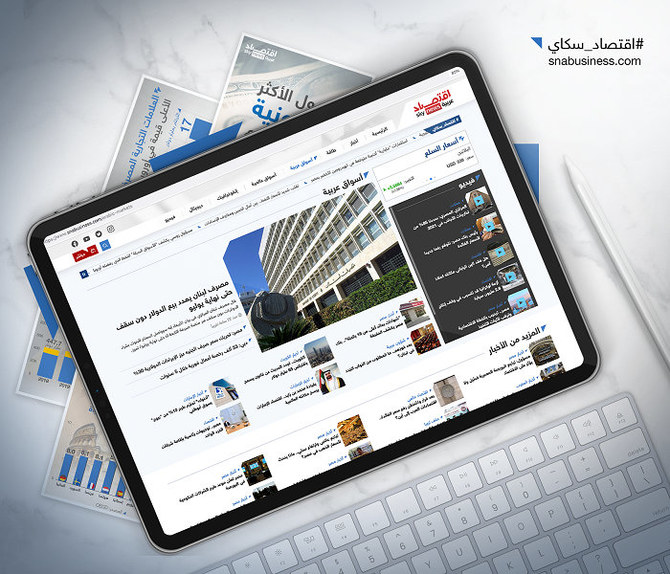
Sky News Arabia launches new Arabic-language digital platform

Short Url
Updated 24 May 2022
Follow

Sky News Arabia launches new Arabic-language digital platform

  • SNABusiness.com will cover business and economic news and analysis

ABU DHABI: Sky News Arabia has launched a new Arabic-language digital platform SNABusiness.com, featuring breaking news, economic analysis and in-depth reporting.

The launch of the platform is in response to “consumer demand for objective and actionable economic intelligence and insights,” according to a company statement.

Youssef Tsouri, head of news at Sky News Arabia told Arab News that the new platform was created in response to “the increased appetite for business news”.

He said: “Over the past few years we have seen a significant increase in the consumption of the business news section of our main website, particularly in the younger Arab generation that is invested in their future and therefore looking for deeper and more relevant information.” 

“With this in mind, we launched the dedicated business platform to provide more depth of coverage to offer both, business leaders and the general public, added value around the current economic landscape,” he added.

The digital publication will cover all topics relating to business and economy across industries including financial technology, energy and oil, tourism, real estate, agriculture and other sectors.

SNABusiness.com will offer more comprehensive news and features tailored to current market trends and audience demands, Tsouri explained.

The website’s content will include diverse content types including reports, videos and exclusive interviews. SNABusiness.com aims to present complex data in an easy-to-understand manner through charts, infographics and digital videos.

“Thanks to a young and digital-savvy population, the Arab world is one of the most advanced digital economies globally, with many Middle Eastern countries being the early adopters of cutting-edge digital technologies,” said Tsouri. 

He added: “The dedicated business website and social handles are complemented by our dedicated business segments and programs on our linear channel.”   


UAE outlines approach to AI governance amid regulation debate at World Economic Forum

Updated 22 January 2026
Follow

UAE outlines approach to AI governance amid regulation debate at World Economic Forum

  • Minister of State Maryam Al-Hammadi highlights importance of a robust regulatory framework to complement implementation of AI technology
  • Other experts in panel discussion say regulators should address problems as they arise, rather than trying to solve problems that do not yet exist

DUBAI: The UAE has made changes to 90 percent of its laws in the past four years, Maryam Al-Hammadi, minister of state and the secretary-general of the Emirati Cabinet, told the World Economic Forum in Davos on Wednesday.

Speaking during a panel discussion titled “Regulating at the Speed of Code,” she highlighted the importance of having a robust regulatory framework in place to complement the implementation of artificial intelligence technology in the public and private sectors.

The process of this updating and repealing of laws has driven the UAE’s efforts to develop an AI model that can assist in the drafting of legislation, along with collecting feedback from stakeholders on proposed laws and suggesting improvements, she said.

Although AI might be more agile at shaping regulation, “there are some principles that we put in the model that we are developing that we cannot compromise,” Al-Hammadi added. These include rules for human accountability, transparency, privacy and data protection, along with constitutional safeguards and a thorough understanding of the law.

At this stage, “we believe AI can advise but still (the) human is in command,” she said.

Authorities in the UAE are aiming to develop, within a two-year timeline, a shareable model to help other nations learn and benefit from its experiences, Al-Hammadi added.

Argentina’s minister of deregulation and state transformation, Federico Sturzenegger, warned against overregulation at the cost of innovation.

Politicians often react to a “salient event” by overreacting, he said, describing most regulators as “very imaginative of all the terrible things that will happen to people if they’re free.”

He said that “we have to take more risk,” and regulators should wait to address problems as they arise rather than trying to create solutions for problems that do not yet exist.

This sentiment was echoed by Joel Kaplan, Meta’s chief global affairs officer, who said “imaginative policymakers” often focus more on risks and potential harms than on the economic and growth benefits of innovation.

He pointed to Europe as an example of this, arguing that an excessive focus on “all the possible harms” of new technologies has, over time, reduced competitiveness and risks leaving the region behind in what he described as a “new technological revolution.”