



MUZAFFARABAD: Pakistan’s auto manufacturers fear their sales will squeeze by about 40 percent in the next fiscal year after achieving the highest ever growth during the ongoing one, as the country finds itself in a major downward economic spiral which is hurting the auto sector.
Pakistan witnessed 18 percent decline in car sales, from 22,799 to 18,625 units, in April due to restrictions on car financing imposed by the central bank along with increased import duties to curtail current account deficit.
The sector posted 51 percent growth during the current fiscal year beginning in July 2021 by selling 191,237 units, the Pakistan Automotive Manufacturers Association’s (PAMA) data show.
“The current economic situation is hurting the auto industry to a large extent,” Ali Asghar Jamali, chief executive officer of the Indus Motor Company (IMC) told Arab News on Friday during an auto industry workshop held in Muzaffarabad, the capital city of Pakistan-administered Kashmir.
The IMC, which manufactures Toyota vehicles, arranged the workshop to highlight the localization level achieved by the auto industry while gauging the impact of auto policies on the sector.
“The automobile market will fall by 30-40 percent in the next fiscal year [FY22-23],” he said. “However, the market will be of around 350,000 units this year which will be the highest ever in the history of Pakistan due to the current orders placed.”
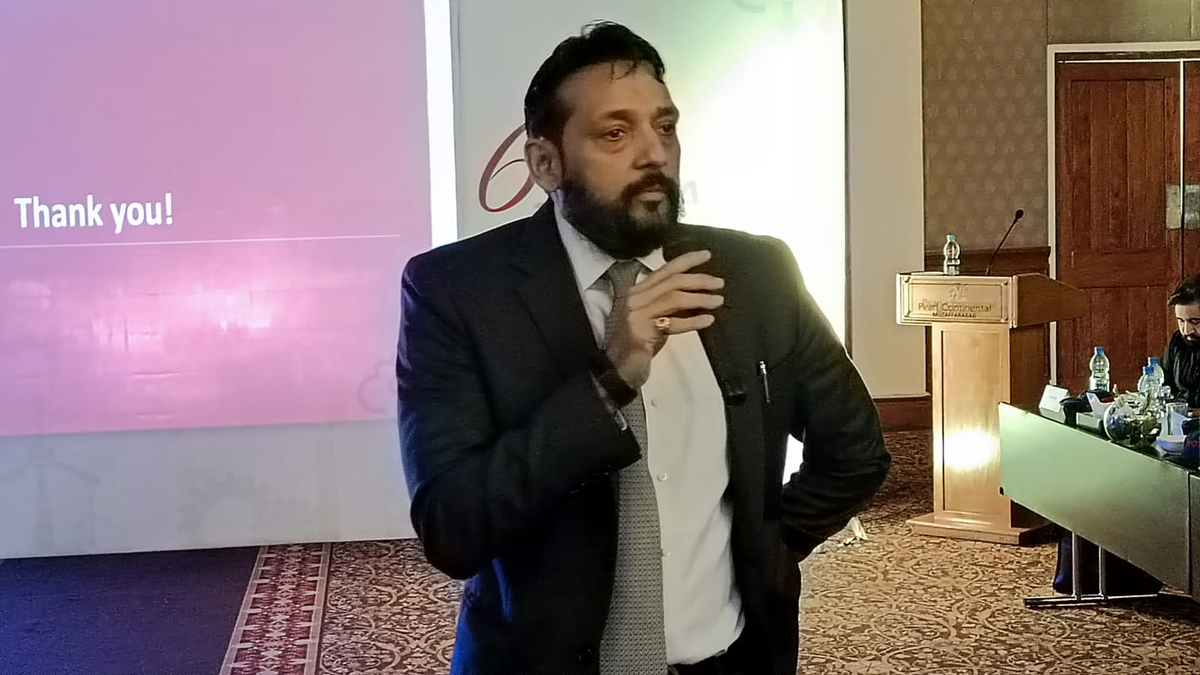
Ali Asghar Jamali, chief executive officer of Indus Motor Company, addresses an auto industry workshop in Muzaffarabad, Pakistan, on May 20, 2022. (AN Photo)
Jamali, who is also the former chairman of PAMA, said the total number of cars sold in the next year was likely to be between 200,000 and 215,000.
Pakistan has imposed a ban on the import of non-essential luxury goods, including vehicles, in a bid to stabilize the economy after its current account deficit spiraled out of control. The country’s foreign exchange reserves have also witnessed a decline while its national currency is trading at low levels against the US dollar.
Supporting the government’s decision to ban import of luxury goods, Jamali said Pakistan’s auto sector required consistent policies.
“The future of Pakistan’s auto sector is bright but at present the country is facing a crisis situation and we have to get out of it,” he said. “We have a major current account deficit due to a high import bill and in the current situation the country will have to take tough decisions. We need to device a sustainable policy to avoid crisis-like situation after every two years.”
Pakistan’s auto sector has witnessed an inclusion of two new entrants and made an investment of about $2 billon since 2016 while providing 2.5 million employment opportunities. The sector contributes 2.2 percent to the overall economy of the country.
“The new entrants have made substantial investment in the sector,” Jamali said. “We [the IMC] have already invested $100 million to make Hybrid Electric Vehicles (HEVs) in Pakistan and another $70-$80 million are in the pipeline.”
“We have invested Rs15-18 billion in plant expansion during the last five years to introduce new models in Pakistan,” he added. “Pakistan’s auto market is still very attractive and what we need is to fix our fundamentals and improve it.”
The IMC chief, who is planning to launch locally assembled hybrid vehicles in Pakistan from next year, said his company was gradually moving toward complete electric vehicles (EVs) with improvement in infrastructure development in the country.
“I agree that the ultimate future is electric vehicle but we think that first it would be hybrid and then it would move into the next stage that is completely electric because at present there is no infrastructure for EVs,” he said, adding: “In the next five to seven years, share of renewable energy in the overall energy mix will improve and the infrastructure for EVs will be available so our strategy is to first bring in hybrid and then move on to the EVs.”
Pakistani auto manufacturers have recently increased prices of the vehicles between seven to 55 percent due to the rise in freight charges by about 252-272 percent, foreign exchange by 24 percent, and 18 to 80 percent rise in the prices of other related goods, according to a presentation given during the workshop.
“The whole world has witnessed unprecedented inflationary pressures in the last couple of years and Pakistan is no exception,” Jamali said. “The pandemic resulted in the disruption of global supply chain which was further aggravated by the Russia-Ukraine conflict.”
“The rupee-dollar disparity, exponential increase in utilities, overwhelming freight charges and government taxation of up to 40 percent have contributed to Pakistan’s economic challenges,” he continued.
However, he warned that any bid to regulate the auto sector, including price fixation, would lead to exit of Toyota cars from the Pakistani market.
In Pakistan, 400 registered vendors have been supplying parts to the auto manufacturers whose number is expected to increase in coming years.
“Vending industry is playing key role in the localization of vehicles and they are investing in modernizing their product lines,” Syed Nabeel Hashmi, former chairman of Pakistan Association of Automotive Parts and Accessories Manufacturers, said while speaking at the workshop. “As a nation, we have to look at the future technology.”
Hashmi called for action against a huge influx of Chinese products which, he said, lacked requisite quality and damaged the automobile sector.
“We want long term policy in Pakistan so that we can manufacture high tech equipment for EVs that are the future of transportation,” he said.


