

Millions still marooned as floods recede in northeast Bangladesh

1 / 2
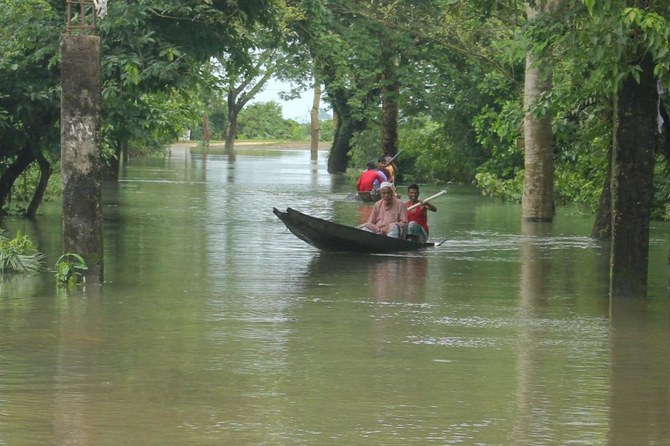
The floods had hit some 70 percent of Bangladesh’s Sylhet district, above, and about 60 percent of neighboring Sunamganj. (AFP)
2 / 2
Floodwater breached a major embankment in Bangladesh’s Sylhet region, above, affecting around two million people. (AFP)
Short Url
Updated 22 May 2022
Follow

Millions still marooned as floods recede in northeast Bangladesh

  • Flooding is worst the region has seen in almost 2 decades
  • Authorities bracing for more flash foods this year

DHAKA: Millions of people in Bangladesh have been marooned by the worst floods to hit the country’s northeast in almost two decades, officials said on Sunday, with rescue efforts ongoing as waters begin to recede.

After heavy rain in neighboring India in the past week, flash floods hit Bangladesh’s Sylhet district, causing rivers to swell and swamping dozens of villages.

At least four people in Sylhet were killed in the floods, according to data from the local health department.

“More than 1.2 million people were affected only in Sylhet district,” Mohammad Nurul Islam, Sylhet’s relief and rehabilitation officer, told Arab News. “At the moment our first and foremost concern is to save the people’s lives with necessary shelter and food.”

Authorities have opened hundreds of shelters in affected areas. Thousands of people are taking refuge in the shelters while others have stayed with relatives. Officials said that the situation is slowly improving.

“The overall flood situation in Sylhet region is getting better slowly since the heavy rainfall stopped pouring,” Arifur Rahman, executive engineer of the state-run Flood Forecasting and Warning Center, told Arab News. “This is the worst flood in Sylhet region since 2004.

“The monsoon is about to begin and I fear this region will experience several more incidents of flash floods this year,” Rahman said.

Shelters should be kept ready for future incidents, he added, and authorities should work on strengthening embankments in the region.

Though many parts of low-lying Bangladesh are prone to flooding and the region itself is used to such incidents, an official from neighboring Sunamganj district, where about 300,000 residents were also hit by the floods, said that the deluge has lasted longer this year.

“Usually flash floods don’t stay too long. But this year people are suffering more as the flood water stayed for a longer period,” Sunamganj's relief and rehabilitation officer Mohammad Shafikul Islam told Arab News.

Some residents in Sylhet district said that their homes were still submerged in knee-high water on Sunday.

“I have been marooned with flood water for the last seven days. Although the water started receding, today my house is still flooded with knee-high water,” Rajat Kanti Gupta, 49, told Arab News.

Deb Jotyi Das, 39, whose house is in a similar situation, recalled the 2004 floods and said that it “was not so devastating like this year.”

Das told Arab News: “I am really afraid of the situation. I fear the residents of Sylhet will witness five to six more flood incidents this year.

“How can we bear the brunt of so many floods in a single year?”

Autopsy finds Cuban immigrant in ICE custody died of homicide due to asphyxia

Updated 2 sec ago
Follow

Autopsy finds Cuban immigrant in ICE custody died of homicide due to asphyxia

  • Witness: Lunas Campos was handcuffed as at least five guards held him down and one put an arm around his neck and squeezed until he was unconscious
  • The US Immigration and Customs Enforcement said Diaz was detained by ICE earlier this month during the immigration crackdown in Minneapolis
WASHINGTON: A Cuban migrant held in solitary confinement at an immigration detention facility in Texas died after guards held him down and he stopped breathing, according to an autopsy report released Wednesday that ruled the death a homicide.
Geraldo Lunas Campos died Jan. 3 following an altercation with guards. US Immigration and Customs Enforcement said the 55-year-old father of four was attempting suicide and the staff tried to save him.
But a witness said last week that Lunas Campos was handcuffed as at least five guards held him down and one put an arm around his neck and squeezed until he was unconscious.
His death was one of at least three reported in little more than a month at Camp East Montana, a sprawling tent facility in the desert on the grounds of Fort Bliss, an Army base.
The autopsy report by the El Paso County Medical Examiner’s Office found Lunas Campos’ body showed signs of a struggle, including abrasions on his chest and knees. He also had hemorrhages on his neck. The deputy medical examiner, Dr. Adam Gonzalez. determined the cause of death was asphyxia due to neck and torso compression.
The report said witnesses saw Lunas Campos “become unresponsive while being physically restrained by law enforcement.” It did not elaborate on what happened during the struggle but cited evidence of injuries to his neck, head and torso associated with physical restraint. The report also noted the presence of petechial hemorrhages — tiny blood spots from burst capillaries that can be associated with intense strain or injury — in the eyelids and skin of the neck.
Dr. Victor Weedn, a forensic pathologist who reviewed the autopsy report for AP, said the presence of petechiae in the eyes support the conclusion that asphyxia caused the death. Those injuries suggest pressure on the body and are often associated with such deaths, he said.
He said the contusions on Lunas Campos’ body may reflect physical restraint and the neck injuries were consistent with a hand or knee on the neck.
The autopsy also found the presence of prescription antidepressant and antihistamine medications, adding that Lunas Campos had a history of bipolar disorder and anxiety. It made no mention of him attempting suicide.
Government provided changing accounts of what happened
ICE’s initial account of the death, which included no mention of an altercation with guards, said Lunas Campos had become disruptive and staff moved him into a cellblock where detainees are held away from others.
“While in segregation, staff observed him in distress and contacted on-site medical personnel for assistance,” the agency said in its Jan. 9 statement. “Medical staff responded, initiated lifesaving measures, and requested emergency medical services.”
Lunas Campos was pronounced dead after paramedics arrived.
Last Thursday, after Lunas Campos’ family was first informed the death was likely to be ruled a homicide, Department of Homeland Security spokesperson Tricia McLaughlin amended the government’s account, saying he had attempted suicide and guards tried to help him.
“Campos violently resisted the security staff and continued to attempt to take his life,” she said. “During the ensuing struggle, Campos stopped breathing and lost consciousness.”
After the final autopsy report was released Wednesday, McLaughlin issued a statement emphasizing that Lunas Campos was “a criminal illegal alien and convicted child sex predator.”
New York court records show Lunas Campos was convicted in 2003 of sexual contact with a person under 11, a felony for which he was sentenced to one year in jail and placed on the state’s sex offender registry. Lunas Campos was also sentenced to five years in prison and three years of supervision in 2009 after being convicted of attempting to sell a controlled substance, according to the New York corrections records. He completed the sentence in January 2017.
“ICE takes seriously the health and safety of all those detained in our custody,” McLaughlin said Wednesday, adding that the agency was investigating the death. DHS has not responded to questions about whether any outside law enforcement agency was also investigating.
Deaths put a spotlight on Camp East Montana
The AP reported in August that the $1.2 billion contract to build and operate Camp East Montana, expected to become the largest detention facility in the US, was awarded to a private contractor headquartered in a single-family home in Richmond, Virginia. The company, Acquisition Logistics LLC, had no prior experience running a corrections facility and has subcontracted with other companies to help operate the camp.
It was not immediately clear whether the guards present when Lunas Campos died were government employees or those of a private contractor.
A final determination of homicide by the medical examiner would typically be critical in determining whether any guards are held criminally or civilly liable. The fact that Lunas Campos died on an Army base could limit state and local officials’ legal jurisdiction to investigate.
Lunas Campos was among the first detainees sent to Camp Montana East, arriving in September after ICE arrested him in Rochester, New York, where he lived for more than two decades. He was legally admitted to the US in 1996, part of a wave of Cuban immigrants seeking to reach Florida by boat.
ICE said he was picked up in July as part of a planned immigration enforcement operation due to criminal convictions that made him eligible for removal.
In addition to Lunas Campos, ICE announced that on Dec. 3 an immigrant from Guatemala held in Camp East Montana died after being transferred to a El Paso hospital for care. While the cause of death was still pending, the agency said Francisco Gaspar-Andres, 48, was suspected to have died of liver and kidney failure.
On Sunday, ICE announced that Victor Manuel Diaz, a 36-year-old immigrant from Nicaragua, died at Camp East Montana on Jan. 14 of a “presumed suicide.” The agency said Diaz was detained by ICE earlier this month during the immigration crackdown in Minneapolis.
Unlike with the two prior deaths, Diaz’s body wasn’t sent to the county medical examiner in El Paso. McLaughlin said Wednesday that the autopsy for Diaz is being performed at the Army medical center at Fort Bliss. DHS again did not respond to questions about whether any agency other than ICE will investigate the death.
Rep. Veronica Escobar, a Democrat whose district includes El Paso, called on DHS Secretary Kristi Noem and acting ICE Director Todd M. Lyons to brief Congress about the recent deaths.
“DHS must preserve all evidence — including halting their effort to deport the witnesses,” Escobar said Wednesday. “I reiterate my call for Camp East Montana to be shut down and for the contract with the corporation running it to be terminated.”