
SLATYNE, Ukraine: The only 10 residents left in the Commune, an apartment complex in the eastern Ukraine town of Slatyne, share the hardships of Russia’s invasion, from relentless shellfire and exploding rounds to a lack of power and running water.
But the inhabitants of two of the blocks, which sit barely 100 meters apart across an overgrown lot, could be living in different worlds.
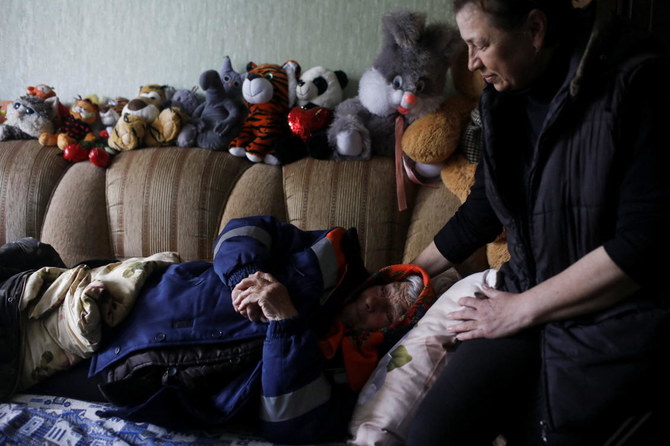
Inside Vera Filipova’s gloomy, grimy home, blackened pots litter the messy kitchen and rumpled comforters sit on unkempt beds.
“It’s like hell,” the 65-year-old retired shop clerk told Reuters. She lives with her friend Nataliya Parkamento, a former shoe factory worker who moved in after her own home was destroyed.
This block is largely intact — unlike many buildings in Slatyne, the Commune has escaped a direct hit from the nearby fighting of a Ukrainian counter-offensive that has driven Russian troops away from the city of Kharkiv over the last two weeks.
But Filipova and Parkamento only have enough humanitarian aid to eat once a day. They cook outside on an open fire of shattered wood they pull from other destroyed homes, shielding the flames from rain with corrugated cement sheeting blown off a roof.
“I have nowhere to go and nobody to take me out of here,” said Parkamento, who fetches drinking water in a plastic bottle from a nearby well.
Across the lot, where abandoned cats nose through the long grass and children once played around a set of rusting swings, the contrast in the conditions could not be more stark.
’WINDOWS ARE BEING SMASHED’
There, Larissa and the six other residents tend neat gardens of roses, peonies, carrots and spring onions. They wash with buckets of water drawn from Slatyne’s many wells. Laundry dries on lines outside their tidy apartments, beds draped with colorful covers, house plants growing in glassed-in balconies.
The conditions are just as challenging. “Windows are being smashed, walls are being destroyed and there is nothing we can do about it,” Larissa, 46, said. But she and the others in her block have tried to make the best of it.
The seven residents — none would give their last names – said they share the humanitarian aid delivered to the complex by volunteers from the nearby town of Dergachi, supplementing it with pickled vegetables stocked in a basement.
Alla, 52, who managed a subway station in Kharkiv, 28 km (17 miles) to the south down a remote, shell-blasted road, cooks for everyone in her kitchen on a stove powered by a gas bottle. When shellfire eases, she ventures out with her husband, Volodymyr, 57, a railway worker who acts as the block’s handyman, to an abandoned home to make meals on a brick grill.
No one in either of the blocks could say why their experiences were so different. “I don’t know,” Filipova responded when asked why she and Parkamento put up with their bleak living conditions.
When the war came, some just found the energy to organize and surmount the hardships together while others languished in despair.
“We’ve tried helping them,” said Anna, 66, a tenant of the second block who has lived for 19 years in the complex built in the early 1970s. “When the humanitarian aid deliveries arrive, we visit Vera and Nataliya to bring them their aid.”
She and some of the other residents said a key to their resilience was maintaining a strict routine, cooking enough food for two days of breakfasts and dinners, eating the former at noon and the latter at 4 pm.
’WE CARE FOR EACH OTHER’
In between, they said, they haul water, read, and tend their gardens and chat, sitting on sunny days at a makeshift table in the shadow of their block, trying to ignore frequent blasts and occasional far-off small arms fire.
“All of the people who have stayed here for the last three months are like family,” Anna said of her companions. “We have got close to each other. We care for each other.”
Gardening is especially calming.
“I love the soil,” said Alla, whose family hails from a farming village in a Russian-controlled area north of Slatyne. “My soul would ache if I could not plant anything in that earth. It distracts you. How is it not possible not to love your soil?”
For all the differences in how they cope, the war is ever present for the seven friends, Filipova and Parkamento, and Volodiya Stachuk, a 34-year-old tractor driver who lives in the basement of another block next to that of the two women.
None can forget being jarred awake the night that a Russian missile plunged into an adjacent house earlier this month.
The explosion blew out that building’s walls and roof, shattered many of the Commune’s windows and shredded Stachuk’s apartment with shrapnel, forcing him to move to his basement.
The blast also killed Filipova’s cat, Gina, she said, and left Alla with a memento of the exact moment of her brush with death.
“The explosion knocked a clock off my wall and broke it,” she recalled. “It stopped at 12:05 am.”