

‘We called her Roger Federer’: How Ons Jabeur made her mark in Tunisia

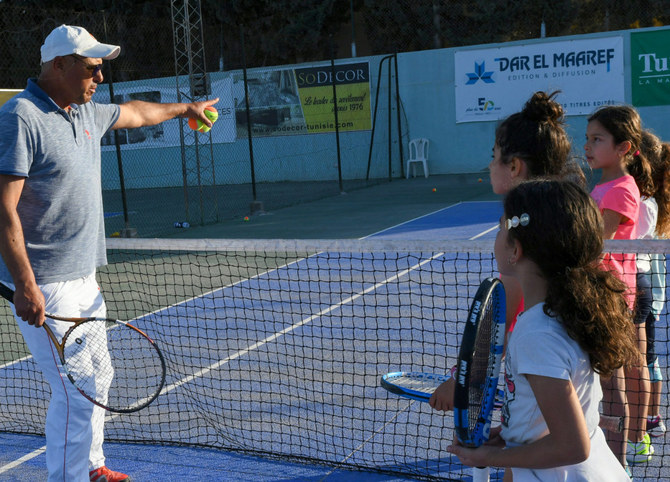
Tunisian tennis coach Nabil Mlika, who trained a young Ons Jabeur for 10 years, teaches students at the Hammam Sousse tennis club in the Mediterranean port city of Sousse on May 13, 2022.  (AFP)
Short Url
Updated 21 May 2022
Follow

‘We called her Roger Federer’: How Ons Jabeur made her mark in Tunisia

  • Jabeur, who hopes to win a maiden Grand Slam title at the French Open which starts in Paris on Sunday, started playing on courts belonging to local hotels
  • She has gone on to rise to sixth place in the global Women’s Tennis Association’s women’s singles rankings — the first Arab woman ever to reach the world top 10

HAMMAM SOUSSE, Tunisia: Fifteen years before Tunisia’s Ons Jabeur became the first Arab or African woman to win a top-flight tennis title, her adolescent sparring partner could see she was destined for glory even if he suffered a broken arm in the process.

Omar Laabidi remembers being repeatedly beaten by a 12-year-old Jabeur, who this month surged to victory at the Madrid Open at the age of 27 — the first WTA 1000 trophy of her career.

“We used to call her Roger Federer,” he said.

Laabidi was talking at the tennis club where it all began, in the North African country’s coastal town of Hammam Sousse.

“One time during a training match she hit a drop shot that I tried so hard to return that I broke my arm,” he said.

Jabeur, who hopes to win a maiden Grand Slam title at the French Open which starts in Paris on Sunday, started playing on courts belonging to local hotels.
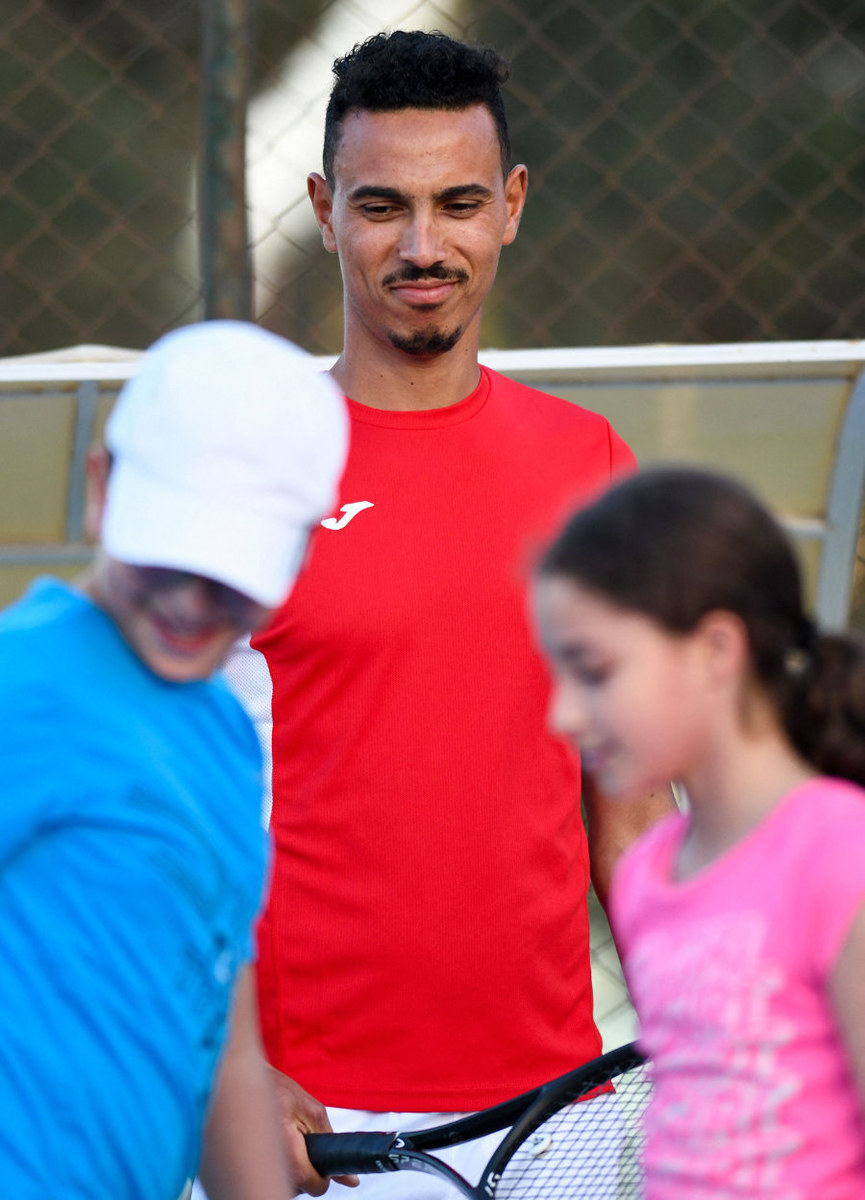


Omar Laabidi, the adolescent sparring partner of Ons Jabeur, teaches students at the Hammam Sousse tennis club in the Mediterranean port city of Sousse on May 13, 2022.  (AFP)

But she soon joined the Hammam Sousse Club, which now bears a huge portrait of its most famous graduate.

It was there that Nabil Mlika first trained a talented girl “determined to stand out” against both female and male peers.

But Mlika, who trained a young Jabeur for 10 years, said there was a moment where she almost quit the sport.

“She had great ball control, to the point where other coaches tried to attract her to handball,” said the 55-year-old.

“Ons thought seriously about switching sport — but decided to stick to tennis.”

She has gone on to rise to sixth place in the global Women’s Tennis Association’s women’s singles rankings — the first Arab woman ever to reach the world top 10.

She also reached the final of the Italian Open in mid-May, eventually won by world No. 1 Iga Swiatek.

Jabeur, known to many Tunisians as “the minister for happiness,” was born in the southern coastal town of Ksar Hellal, one of four siblings.

She moved to the capital Tunis at the age of 12 to train at a prestigious state-backed sports club.

She has been married to her physical trainer and former fencer, Karim Kammoun, since 2015.

The right-hander is known for her stamina and for constantly changing the pace of the match.

“She hates playing at one pace. She’s always trying to create a spectacle by switching up the game with shots that surprise her opponents, especially with drop shots,” said Mlika.

“She’s really the queen of the drop shot.”

Jabeur made her first entry to the global scene in 2011, winning the girls’ singles finals at the French Open at the age of 16.

Laabidi also moved to Tunis around the same time as the adolescent Jabeur and joined the same academy, where they continued sparring.

“She was always fun and quickly got to know strangers,” he said.

“But she was always provocative and competitively debating on all subjects.”

Those who knew her as a teenager say she has changed little despite her growing fame.

“She still runs around gathering up all the balls during training, which she’s been doing since she started playing,” said Mlika.

Unsurprisingly, as her fame has spiralled since 2018, subscriptions have skyrocketed at her home club from 320 to more than 700 students today.

For Yousra Koubaa, the mother of eight-year-old student Yasmine, Jabeur is “an example of hope, one we’re always showing to our children.”

Mlika says he uses photos of a young Jabeur to inspire his students today.

“She was a spark of enthusiasm, always moving and wanting to show that she was the best,” he said.

“She always put me in a difficult position because I had to balance between taking the training up a level, or waiting for her peers to catch up with her level and her pace.”


‘20 years of engagement’ — inaugural Formula 4 championship success signals bright future for motorsport in Saudi Arabia

Updated 03 February 2026
Follow

‘20 years of engagement’ — inaugural Formula 4 championship success signals bright future for motorsport in Saudi Arabia

  • Peter Thompson, founder of the Formula 4 Saudi Arabian Championship and Meritus.GP team principal, spoke about the Kingdom’s first motorsport academy and his hopes for the future

RIYADH: Last year welcomed the inaugural season of the FIA-certified Aramco Formula 4 Saudi Arabian Championship.

The series, which aims to provide the first step on the ladder towards Formula 1, was the culmination of years of collaboration between various investors and partners, led by the Kingdom’s first motorsport academy, Meritus.GP.

The championship’s mission?

To produce local driving talent, strengthen Saudi national race engineering capabilities and advance motorsport in alignment with the objectives of Saudi Vision 2030.

Five Saudi drivers emerged, with standout victories by Omar Al-Dereyaan and Faisal Al-Kabbani, both from Riyadh. Other graduates included race winner Oscar Wurz, who has since won the 2025 Central European Formula 4 Championship.

Arab News spoke with Peter Thompson, founder of Formula 4 Saudi Arabia and Meritus.GP, about the season’s success and his hopes for the future.

How did Meritus.GP build the Formula 4 Saudi Arabian Championship?

The Formula 4 Saudi Arabian Championship was the result of more than 20 years of engagement, exploration and groundwork in Saudi Arabia, in anticipation of a potential FIA-certified junior single-seater championship in the Kingdom.

Long before the first Formula 1 Saudi Arabian Grand Prix, we were on the ground exploring circuit development opportunities, assessing infrastructure readiness and evaluating whether Saudi Arabia could host a round of one of the Asian championships operated by the team. Throughout this period, we maintained long-standing relationships within Saudi motorsport circles including former Meritus.GP driver Raad Abduljawad and his brother Mohammed Abduljawad.

A defining moment came with the introduction of Formula 1 to Saudi Arabia. The Jeddah Corniche Circuit quickly became a visible symbol of this ambition, providing confidence that Saudi Arabia could support not only Formula One, but also a structured ladder of junior single-seater racing.

When did Meritus.GP receive formal institutional approval to begin Formula 4 Saudi Arabia?

More than three years of focused groundwork preceded the first race. During this period there was no formal government mandate, no guaranteed institutional backing and no commercial certainty that the project would proceed or be viable.

Then, in December 2022, a formal No-Objection Letter was issued by the Saudi Automobile and Motorcycle Federation, under the leadership of its then-CEO Sattam Al-Hozami, which allowed the project to progress from concept to reality.

Recognizing the benefits F4 would bring to the Kingdom, Mohammed Abduljawad became an investor in June 2023, and Formula 4 Saudi Arabia moved into full delivery mode.

What were the objectives of the proposal presented to Saudi Aramco?

The proposal positioned Aramco Formula 4 Saudi Arabia as a long-term national development platform aligned with Vision 2030.

Its objectives included creating a structured FIA driver pathway from grassroots to Formula One, as well as developing Saudi engineers, mechanics and officials in motorsports.

How did the championship support Saudi drivers, and what was the impact on local talent?

A core objective of Formula 4 Saudi Arabia was to create a genuine, fair and internationally credible environment in which Saudi racers could develop.

Saudi drivers competed alongside international peers under identical technical and sporting conditions, allowing performance and development to be measured objectively.

They ended up achieving race wins, podium finishes and measurable progress across the season, demonstrating that when provided with the right structure, Saudi talent can compete at international level. 

How has Formula 4 Saudi Arabia engaged with Saudi education and skills development?

Education and skills transfer formed an important part of the championship’s wider mission.

During the season, Meritus.GP engineers and senior staff visited Saudi education and research institutions such as KAUST, Alfaisal University, University of Tabuk and the Japanese College in Jeddah to discuss career pathways in motorsport engineering, data analysis, and systems integration. These engagements were designed to connect academic study with real-world high-performance engineering environments.

What level of investment was required and how did you ensure equality of performance?

Approximately $6.5 million was invested prior to the first event.

Was there any pre-season training to help Saudi drivers prepare?

During August and September 2023 Saudi drivers participated in a structured pre-season academy program at Meritus.GP’s training facility in Sepang, Malaysia.

What role did sports psychology and driver well-being play in the championship?

Driver well-being and mental performance were treated as integral components of driver development.

Formula 4 Saudi Arabia appointed a dedicated sports psychologist to support drivers throughout the season, focusing on mental preparation, confidence building, coping strategies, performance consistency and adaptation to high-pressure racing environments.