

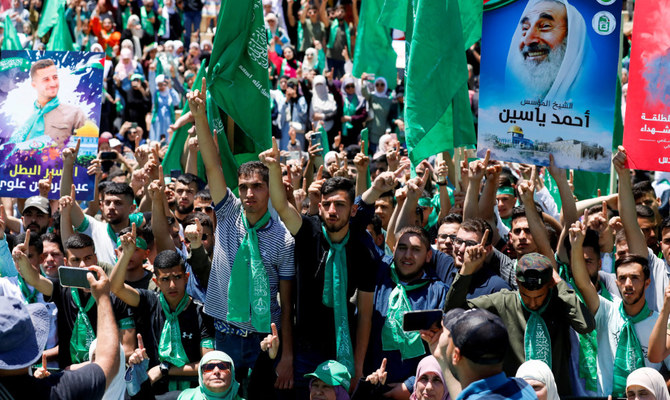
Outrage, shock among Fatah members over Birzeit University student election loss

Palestinians take part in a rally celebrating Hamas winning students council election in Birzeit University, near Ramallah, in the Israeli-occupied West Bank, May 19, 2022. (Reuters)
Short Url
Updated 19 May 2022
Follow

Outrage, shock among Fatah members over Birzeit University student election loss

  • Crushing defeat prompts calls for inquiry amid claims movement ‘is filled with mercenaries and intruders’
  • PA ‘leading us from defeat to defeat,’ says Fatah official after Hamas activist bloc takes control of student council

RAMALLAH: The crushing defeat of the Fatah-backed bloc in Birzeit University student council elections this week has caused shock and outrage among members and supporters of the movement, which is aligned with Palestinian President Mahmoud Abbas.

In the wake of the defeat, one of its heaviest, Fatah says it will form a committee to study the cause of the loss and draw lessons.

The Fatah bloc’s rivals, a Hamas-linked activist group, won a landslide victory in the poll at the flagship West Bank university on Wednesday, a result that some observers believe signals a possible shift in Palestinian public opinion.

The loss is believed to be Fatah’s biggest since its defeat by Hamas in the 2005 legislative elections. 

Fatah has led the Palestinian struggle since its launch in 1965 and formed the ruling party of the Palestinian Authority since its establishment in 1994.

However, the Fatah bloc gained the lowest number of votes and seats since the start of the university elections in 1996, prompting the head of the Fatah movement in Ramallah and Al-Bireh, Muwafaq Suhwail, to resign.

Other members of the Fatah leadership in Ramallah are expected to quit in coming days amid demands for an inquiry into the defeat.

Suhwail called for an investigation into the election result, claiming the movement was filled with “mercenaries and intruders.”

Hamas, meanwhile, said that its victory sends “a message to the Palestinian Authority that security coordination will not bring rights to the Palestinian people.”

The group said that the “broad support confirms that it has become a leader of the national project, and resistance has become the choice of the Palestinian people.”

The Fatah loss will discourage the PA from organizing legislative or presidential elections of any kind from now on. The last legislative elections were scheduled in early 2005.

Hamas’ Al-Wafaa’ Islamic bloc won the Birzeit University election by a large margin, claiming 28 seats on the student council, the first time its candidates have gained control of the body. The Fatah movement won just 18 seats.

Fatah is reportedly trying to distance itself from the PA.

However, the movement’s supporters blame the election loss on the authority’s mistakes, as well as its policies regarding Israel and Palestinian citizens.

In an online post, former Hamas minister Mohammed Al-Barghouti wrote: “It is no longer convincing at all to try to convince people, especially university students, that the Palestinian Authority is one thing and the Fatah movement is another, especially since the head of the Fatah movement — the president of the Palestinian Authority — and the head of the Palestine Liberation Organization is the same president.”

Al-Barghouti said that all the “negatives and misfortunes of the PA are borne and paid for by the Fatah movement.”

In return, he said “all the privileges and benefits of the PA go to a few beneficiaries, most of whom are not from the Fatah movement and have never been among its cadres.”

Fatah needs to take bold decisions and develop a well-thought-out structure if it wants to restore its image and build confidence, he said.

One of the leaders of the Fatah movement in the West Bank, Walid Assaf, a former head of the Wall and Settlement Resistance Commission, wrote: “When the successful are held accountable, and the failures are rewarded, the price will be heavy on Fatah and the national project.”

Ahmed Ghuneim, a prominent Fatah leader in East Jerusalem, told Arab News: “Fatah cannot continue in this way. It is time for a decisive and courageous decision to be taken to stop this collapse and that the central committee bears responsibility for the weakness of Fatah.”

He added: “We in Fatah are paying the price for the failed decisions in the political, governmental, organizational and economic performance of the Palestinian Authority and leadership. This leadership knows and realizes that it is a problem, but they insist that they remain in power and lead us from defeat to defeat.”

However, Lt. Gen. Jibril Rajoub, Fatah central committee secretary-general, told Arab News that a committee meeting on Saturday will review the defeat and take necessary decisions.

“Our experience with this leadership is that they do not assess any loss, and if that happens, they do not take measures but blame the lower levels of the movement for their mistakes.”

Nasser Al-Kidwa, the former Palestinian foreign minister dismissed from Fatah by Abbas after criticizing the PA leader’s policies, told Arab News from his home in France: “The votes that went to Hamas do not necessarily mean that they support its policy, but rather to punish Fatah, which deserves punishment because it has committed enough mistakes to turn Palestinian public opinion against it.”


Abu Ali Al-Hadrami: the shadowy figure who controlled Hadramaut, then vanished

Updated 5 sec ago
Follow

Abu Ali Al-Hadrami: the shadowy figure who controlled Hadramaut, then vanished

  • Uncovering the details behind his mysterious profile, and how he built a security force beyond state control

HADRAMAUT, Yemen: Throughout Hadramaut in Yemen, the mere mention of Abu Ali Al-Hadrami conjures images of secrecy and fear.

Some dubbed him “Hadramaut’s Qassem Soleimani,” though he preferred the alias Abu Mohammed. His true identity — Saleh bin Al-Sheikh Abu Bakr — remained hidden until roughly a year ago, a testament to a man who deliberately operated from the shadows.

Abu Ali Al-Hadrami emerged on Hadramaut’s landscape without warning, carrying no visible credentials or traceable past, cloaked in an impenetrable aura of mystery. His exit proved equally abrupt: he boarded an Emirati plane at Mukalla’s Al-Rayyan Airport without saying goodbye to anyone.

Once, he described himself — according to multiple witnesses — as “a world-class intelligence operative.” This self-characterization matched the impression he cultivated among those in his orbit.

BACKGROUND

Al-Hadrami practiced extreme operational security in every aspect. He avoided conventional phones and refused proximity to anyone during communications. When using Emirati communication lines, he insisted on complete privacy.

One former associate of Al-Hadrami who agreed to share unprecedented details about a figure whose name alone inspired widespread apprehension across the region emphasized that this man was accustomed to working in the shadows, specializing in leaving minimal footprints.

The source, speaking on condition of anonymity, characterized Al-Hadrami as “extraordinarily secretive, calculating, and ruthless — you could barely extract any personal information from him.”

He added: “His full name only surfaced about a year ago. We knew him solely as Abu Mohammed until individuals from Dhale arrived who recognized him from earlier encounters, and his interactions with them displayed unusual warmth.”

According to the source, Al-Hadrami practiced extreme operational security in every aspect. He avoided conventional phones and refused proximity to anyone during communications. When using Emirati communication lines, he insisted on complete privacy. “His secrecy extended even to family,” the source noted. “He once told us: ‘Even my relatives remain unaware of my whereabouts.’”

Al-Hadrami first surfaced in Hadramaut around 2022, when the Security Support Brigade was formed — a military unit operating under Emirati forces based at Al-Rayyan with a stated counterterrorism mandate.

According to the source, the brigade consisted of approximately 1,200 personnel, with Hadramaut locals representing about 90 percent of the force, though the elite strike units came from Dhale and surrounding provinces.

Al-Hadrami immediately implemented an iron-fisted management approach marked by severe discipline and unconventional regulations. Most notably, he completely prohibited khat chewing.

The source confirmed: “Anyone discovered with khat, even a single leaf, faced immediate dismissal and detention pending execution of the termination.” This policy drove away many who found the restrictions intolerable.

When asked about the “Hadramout’s Qassem Soleimani” moniker, the source replied: “Yes, we heard that label, along with ‘Abu Ali the ruler.’ His background remained unknown to us, and we were not even certain he was Hadrami. Many assumed he was Emirati, particularly given their use of cover names, and nothing about his demeanor or dialect suggested Hadramaut origins.”

Though publicly tasked with counterterrorism, the Security Support Brigade’s reputation within Hadramaut soon nosedived, as confirmed by the official with close ties to Al-Hadrami.

“Public perception of the Security Support forces turned predominantly negative,” the source explained, noting that several locals working with Emirati forces “seriously contemplated resignation due to the organization’s tarnished reputation.”

He added: “We eventually requested that the Emiratis moderate his tactics and adopt a gentler approach, but these appeals went ignored.” This indifference reflected the extensive latitude granted to him for managing security operations by his own methods, disregarding social or community concerns.

The source discloses that the Emiratis specifically sought Security Support Brigade recruits aged 18 to 24, “because molding young minds at that stage proves simpler.”

Among the stringent requirements was rejecting applicants with family members in “Shield of the Nation” forces. Al-Hadrami personally interviewed every candidate, never delegating this responsibility regardless of circumstances. “Even when Emiratis nominated someone for enrollment, he personally vetted them — either accepting or finding grounds for exclusion. He placed absolute trust in no one.”

The vetting process gained additional layers through a specialized Emirati officer dedicated to personality assessment who remained silent throughout, simply observing facial expressions and behavioral patterns.

According to the source, “acceptance rates barely reach 7 percent of total candidates,” noting that roughly 6,000 people underwent screening, with only about 300 ultimately selected.

According to the source, the Emirati forces in Hadramaut created a parallel structure comprising local intellectuals operating under the “External Projects” designation, reportedly numbering 19 academics who served as a civilian facade for developmental and service programs ostensibly planned for the region.

However, the source confirms these civilian initiatives never materialized, suggesting this entity existed primarily as camouflage for security operations rather than genuine development work. “In my assessment, this group was assembled to buy time, create appearances and exploit their credentials to demonstrate representation from diverse Hadramaut communities, without delivering tangible outcomes.”

This evaluation corresponds with earlier public statements by Sheikh Amr bin Habrish, first deputy governor of Hadramaut and commander of Hadramaut Protection Forces, who expressed to Asharq Al-Awsat his confusion over Al-Hadrami’s name appearing “from nowhere” without legitimate official standing, discussing development and stability while controlling the security landscape through command of unofficial forces.

He went further, suggesting these activities indicated “an agenda more extensive than visible,” confirming they “undermine southern interests and the broader southern cause.”

According to the source, Al-Hadrami maintained direct communication with Emirati committees while cultivating connections within Southern Transitional Council circles, including individuals close to council leadership such as Munif Al-Zubaidi, secretary to Aidarous Al-Zubaidi.

During one instance, the source recalled, Al-Hadrami revealed a statement encapsulating the persona he cultivated: “I am a world-class intelligence operative.” Those present interpreted this not as an inadvertent disclosure but as calculated confirmation of an identity he intended to establish — a veiled warning that what remained unsaid about him posed greater danger than what was known.

The source referenced substantial quantities of new motorcycles with unusual specifications warehoused inside Al-Rayyan Airport, formerly an Emirati military base, observing they were “entirely unlike motorcycles commonly seen on Mukalla streets.” He refrained from speculating about their purpose, offering only: “Maybe they were brought for service-related uses.” Local sources, however, view these motorcycles as preparation for a wave of assassinations to come in the governorate.”

The withdrawal unfolded not in one night but across several nights in Al-Mukalla, with Emirati forces and Southern Transitional Council units retreating as legitimate Yemeni government forces, backed by Saudi air support, advanced toward Seiyun and subsequently Al-Mukalla.

“The night Saudi Royal Air Force launched strikes against Emirati vehicles at Al-Mukalla port, Abu Ali Al-Hadrami vanished and failed to appear at his Al-Rayyan Airport office the following morning, though he returned that evening. He ate dinner, then left.”

The source continued: “We encountered him again entering the airport before boarding an Emirati aircraft. He offered no farewells or conversation with us — we were conducting equipment inventory. He exited the vehicle and proceeded to the terminal with a group, clearly departing, carrying a backpack and dressed in civilian attire.

“Subsequently, we observed Emiratis removing photographs from offices. They similarly withheld notification of their departure plans, and the night following Abu Ali Al-Hadrami’s exit, Abu Taher Al-Shuaibi, Southern Ground Forces commander, arrived and stated plainly: ‘I am in charge now.’”

The source described confusion over how Al-Shuaibi’s forces handled airport personnel at Al-Rayyan before Emirati forces withdrew, portraying the situation as severely disorganized and chaotic.

“If you questioned one of them, he would immediately discharge his weapon overhead as intimidation, and they branded anyone not following their directives a traitor,” he explained.

“Everyone moved about armed, some displaying signs of intoxication. We witnessed them loading weapons while facing each other, and during this period, vehicle thefts occurred within Al-Rayyan.”

According to his testimony, these hours reflected a total security breakdown where coherent command disappeared and armed force became an immediate danger to everyone present — the “most perilous” situation since events commenced.

According to the source, as the final Emirati aircraft departed Al-Rayyan, Al-Shuaibi’s forces began sealing gates and allocating vehicles, a process that rapidly devolved into heated conflicts over distribution procedures with the Command and Control Center operated by Faisal Badabis.

“Abu Taher and his contingent commandeered numerous vehicles. Approximately 200 vehicles were designated for their distribution, 20 for personnel inside the airport, and 47 for Faisal Badabis, head of the Command and Control Center.

“The confrontation erupted between them regarding this allocation, culminating in complete closure of all gates and access points.”