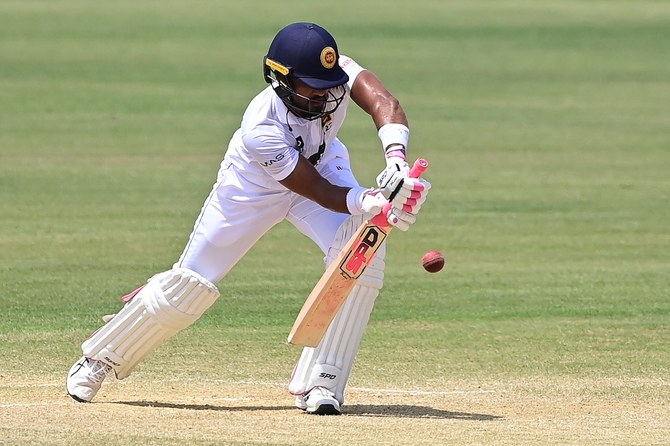

Throughout cricket, when the person batting has scored 50 runs, it is normally the cue for applause, the strength of which will be according to the manner and style of the innings. In former days of league cricket in northern England, when the professional reached 50, it was customary for a club official to go around the spectators with a box asking for small change to be proffered in recognition of the feat.
This is my 50th column for the Arab News. In recognition of this, I organized my own collection — that of recurring topics which have emerged during the compilation of these columns. Too many emerged to be discussed in one column. Hence, I will focus on those which have material implications for the future of the game.
Acting as a backdrop to the whole year has been the impact of COVID-19. It is easy to forget that, at this stage of 2021, preparations were being made in England for international matches to be staged at biosecure venues in front of a restricted number of spectators. This method of “keeping the show on the road” worked for a time, but players began to feel the pressure, leading to concerns for their mental well-being. These are now being taken more seriously.
Another lasting impact of the pandemic on cricket has been the way it has been forced to adapt its products and revenue streams. The Indian Premier League could not be played in India in March/April 2020. It was later switched to the UAE, taking place between mid-September and mid-November, thus preserving its media and sponsorship income streams. In 2021, the IPL began in India but was suspended halfway through, resuming in the UAE in September.
Apart from ensuring that the tournaments were completed, the switches also provided the UAE with enhanced exposure within the cricketing world.
This was further highlighted to a broader audience when the delayed men’s 2020 T20 World Cup, due to be hosted by India, was played in the UAE, plus Oman, in October/November 2021. Additional stimulus has been provided by positive performances from both men’s and women’s teams in the UAE and Oman, plus Bahrain, in World Cup qualifying 20 and 50-over competitions. All of this points to a real advance in competitiveness within these countries, on and off the field.
Emergence from the constraints imposed by the pandemic has led to an abundance of cricket in recent months, as tournaments, particularly ICC World Cup qualifiers, catch up on a backlog of fixtures.
Into this mix, new tournaments have been added or existing ones expanded. In 2021, The Hundred was introduced in England and Wales, a format played nowhere else in the world, designed to appeal to a younger spectator.
In the same year, a T20 minor League Cricket Championship was introduced in the US, consisting of 27 teams from four regions. This is a developmental league for the US major Cricket League, planned for six cities in 2023.
In 2022, the IPL was expanded from eight to 10 franchises, necessitating an extension in its duration. Within the last year, the direction of travel for cricket, in terms of a focus on the T20 format, has been reaffirmed, especially in emerging countries.
What has also been reaffirmed is the dominance of Australian cricket in both men’s and women’s cricket. This is based on its men’s team winning the T20 World Cup in November in the UAE, its crushing of England in the 2020/21 Ashes. The women’s team won the 50-over ODI World Cup in April, and beat England in a combined Test and short format series in January/February. For the time being, India’s bid to dominate has been halted in recent months, partly because of a hiatus caused by changes of coach and captain.
One of the most significant developments in the last 12 months has been the increased support for women’s cricket. This has taken the form of increased funding, increased audiences, both in person and on media channels and increased remuneration, although gender parity has not yet been reached. Most women’s cricket is played to the shorter formats and cricket’s authorities seem reluctant to increase the opportunities for women’s Test cricket.
It is in India where women’s cricket has the greatest latent potential, but the Board of Control for Cricket in India has been slow to provide the platforms for its realization. Even recently, it expressed the view that, at this stage, there is not enough depth in the women’s game in India to justify further investment. This has been accompanied by vague talk about a women’s IPL.
Despite the current president of the MCC being a woman, as well as holding the post of managing director of women’s cricket for the England and Wales Cricket Board, cricket remains a game dominated by male administrators.
By way of example, only one of the 18 professional county cricket clubs in England and Wales currently has a woman in the post of either chair or CEO. Somewhat bucking the fashion, one county had a woman in both positions in 2019. Neither are still in post. The chair, herself a woman of color, stepped down in November 2021, apparently saddened by the high-profile allegations of racism within the domestic game.
My column of Nov. 24, 2021 covered those revelations. They rocked cricket, especially in Britain, where inquiries, sackings and recriminations ensued.
These have died down, but the problem cannot have dissipated overnight. Out of the key recurring topics of the last year — coping with the impact of the pandemic, recognition of mental health issues, continuing growth of T20 competitions, surge in support for women’s cricket, limelight for the UAE and Oman, and Australia’s resurgence — racism is the most concerning one.
Work is underway within the game to counter its impact and bring about behavioral change. However, progress is not always obvious and needs monitoring. Time is required to educate and develop the willingness to change among those who remain in doubt.