

Teen machines: Alcaraz looks to join elite Grand Slam club at French Open

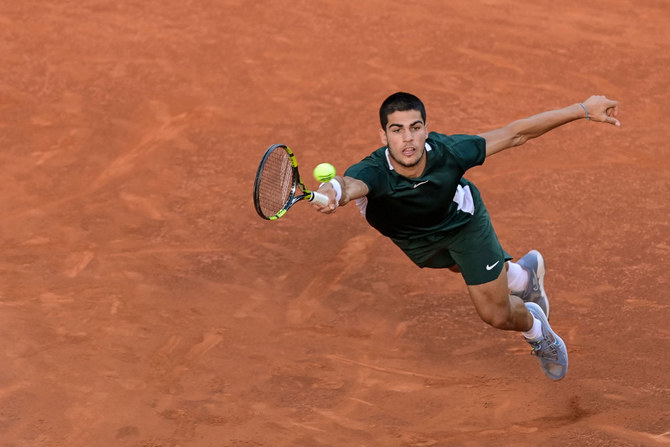
Spain's Carlos Alcaraz returns the ball to Germany's Alexander Zverev during their 2022 ATP Tour Madrid Open tennis tournament men's singles final match on May 8, 2022. (AFP)
Short Url
Updated 19 May 2022
Follow

Teen machines: Alcaraz looks to join elite Grand Slam club at French Open

  • Nadal was the last teenage man to win a Slam — a feat which eluded his great rivals Djokovic and Federer

PARIS: At just 19, Carlos Alcaraz is bidding to become only the eighth teenager to win a Grand Slam men’s singles title at the French Open which gets underway at Roland Garros on Sunday.

AFP Sport looks at the seven men to have won majors while still in their teens:

• In 1974, Sweden’s reluctant superstar Borg won the first of his six French Opens having just passed his 18th birthday when he defeated Manuel Orantes 2-6, 6-7, 6-0, 6-1, 6-1. Borg would win 11 majors, including five in a row at Wimbledon from 1976-1980 before retiring — for the first time — at 26. Borg was the first male tennis player to earn a million dollars in a season in 1979. “It’s tough when you’re No. 1. You don’t have any private life, you can’t even walk anywhere. I think that was one reason why I lost my motivation to play tennis,” said Borg when he quit.

• At 17, Sweden’s Wilander defeated Guillermo Vilas of Argentina 1-6, 7-6, 6-0, 6-4 in a marathon four hours and 42 minutes French Open final in 1982 despite being unseeded. Wilander was widely hailed for his sportsmanship in his defeat of Jose Luis Clerc in the semifinals when he requested a replay of match point after a forehand from his opponent was called long. Wilander would eventually become a world No. 1, ending his career with seven Grand Slam titles.

• Becker burst on the scene with his maiden Wimbledon triumph in 1985 at the age of 17. His 6-3, 6-7, 7-6, 6-4 win over Kevin Curren made him the tournament’s youngest men’s champion and its first unseeded victor. The German served and volleyed and dived right and left, enchanting the Center Court crowd. Becker would win six majors but he fell from grace last month when he was jailed in the UK after a bankruptcy trial.

• Sweden’s Edberg was 19 when he won his first Slam at the 1985 Australian Open, beating Wilander 6-4, 6-3, 6-3 having seen off Ivan Lendl in a marathon semifinal 6-7, 7-5, 6-1, 4-6, 9-7. The elegant serve-and-volleyer won a second Australian Open in 1987 and also captured four more Slams at Wimbledon in 1988 and 1990 and at the US Open in 1991 and 1992.

• Chang became the youngest male player in history to win a Grand Slam tournament when he claimed the 1989 French Open at 17 years and three months. Chang defeated Edberg 6-1, 3-6, 4-6, 6-4, 6-2 having also knocked out world No. 1 Lendl in a 4-hour and 37-minute last 16 tie in which he was cramping and forced to serve underarm. He was the first American champion in Paris since Tony Trabert in 1955. The diminutive Chang was also runner-up at the 1996 Australian and US Opens.

• Just a month past his 19th birthday, ‘Pistol Pete’ won the first of his 14 Slams at the 1990 US Open, beating American compatriot Andre Agassi 6-4, 6-3, 6-2 in the New York final having seen off Lendl and John McEnroe in the previous two rounds. Sampras ended his career with 64 titles, with a majors haul made up of seven at Wimbledon, two at the Australian Open and five US Open triumphs. His last major was in New York in 2002, bringing the curtain down with another victory against Agassi.

• At 19, Nadal defeated Mariano Puerta in the 2005 French Open final, 6-7, 6-3, 6-1, 7-5. It was his first major title and the first of a record 13 Roland Garros triumphs. The Spaniard, who now has 21 majors, won on his Paris debut, the first man to do so since Wilander in 1982. He was also the youngest champion since Chang in 1989. Interestingly, 2005 also saw the French Open debut of Novak Djokovic who made the second round where he retired against Guillermo Coria. Nadal was the last teenage man to win a Slam — a feat which eluded his great rivals Djokovic and Federer.


Former cricket captains urge Pakistan to ensure better medical care for Imran Khan in prison

Updated 10 sec ago
Follow

Former cricket captains urge Pakistan to ensure better medical care for Imran Khan in prison

  • In a letter to Prime Minister Shehbaz Sharif, 14 former captains, including India’s Sunil Gavaskar and Kapil Dev, called for Khan to be treated with “dignity and basic human consideration”
  • “The conditions of his imprisonment over the past two and a half years have caused us profound concern,” the cricketers wrote

ISLAMABAD: More than a dozen former international cricket captains have urged Pakistan’s government to ensure better treatment in prison and medical care for former cricketer-turned-politician Imran Khan, citing concerns about his eyesight, as his party demanded Wednesday he be shifted to hospital from prison.
In a letter to Prime Minister Shehbaz Sharif, 14 former captains, including India’s Sunil Gavaskar and Kapil Dev, called for Khan to be treated with “dignity and basic human consideration,” expressing concern about reports that the vision in his right eye had worsened in detention.
“Recent reports concerning his health — particularly the alarming deterioration of his vision while in custody — and the conditions of his imprisonment over the past two and a half years have caused us profound concern,” the cricketers wrote.
There was no immediate official response from Islamabad, but authorities have said that Khan is getting better facilities at the prison, a claim endorsed by Khan’s attorney Salman Safdar, who met with him recently.
Political allies of Khan and lawmakers from his opposition Pakistan Tehreek-e-Insaf party on Wednesday ended a dayslong sit-in outside parliament after doctors reported significant recovery in his right eye and no issues with his left.
Khan, 73, led Pakistan to the 1992 Cricket World Cup and later served as prime minister from 2018 until his ouster in 2022. He has been imprisoned since 2023 after he was convicted of graft and other offenses.
Khan, who has faced multiple trials since then, has said all the charges against him were politically motivated.
Concern about Khan’s health grew in late January after he was taken to hospital for eye treatment. Safdar, his lawyer, said last week that Khan had lost about 85 percent of the vision in his right eye.
Pakistan’s Interior Minister Mohsin Naqvi said a day earlier that such claims were “propaganda.” Other government officials, citing doctors who treated Khan, said the vision in his right eye had improved significantly, although Khan’s family and his personal physician say they can only confirm his condition once they are allowed to see him.
According to Australia’s The Age newspaper, signatories include former captains Ian Chappell, Clive Lloyd, Allan Border, Michael Brearley, David Gower, John Wright and Kim Hughes, among others who played against Khan. “Many of us competed against him, shared the field with him, or grew up idolizing his all-round brilliance, charisma and competitive spirit,” the letter said.
The group also urged Pakistan to allow “immediate, adequate and ongoing medical attention from qualified specialists of his choosing.”
Several former Pakistani cricketers, including Wasim Akram, Waqar Younis and Shoaib Akhtar, have also expressed concern publicly after former India batter Ajay Jadeja encouraged Pakistani players to speak out.
Khan made his international debut in 1971 against England and became captain in 1982. Widely regarded as one of cricket’s finest all-rounders, he retired soon after leading Pakistan to its only World Cup title in 1992. He founded the PTI party in 1996 and rose to power in 2018.
Khan was removed from office in April 2022 through a parliamentary no-confidence vote and later jailed after court convictions. He alleges his removal resulted from a US-backed conspiracy involving political rivals and Pakistan’s military, claims denied by Washington, the military and Prime Minister Sharif, who succeeded him.
Despite his imprisonment, Khan remains a central and influential figure in Pakistan’s politics.