

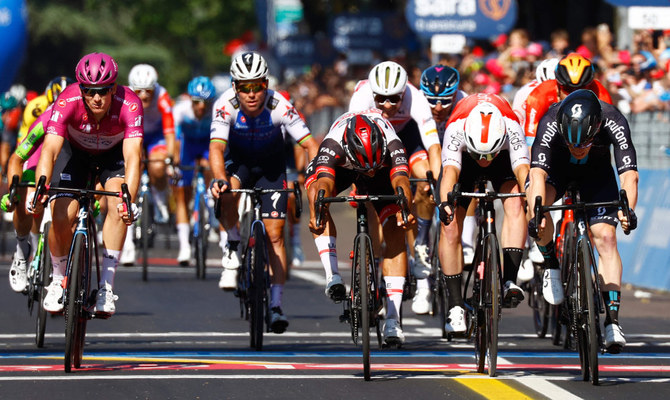


REGGIO EMILIA, ITALY: Alberto Dainese (DSM) became the first Italian winner in this year’s Giro d’Italia when he edged the sprint to take stage 11 in Reggio Emilia on Wednesday.
Dainese, 24, who had never previously won a stage in the Giro, beat the Colombian Fernando Gaviria in the dash for the finish. Another Italian Simone Consonni took third.
On the podium, the Italian was treated to the traditional giant bottle of prosecco, like his predecessors.
But significantly, the magnum had been uncorked as a precaution against a repeat of the accident that befell Biniam Girmay on Tuesday when he was injured in the left eye by the cork and subsequently ruled out of the race.
The Spaniard Juan Pedro Lopez (Trek) retained the leader’s pink jersey after a 203-kilometer stage which was relatively comfortable other than the heat and wind.
Ecuadorian Richard Carapaz, however, pocketed three bonus seconds in an intermediate sprint to climb two places into second, equal in time with the Portuguese Joao Almeida, 12 seconds behind Lopez.
“I saw Carapaz gained some time in an intermediate sprint but I’m not as fast as him. There was nothing I could do,” said Lopez who has been leading since the fourth stage.
“Anyway, I’m very happy to keep the pink jersey for at least one more day.”
Eritrean Girmay, who on Tuesday became the first black African to win a stage at the Giro, pulled out before the start following Tuesday’s cork accident.
Intermarche’s team doctor Piet Daneels said tests showed “hemorrhage in the anterior chamber of the left eye.”
With temperatures hitting 30 degrees, the peloton largely stuck together apart from one wishful breakaway by Luca Rastelli and Filippo Tagliani which was reeled in just after halfway.
Belgian Dries De Bondt embarked on a solo raid 58 kilometers from the finish, which ended just 1,300 meters from the line.
In the sprint, French rider Arnaud Demare, who already has two stage wins to his name in this Giro, attacked from deep.
He was hunted down by Gaviria before Dainese, taking full advantage of the slipstream, came through to take the third victory of his career.
Last year, he finished second in a Vuelta stage, behind Dutchman Fabio Jakobsen.
The peloton faces its longest day in the saddle on Thursday with a mountainous 12th stage of 204 kilometers which crosses the Apennines from Parma to Genoa.


