

South Asia pummelled by heatwave that hits 50C in Pakistan

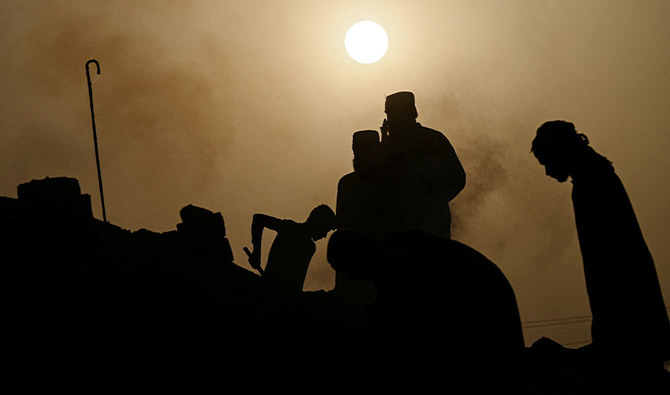
In this picture taken on May 12, 2022, labourers are silhouetted against the sun as they work at a brick kiln factory on a hot summer day during a heatwave in Jacobabad, in southern Sindh province. (AFP)
Short Url
Updated 14 May 2022
Follow

South Asia pummelled by heatwave that hits 50C in Pakistan

  • Officials warned of acute water shortages and a threat to health
  • Climate minister warned residents of Lahore “to take cover for the hottest hours of the day“

JACOBABAD: South Asia was in the grip of an extreme heatwave on Friday, with parts of Pakistan reaching a temperature of 50 degrees Celsius as officials warned of acute water shortages and a health threat.

Swathes of Pakistan and neighboring India have been smothered by high temperatures since April in extreme weather that the World Meteorological Organization has warned is consistent with climate change.
On Friday, the city of Jacobabad in Sindh province hit 50C (122 degrees Fahrenheit), the Pakistan Meteorological Department (PMD) said, with temperatures forecast to remain high until Sunday.
“It’s like fire burning all around,” said laborer Shafi Mohammad, who is from a village on the outskirts of Jacobabad where residents struggle to find reliable access to drinking water.
Nationwide, the PMD alerted temperatures were between 6C and 9C above normal, with the capital Islamabad — as well as provincial hubs Karachi, Lahore and Peshawar — recording temperatures around 40C on Friday.
“This year we have jumped from winter right into summer,” said PMD chief forecaster Zaheer Ahmad Babar.
Pakistan has endured heightened heatwaves since 2015, he said, especially in upper Sindh province and southern Punjab province.
“The intensity is increasing, and the duration is increasing, and the frequency is increasing,” he told AFP.
Jacobabad nurse Bashir Ahmed says that, for the past six years, heatstroke cases in the city have been diagnosed earlier in the year — starting in May, rather than June or July.
“This is just increasing,” he said.
Far worse may be on the horizon for South Asia as climate change continues apace, top climate scientists have said.

Punjab province irrigation spokesman Adnan Hassan said the Indus river — Pakistan’s key waterway — had shrunk by 65 percent “due to a lack of rains and snow” this year.
Sheep have reportedly died from heatstroke and dehydration in the Cholistan Desert of Punjab — Pakistan’s most populous province, which also serves as the national breadbasket.
“There is a real danger of a shortfall in food and crop supply this year in the country should the water shortage persist,” Hassan said.
Pakistan’s climate minister Sherry Rehman this week warned residents in the megacity of Lahore “to take cover for the hottest hours of the day.”
The heatwave has also ravaged India, with temperatures in parts of Rajasthan hitting 48.1C on Thursday and expected to hit 46C in Delhi anytime from Sunday.
Suman Kumari, 19, a student who lives in northwest Delhi, told AFP: “It was so hot today that I felt exhausted and sick while returning from college in a bus. The bus seemed like an oven. With no air conditioning, it was sizzling hot inside,” she said.
Most schools have declared summer holidays from Monday for junior classes.
Heatwaves were also predicted in parts of northwest India including areas of Rajasthan, Madhya Pradesh, Maharashtra and Uttar Pradesh — collectively home to hundreds of millions of people — over the coming days.
But some respite is expected when the southwest monsoon makes its advance into the Andaman Sea and adjoining Bay of Bengal around May 15, said the India Meteorological Department.
As power outages exacerbate heatwaves, India plans to lease abandoned coal pits to private mining companies, a government official said on Friday, in an effort to ramp up production.
Pakistan has also faced severe power outages, with some rural areas getting as few as six hours of electricity a day.

Home to 220 million — Pakistan says it is responsible for less than one percent of global greenhouse gas emissions.
But it ranks as the nation eighth most affected by extreme weather events, according to a 2021 study by environmental group Germanwatch.
Extreme heat can also trigger cascading disasters that could pummel Pakistan’s generally impoverished population.
The mountainous portions of the country are home to more than 7,000 glaciers, a number larger than any region outside the poles.
Quickly melting glaciers can swell lakes, which then burst their banks and unleash torrents of ice, rock and water in events known as glacial lake outburst floods.
Last weekend a key highway bridge in the Gilgit-Baltistan region was swept away in flash flooding caused by glacier melt.
In April, officials warned there were 33 lakes in Pakistan in danger of unleashing similar dangerous deluges. 


India’s Bollywood bets big on ‘event cinema’

Updated 6 sec ago
Follow

India’s Bollywood bets big on ‘event cinema’

  • Films centered on geopolitical conflict, internal enemies, masculinity now dominate mainstream Hindi cinema
  • Critics argue Bollywood is using cinema’s unrivalled mass reach to shape the public sentiment in India 

MUMBAI: India’s Bollywood is moving decisively toward a cinema of scale and confrontation — where patriotism, spectacle, and ideological clarity increasingly trump nuance and narrative risk, industry insiders say.

The shift has fueled what experts describe as “event cinema,” as studios rely on big-budget spectacles and top-tier stars to lure audiences — especially smartphone-loving Gen Z viewers — back into theaters.

That strategy appears to be working. Akshaye Rathi, a prominent film exhibitor, predicted a 45-50 percent rise in net Hindi box-office collections and a 25 percent increase in young theater-goers this year.

“The year looks poised for historic numbers,” Rathi told AFP.

The industry’s financial model was shaken during the Covid-19 pandemic, which coincided with the rapid rise of streaming platforms and a shift to home viewing.

But its 2026 upcoming slate, packed with patriotic war dramas, spy thrillers, mythological epics and nationalist narratives — reflects not just a commercial recalibration, analysts say, but a broader change in creative priorities.

‘PROPAGANDA’

Critics argue Bollywood is increasingly producing polarizing films aligned with the ideology of Prime Minister Narendra Modi’s Hindu-nationalist government, using cinema’s unrivalled mass reach to shape public sentiment.

“These days film themes also depend upon who is ruling at the center — Hindu wave, propaganda... all these are big factors that filmmakers cash in on,” said movie business analyst Atul Mohan, editor of film trade magazine Complete Cinema. “But only one or two films work, not all 10 or 15.”

He cited the success of 2022 blockbuster “The Kashmir Files,” depicting in harrowing detail how several hundred thousand Hindus fled Muslim militants in Indian-administered Kashmir in 1989-90.

And he compared that with the 2025 film “The Bengal Files,” on alleged political violence in eastern India, which he described as a commercial “disaster.”

Films centered on geopolitical conflict, internal enemies, and heroic masculinity now dominate mainstream Hindi cinema, reflecting both the political mood and the economics of theatrical survival.

Last year’s gory action thriller “Dhurandhar,” meaning “formidable,” leaned heavily on hyper-nationalist tropes of Indian agents confronting Pakistan-linked foes, and became one of 2025’s highest-grossing films — following a real-life four-day border clash with Pakistan.

Its sequel, “Dhurandhar 2,” again starring Ranveer Singh, is set for release in March.

‘GRATUITIOUS VIOLENCE’

Veteran Delhi-based film critic Arnab Banerjee said political messaging now outweighs craftsmanship.

“It is not the quality of the film that matters today, it is propaganda films that are working,” said Banerjee.

“The mood of the nation is such that people are lapping up these subjects. Pakistan-bashing and references to enemy countries are being accepted without questioning.”

Banerjee also criticized what he called an excess of “gratuitous violence,” arguing that “it is social media hype that is deciding the film’s fate.”

He pointed to “Ikkis,” a film on the 1971 India-Pakistan war released in January, which struggled commercially despite positive reviews.

“It is a well-made film, but it didn’t work,” he said. “Perhaps because Pakistan is not shown as the enemy.”

Director Ahmed Khan, however, said quality still ultimately determines success, citing his upcoming action-comedy “Welcome to the Jungle,” starring Akshay Kumar.

“Whatever the genre — action, drama, comedy or horror — it depends on how well you’ve made it,” Khan said.

He pointed to the 2025 successes of the contrasting romantic drama “Saiyaara” as well as high-octane “Dhurandhar.”

“Both, poles apart in genre, did great business,” he said. “People’s mood can change any time.”