

Iranians protest over government price hikes

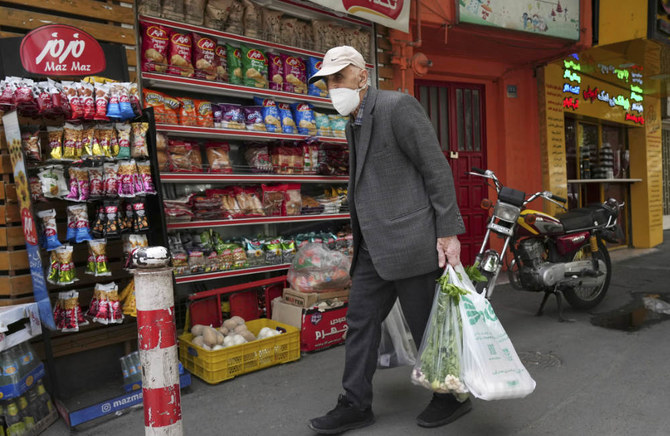
An elderly man carries his shopping in front of a grocery store in Tehran, Iran, Wednesday, May 11, 2022. (AP)
Short Url
Updated 14 May 2022
Follow

Iranians protest over government price hikes

  • To mitigate the impact of the price increases, Raisi said monthly payments of between $10 and $13 would be disbursed for each family member of low-income households

TEHRAN: Hundreds of people have taken to the streets in cities across Iran to protest the government’s decision to raise the prices of essential goods, state media reported on Friday.
Earlier this week, President Ebrahim Raisi announced a series of measures to tackle the country’s economic woes, including changing a subsidy system and increasing the prices of several staples including cooking oil, chicken and eggs.
Iran’s economy has suffered under stringent sanctions reimposed by the US after it unilaterally pulled out of a deal with world powers on Iran’s nuclear program in 2018.
Official figures put inflation at around 40 percent.
Iranians reacted to the move — which took effect on Friday — with protests in several cities over the past two days, state news agency IRNA reported.

BACKGROUND

Iran’s economic woes have sparked several waves of protests in recent years, most notably in November 2019 following an unannounced hike in fuel prices.

More than 20 people were arrested in the southwestern cities of Dezful and Yasuj, where protesters called on authorities to reverse their decisions.
Demonstrators in the southern city of Izeh attacked shops and tried to set fire to a mosque, the news agency said.
Protests broke out soon after Raisi’s announcement late Monday of changes to the subsidy system introduced by his predecessor Hasan Rouhani in 2018, which covered several basic goods.
But he pledged that the prices of bread, petrol and medicines would remain unchanged.
To mitigate the impact of the price increases, Raisi said monthly payments of between $10 and $13 would be disbursed for each family member of low-income households.
But for some residents of Tehran, the allowance won’t do much.
Azadeh, a 43 year old housewife, said the changes were “horrible.”
“The new prices have limited my family’s purchasing power for everything ... prices of food items, fruits and other consumables have risen,” she said in the north of the capital.
The price of cooking oil has almost quadrupled since Raisi’s announcement, while the price of eggs and chicken nearly doubled.
Mohammad, a 40-year-old private sector employee, said prices were rising “by the hour.”
“How can people live like this?” he asked.
Following Raisi’s announcement, people rushed to supermarkets to stock up on goods, videos shared on social media and footage broadcast on state television showed.
The president visited one of the main meat and poultry distribution centers in south Tehran and a supermarket in the city center, his website said.
First Vice President Mohammed Mokhber stressed that rising prices were a global problem not limited to Iran.
“Prices in the world have changed ... the situation in the region has created problems in the prices of products and the prices of basic goods were set accordingly,” IRNA quoted him as saying.
Iran’s economic woes have sparked several waves of protests in recent years, most notably in November 2019 following an unannounced hike in fuel prices.
Iranian authorities said 230 people were killed in protest-related violence but experts working for the United Nations put the death toll at 400.     


Gaza’s ceasefire had some momentum. Now, some fear a new war will distract the world

Updated 7 sec ago
Follow

Gaza’s ceasefire had some momentum. Now, some fear a new war will distract the world

  • Residents say they are scared of neglect and deprivation, with Israel in the wake of the weekend strikes closing all crossings into their shattered territory of over 2 million people

DEIR AL-BALAH, Gaza Strip: Some Palestinians say they fear the widening war sparked by US and Israeli attacks against Iran could overshadow the fragile situation in Gaza, just over a week after US President Donald Trump rallied billions of dollars in pledges for the territory’s reconstruction and tried to nudge a ceasefire forward.
Residents say they are scared of neglect and deprivation, with Israel in the wake of the weekend strikes closing all crossings into their shattered territory of over 2 million people.
Palestinians told The Associated Press they were rushing to markets, haunted by memories of painful food scarcity last year under months of Israel’s blockade. Part of Gaza, around Gaza City, was found to be in famine.
“When the crossings shut down, everything was suspended from the market,” said Osamda Hanoda from Khan Younis. “The prices go up, and people live in misery.”
Reports show prices of goods rising sharply
The shaky Israel-Hamas ceasefire had led to more humanitarian aid and other supplies entering Gaza, even as the United Nations and aid partners say more of everything from basic medical supplies to fuel is needed.
Now, Palestinians are hoarding again, with reports of prices rising sharply for basic goods such as bags of flour.
“We are afraid of not finding milk” and diapers for the kids, or food and water, said Hassan Zanoun, who was displaced from Rafah.
COGAT, the Israeli military body overseeing civilian affairs in Gaza, did not respond to a request for comment Sunday. In its announcement of the closings, it asserted that the food supply inside the territory “is expected to suffice for an extended period.” It added that the rotation of humanitarian workers in and out of Gaza is postponed.
It was not clear when any crossing might reopen. Israeli authorities focused on Iran, and citizens dashed repeatedly for shelter as sirens wailed.
Ramadan is disrupted
The war in Gaza began with the Hamas-led attack on Israel on Oct. 7, 2023, and it’s been marked from the start by restrictions on people and supplies being allowed into the territory — and terrified people, including medical evacuees in need of treatment, getting out.
A month ago, Gaza’s main Rafah border crossing with the outside world — its only crossing not with Israel — reopened, allowing a small and tightly controlled flow of Palestinian traffic in both directions. No cargo was allowed through.
Now all crossings are closed again in the middle of the holy Muslim fasting month of Ramadan, a time of chosen deprivation, evening feasts and prayer. Images have shown Palestinians lined up at long tables in the middle of bombed-out debris.
The strikes on Iran shook that routine.
“All the people rushed to markets, and they all wanted to shop and hide,” said Abeer Awwad, who was displaced from Gaza City, as word of the explosions in Tehran began to spread.
Under the Oct. 10 US-brokered ceasefire, the heaviest fighting has subsided, though regular Israeli fire continues in Gaza. The UN World Food Program has noted progress in the enclave but said in its latest food security analysis last week that hunger remains.
“Households reported an average of two meals per day in February 2026, compared to one meal in July,” it said. “Still, one in five households consumed only one meal daily.”
A challenge for aid groups and others
Refocusing the world’s attention on Gaza is a challenge for aid groups and others as Iran scrambles for new leadership and explosions continue in Tehran, Israel and around the Middle East.
Trump has said bombing in Iran could continue through the week or longer, and warned Tehran of “A FORCE THAT HAS NEVER BEEN SEEN BEFORE!” if it escalates attacks.
It’s a dramatic turn from Trump’s launch less than two weeks ago of his new Board of Peace, a gathering of world leaders that is aimed at ending the war in Gaza but has ambitions of resolving conflicts elsewhere.
Even with that bump in momentum on Gaza, major challenges remain for the ceasefire. They include disarming Hamas, assembling and deploying an international stabilization force, and getting a newly appointed Palestinian committee meant to govern Gaza into the territory.
As the Middle East turns to another war, some Palestinians see a benefit: Israel’s military is distracted.
“The good thing is that the sound of booms and demolitions is rare now near the yellow line,” said Ahmed Abu Jahl, of Gaza City, speaking about the line dividing Gaza and marking out roughly half the territory controlled by Israeli forces.
“Even the drones, they are still flying overhead, but their number has gone down.”