

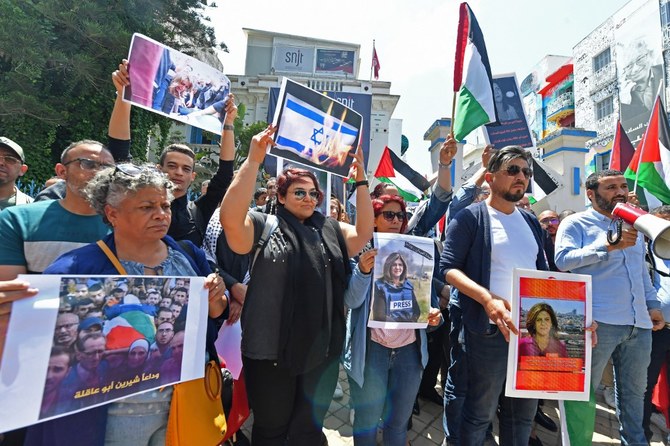

LONDON: Arab journalists paid tribute on Wednesday to Al Jazeera reporter Shireen Abu Akleh who was shot and killed — which they blamed on Israeli gunfire — while covering developments in the West Bank.
Heartwarming and angry tributes flooded social media platforms with colleagues, journalists and admirers of Abu Akleh expressing their sadness over the Palestinian broadcaster’s death.
Linah Alsaafin, producer at Al Jazeera English, wrote: “My god. What news to wake up to. Veteren (sic) Al Jazeera Arabic reporter @ShireenNasri has been killed by Israeli forces while covering a raid into Jenin refugee camp in the occupied West Bank. We grew up watching Shireen on TV. Total shock.”
My god. What news to wake up to. Veteren Al Jazeera Arabic reporter @ShireenNasri has been killed by Israeli forces while covering a raid into Jenin refugee camp in the occupied West Bank.
We grew up watching Shireen on TV. Total shock. pic.twitter.com/HclRU1xvxO
— لينة (@LinahAlsaafin) May 11, 2022
Similarly, Arwa Ibrahim, another colleague of Abu Akleh at Al Jazeera, tweeted how she listened to her reports growing up and said she was devastated by the news.
“I grew up listening to Shireen Abu Akleh’s brave voice on Palestine & became privileged to work alongside her while reporting from Jerusalem & the occupied West Bank. Shireen was shot dead by Israeli police while doing her job — reporting. This news tears into all of us,” Ibrahim tweeted.
I grew up listening to Shireen Abu Akleh’s brave voice on Palestine & became privileged to work alongside her while reporting from Jerusalem & the occupied West Bank. Shireen was shot dead by Israeli police while doing her job - reporting. This news tears into all of us. pic.twitter.com/8FVqrfKO4V
— Arwa Ibrahim (@arwaib) May 11, 2022
Dima Khatib, managing director of AJ+, praised Abu Akleh for her bravery and pioneering career in war reporting, tweeting: “Shireen Abu Akleh was one of the first Arab women war correspondents in the late 1990s, when the traditional role of women on television was to present from the studio.”
“Shireen was one of the pioneers of the generation that broke the stereotypical gender roles in television journalism. Her bravery has always been a huge inspiration to all of us.”
شيرين أبو عاقلة كانت من أوائل النساء العربيات مراسلات الحرب في أواخر التسعينيات حين كان دور المرأة التقليدي في التلفزيون هو التقديم من الأستوديو. شيرين كانت من طلائع الجيل الذي كسر نمطية الأدوار الجندرية في مهنة الصحافة التلفزيونية. كانت شجاعتها دائماً مصدر إلهام كبير لنا كلنا pic.twitter.com/9bfJLV5p2d
— Dima Khatib (@Dima_Khatib) May 11, 2022
The 51-year-old was shot and killed on Wednesday morning.
She was a veteran reporter on the Israeli-Palestinian conflict for Al Jazeera, and highly renowned across the Arab world as an authoritative voice on the region’s most contested story.
Abu Akleh had worked with UNRWA, Voice of Palestine Radio, Amman Satellite Channel, the Miftah Foundation and Monte Carlo Radio before joining Al Jazeera.
In a statement, Al Jazeera blamed Israel and said the occupation forces “deliberately” targeted and killed Abu Akleh. Meanwhile, Israel’s military said it was looking into the possibility she was hit by “Palestinian gunmen.”
Abu Akleh was wearing a helmet and a bulletproof vest, with “press” clearly written on it, when she was shot.
Salman Andary, a senior news reporter at Sky News Arabia, mourned Abu Akleh’s death in a tweet. “Targeting and assassinating colleague Shireen Abu Akleh in this way only indicates fear of the journalist’s voice and message and that no protective vest can deter the cowardly killers.”
“Shireen, the bride of Palestine and a colleague who we all grew up with her voice, messages and reports.. It’s a black, sad and terrifying day.. #Shireen_Abu_Akleh,” he added.
استهداف الزميلة شيرين ابو عاقله واغتيالها بهذه الطريقة لا يدل الا على الخوف من صوت الصحفي ورسالته. وان لا سترة حماية يمكن ان تردع القاتل الجبان. شيرين عروسة فلسطين. وزميلة كبرنا على صوتها ورسائلها وتقاريرها.. انه يوم اسود وحزين ومرعب.. #شيرين_ابو_عاقله
— Salman Andary (@salmanonline) May 11, 2022
Lebanese journalist, Luna Safwan, joined the ranks in expressing her sadness over the journalist’s death, praising Abu Akleh for her tremendous inspiration.
Expressing how much of a loss this is, it's just beyond words. I grew up watching Shireen's coverage on TV. I learned about Palestine and the occupation through her coverage. Such an inspiring woman.https://t.co/DSgznemDsz via @AJEnglish
— Luna Safwan - لونا صفوان (@LunaSafwan) May 11, 2022
“Shocking and devastating” wrote Kim Ghattas, a contributing writer for The Atlantic while adding the hashtag #JournalismIsNotACrime to her mourning tweet.
“Shireen was an icon, a veteran, fearless and calm. Her colleagues described her being targeted by sniper fire even though she was wearing her press vest, and a helmet. She was hit below the helmet just behind the ear.”
Shocking and devastating. Shireen was an icon, a veteran, fearless and calm. Her colleagues described her being targeted by sniper fire even through she was wearing her press vest, and a helmet. She was hit below the helmet just behind the ear. #JournalismIsNotACrime https://t.co/XCGTB332R7
— Kim Ghattas (@KimGhattas) May 11, 2022
Meanwhile, Joyce Karam, senior correspondent at The National, wrote a tribute to Abu Akleh and proceeded to report in detail on the latest developments surrounding her killing.
Horrible news: Al-Jazeera senior journalist Shireen Abu Aqleh @ShireenNasri shot dead by Israeli forces while covering a raid in Jenin (West Bank) today. Veteran reporter, covered conflict for >15 years pic.twitter.com/nyPbOCwj19
— Joyce Karam (@Joyce_Karam) May 11, 2022
BBC journalist, Rushdi Abualouf, wrote: “Shocking news, our colleague Al #Jazeera’s long-time senior correspondent in #Palestinian territories Shireen Abu (Akleh) was shot with a bullet in the head during an Israeli operation in Jenin refugee camp. RIP.”
Shocking news,our colleague Al #Jazeera’s long-time senior correspondent in #Palestinian territories Shireen Abu Aqleh was shot with a bullet in the head during an Israeli operation in Jenin refugee camp . RIP pic.twitter.com/5h8FnfZaar
— Rushdi Abualouf (@Rushdibbc) May 11, 2022


