

Pakistan’s currency hits historic low as dollar crosses Rs190 in interbank market

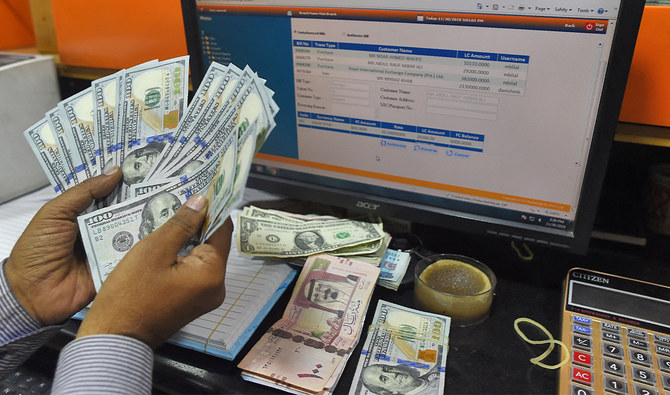
A Pakistani dealer counts US dollars at a currency exchange shop in Karachi, Pakistan, on November 30, 2018. (AFP/File)
Short Url
Updated 11 May 2022
Follow

Pakistan’s currency hits historic low as dollar crosses Rs190 in interbank market

  • The rupee depreciated by 0.72 percent before closing at Rs190.02 on Wednesday
  • Experts say the currency is under pressure due to lack of clarity on IMF program

ISLAMABAD: Pakistan’s national currency depreciated further against the US dollar on Wednesday, crossing Rs190 amid increasing demand for import payments coupled with growing economic and political uncertainty at home.
The country’s finance minister Miftah Ismail held meetings with International Monetary Fund (IMF) officials in April for the resumption of a $6 billion loan program to secure external financing.
However, the government has yet to decide if it wants to meet all the IMF conditions, including the reversal of fuel subsidies, to secure the next tranche of about $1 billion.
According to the State Bank of Pakistan (SBP), the rupee depreciated by 0.72 percent, or Rs1.36, in the inter-bank market on Wednesday, closing at Rs190.02 against the US dollar.

“Lack of clarity on IMF front and increasing demand for dollar for import payments amid dwindling forex reserves continue to exert pressure on Pakistani rupee,” Samiullah Tariq, research director at the Pakistan-Kuwait Investment Company, told Arab News on Tuesday.
Pakistan’s foreign exchange reserves declined to $10.499 billion due to external debt payments during the week ending on April 30, according to the central bank.
The country’s new administration has also sought financial assistance from friendly nations in recent weeks, though it has not managed to secure the required funding amid the prevailing economic situation.


Pakistan bank enables Shariah-compliant digital payment facility for passengers at Islamabad airport

Updated 23 February 2026
Follow

Pakistan bank enables Shariah-compliant digital payment facility for passengers at Islamabad airport

  • Pakistan is a cash-dominated market where a significant portion of transactions in the informal sector are made without any taxes, officials say
  • The move comes amid Pakistan’s efforts to introduce a cashless model at airports under which only digital service providers can provide services

KARACHI: Aik, Pakistan’s first Islamic digital bank, has enabled fully digital payments at Islamabad International Airport to offer travelers and passengers secure, Shariah compliant digital transaction facility.

The development comes amid Pakistan’s efforts to introduce a cashless model at airports across the country, under which only digital service providers can provide services to customers.

Aik, a subsidiary of Bank Islami, said it has onboarded merchants across the Islamabad airport and integrated QR code deployments at key touchpoints to allow passengers and visitors to make secure, seamless, and Shariah-compliant digital transactions at all counters, retail outlets, and service points.

It said the implementation complies with the regulations and framework set by the State Bank of Pakistan (SBP) and is a working model for a large-scale adoption of cashless systems in public infrastructure.

“This deployment reflects our commitment to building practical digital infrastructure that improves everyday transactions,” Aik Chief Officer Ashfaque Ahmed said in a statement.

“By enabling a fully cashless environment at a major national gateway, we are supporting efficiency, transparency, and financial inclusion at scale. This is not only a project; it is a foundation for Pakistan’s cashless future.”

Pakistan is a cash-dominated market where a significant portion of transactions, particularly in the informal sector, are conducted in cash. Officials say many of these transactions are aimed at avoiding taxes.

In recent years, the SBP has taken steps to ensure a transition toward a more cashless economy so that transactions are more traceable, reducing chances of tax evasion and corruption.

By digitizing Islamabad airport, aik said it continues to invest in secure and accessible financial solutions that “expand digital participation and support national economic modernization.”