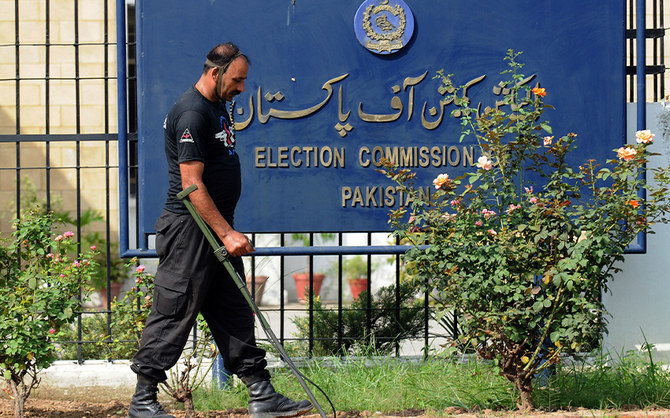
ISLAMABAD: The Election Commission of Pakistan (ECP) on Wednesday dismissed references filed by former prime minister Imran Khan’s party, the Pakistan Tehreek-e-Insaf (PTI), seeking the disqualification of dissident legislators who had failed to support Khan in a vote of no confidence last month that saw him ousted from office.
Khan lost the crucial vote in the National Assembly on April 10 after over 20 PTI lawmakers and as well as legislators from coalition partners of his government refused to support him. Khan ceased to be the PM and Shehbaz Sharif was elected as the new premier.
The PTI subsequently filed references against the dissidents seeking their disqualifications from the National Assembly under Article 63-A of the constitution.
In its short verdict on Tuesday, the ECP “unanimously said the declaration filed against the MNAs was not found in accordance with the Constitution of Pakistan.”
Imran Khan’s close aide and former information minister Chaudhry Fawad Hussain said the party would challenge the ECP verdict in the Supreme Court.
“Will we file a reference against the Election Commissioner in the Supreme Judicial Council as Election Commission has become PML-N’s B team,” Hussain said, referring to the Pakistan Muslim League-Nawaz party, which replaced Khan party in the center last month.
According to Article 63-A of the constitution, a parliamentarian can be disqualified on grounds of defection if he “votes or abstains from voting in the House contrary to any direction issued by the parliamentary party to which he belongs, in relation to election of the prime minister or chief minister; or a vote of confidence or a vote of no-confidence; or a money bill or a Constitution (amendment) bill.”
The article says that the party head has to declare in writing that the MNA concerned has defected but before making the declaration, the party head will “provide such member with an opportunity to show cause as to why such declaration may not be made against him.”
After giving the member a chance to explain their reasons, the party head will forward the declaration to the speaker, who will forward it to the chief election commissioner (CEC). The CEC will then have 30 days to confirm the declaration.
If confirmed by the CEC, the member “shall cease to be a member of the House and his seat shall become vacant.”


![]()

Election Commission dismisses ex-PM Khan’s references seeking disqualification of dissident lawmakers
Short Url
https://arab.news/jwyku
Election Commission dismisses ex-PM Khan’s references seeking disqualification of dissident lawmakers
- Khan lost crucial no-confidence vote last month after over 20 lawmakers from his party pulled support
- PTI information secretary says verdict of Election Commission will be challenged in Supreme Court
Latest updates


© 2026 SAUDI RESEARCH & PUBLISHING COMPANY, All Rights Reserved And subject to Terms of Use Agreement.