


Ecuador prison riot leaves 43 dead, 108 on the run

1 / 3
A wounded inmate is transferred to an ambulance after a riot outside the Bella Vista prison in Santo Domingo de los Tsachilas, Ecuador, on May 9, 2022. (AFP)
2 / 3
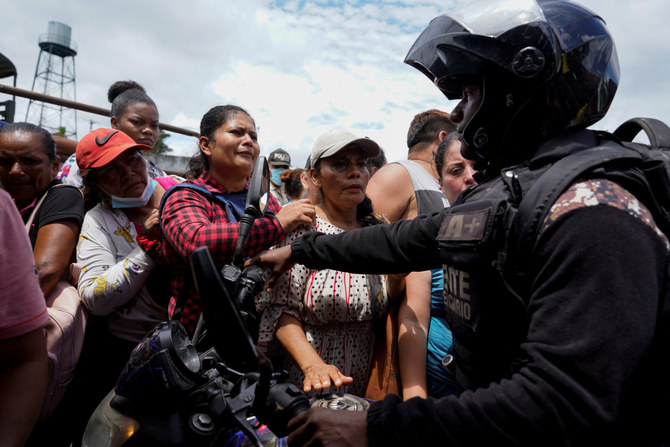
Relatives of inmates pleads to a police officer outside the riot-hit Santo Domingo de los Tsachilas prison in Ecuador on May 9, 2022. (REUTERS/Johanna Alarcon)
3 / 3
Short Url
Updated 10 May 2022
Follow

Ecuador prison riot leaves 43 dead, 108 on the run

  • Authorities said a fight broke out between the rival Los Lobos and R7 gangs inside the Bellavista prison
  • Ecuadoran President Guillermo Lasso blames violence on feuding drug gangs

SANTO DOMINGO DE LOS COLORADOS, Ecuador: At least 43 inmates died on Monday in Ecuador’s latest grisly prison riot, the public prosecutor said, as another 100 prisoners managed to escape.
Authorities said a fight broke out between the rival Los Lobos and R7 gangs inside the Bellavista prison in Santo Domingo de los Colorados, in the center of Ecuador some 80 kilometers (50 miles) from Quito.
“For now there are 43 inmates dead,” said the public prosecutor’s office on Twitter, adding that the situation was “developing.”
During the riot, dozens of inmates tried to escape.
Police chief Fausto Salinas told reporters that 108 were missing after another 112 escaped prisoners were recaptured.
The South American country’s prison authority SNAI said it has activated “security protocols” to contain the “disturbances to order.”
Interior minister Patricio Carrillo initially told reporters that two inmates had been killed before later increasing that figure to 41 in a press conference.
However, he also said “13 people have been taken to hospital, several with serious injuries, and it is possible the number (of dead) will rise.”
The public prosecutor’s office then tweeted the latest death toll.
Carrillo had initially claimed authorities were in control of the situation and that all escaped prisoners had been recaptured.
Inmates with facial injuries were taken by truck and ambulance to medical facilities while family members of those incarcerated gathered at the prison looking for information, AFP reporters at the scene said.
Salinas said “200 police, 200 soldiers and additional reinforcements are on their way.”

Prior to this one, around 350 inmates had been killed in five separate prison riots since February 2021.
Just last month, at least 20 inmates died inside the El Turi prison in Cuenca, southern Ecuador.
Ecuadoran President Guillermo Lasso insists the problem inside the facilities mirrors that outside, where drug gangs are vying for control of trafficking routes.
Those rivalries among inmates sometimes explode into violence, with some prisoners hacked to death or beheaded with machetes.
“The majority of victims, if not almost 100 percent, were killed with knives and not guns,” said Carrillo.
“Their mutilated bodies were left where they were.”
The prisoners were killed in their cells and common rooms, after which inmates then used guns to try to escape the facility.
Authorities have said they will carry out a search for weapons and transfer gang leaders to a different prison in Guayas province.
“This is the unfortunate result of gang violence,” Lasso, who is on a state visit to Israel, wrote on Twitter.
He also expressed “condolences to relatives” of the victims.
Even with greater investment in the prison system, the creation of a commission to pacify facilities and new policies such as the holding of the most dangerous prisoners at a single penitentiary, have not reduced the bloody violence.
Overcrowding is another problem, with 35,000 detainees in 65 prisons that only have a capacity for 30,000 inmates.
The 1,200-capacity Bellavista prison houses 1,700 inmates.
Ecuador has also seen a rise in street crime and drug trafficking which the government has tried to tackle by declaring a state of emergency in the three worst affected provinces: Guayas, Manabi and Esmeraldas.
The country seized a record 210 tons of drugs in 2021 and has already seized another 82 tons this year.
Ecuador, which borders the world’s two largest producers of cocaine, Colombia and Peru, is often used as a jumping off point to export the white powder to the United States and Europe.


Congressional Black Caucus and civil rights leaders unite to counter Trump administration’s agenda

Updated 4 sec ago
Follow

Congressional Black Caucus and civil rights leaders unite to counter Trump administration’s agenda

  • Rep. Yvette Clarke of New York, caucus chair, lamented the concerted effort to roll back civil rights underlying voting access and dismantling of social programs 
  • Civil rights leaders and Democratic lawmakers have already filed dozens of lawsuits against the administration’s anti-DEI policies

WASHINGTON: The Congressional Black Caucus and major civil rights groups on Tuesday marked Black History Month by relaunching a national plan to mobilize against what they say are the Trump administration’s efforts to weaken legal protections for minority communities.
The assembled leaders voiced outrage over the series of policy actions President Donald Trump has implemented since his return to the White House, as well as the president’s personal conduct, but offered few concrete details about what they’re prepared to do in response to the administration.
“Over the past year, we have seen a concerted effort to roll back civil rights underlying voting access, dismantle social programs and concentrate power in the hands of the wealthy and well-connected, at the expense of our community,” said Rep. Yvette Clarke, D-N.Y., chair of the Congressional Black Caucus.
Clarke, who spoke in front of leaders from major civil rights organizations and her Democratic colleagues, promised the caucus would “legislate, organize, mobilize our communities.” The coalition, which spoke privately before the press conference, discussed how to protect voters ahead of the fall midterms and how to build a policy agenda for Democrats should the party win back power in either chamber of Congress next year.
“It’s an all-hands-on-deck moment, and every tool available to the leadership collectively has got to be deployed to get this thing turned around,” House Minority Leader Hakeem Jeffries, D-N.Y., told The Associated Press after the press conference.
Jeffries did not rule out mass protests, organizing boycotts and further legal action as potential steps organizers may take.
The leaders’ warnings come at a moment when the Trump administration has continued its crusade against diversity, equity and inclusion across the US government, in higher education and the private sector.
At the start of his second term, Trump signed multiple executive orders banning the use of “illegal DEI” in government agencies, as well as organizations that interact with the federal government. Trump has threatened to withhold funds from major companies, non-profit groups and state governments as part of the administration’s efforts to upend DEI.
The administration has also sought to redefine the nation’s culture and how history is taught in museums, classrooms and other educational settings. It also prioritized investigating and prosecuting civil rights cases of potential discrimination against white people through both the Justice Department’s civil rights division and the Equal Employment Opportunity Commission, among other agencies.
Civil rights leaders and Democratic lawmakers have already filed dozens of lawsuits against the administration’s anti-DEI policies.
Locked out of power in both chambers of Congress, Democrats have fewer ways to conduct oversight or limit the actions of the Trump administration. And civil rights leaders, who were largely knocked on the back foot by a deluge of policy changes over the last year, are attempting to regroup ahead of this year’s midterm elections.
Progressive civil rights leaders, who are broadly unhappy with the administration’s entire agenda, have argued that the president’s agenda on immigration, voting rights, the economy and other issues is exploiting hard-won policies that civil rights leaders had, for decades, used to ensure anti-discrimination and economic advancement for Black communities.
“This is about how this administration is using the tools we built as a Black community to ensure that all of our people are protected,” said Maya Wiley, president and CEO of the Leadership Conference on Civil and Human Rights.
Progressive state leaders and civil rights groups have also stepped up their efforts elsewhere. A coalition of state attorneys general and civil rights groups this month launched a coalition to promote DEI and accessibility policies through more aggressive legal action.
“State attorneys general are in a unique position to defend these fundamental rights, and this campaign will ensure everyone is heard and shielded from those who aim to weaken civil rights,” Illinois Attorney General Kwame Raoul said in a statement on Monday announcing the initiative.
The initiative includes Democratic attorneys general from fourteen states District of Columbia, as well as over a dozen civil rights groups from across the country. The group intends to launch inquiries and file lawsuits across the country into instances where, the leaders argue, organizations may be violating anti-discrimination laws in response to the rollback of DEI policies by major companies and the Trump administration.
The effort faces an uncertain and shifting legal landscape.
Federal courts remain divided over the use of race in hiring and anti-discrimination in the workplace. And the conservative-majority on the Supreme Court has ruled against the use of race in college admissions. Several justices have voiced skepticism about how race and other characteristics can be used by government agencies and private institutions, even if a policy was meant to combat discrimination.
On Tuesday, the assembled civil rights leaders repeatedly acknowledged the uphill battle that their movement faced on multiple fronts. Some said that the administration’s policy decisions may set up stark political battles in the coming years.
Marc Morial, president of the National Urban League, said: “We commit today to fight and fight and fight until hell freezes over, and then, I can assure you, we will fight on the ice.”