DAVAO CITY, Philippines: Three security guards were killed Monday when gunmen opened fire at a polling station in a restive region of the southern Philippines, police said, as millions of Filipinos voted in national elections.
Elections are a traditionally volatile time in a country with lax gun laws and a violent political culture, but police said this season had been comparatively peaceful.
The deadly shooting happened shortly after voting got under way in Buluan municipality on Mindanao island, a haven for multiple armed groups ranging from communist insurgents to Islamist militants.
Former mayor Ibrahim Mangudadatu told AFP that people inside the school being used as a polling station ran for cover when the shooting started.
A fourth guard was wounded in the attack, said Maguindanao provincial police spokesman Major Roldan Kuntong.
It came after five grenades exploded outside a polling station in Datu Unsay municipality late Sunday that left nine people wounded.
Minutes after that attack, a grenade exploded in the neighboring municipality of Shariff Aguak, but there were no casualties. Both of those towns are also in Maguindanao province.
Police said the grenade victims had walked from their remote mountain villages to cast their votes at the municipal hall in Datu Unsay when polling stations opened across the country on Monday morning.
“It is their custom to come down early from their villages, which are located eight to 12 hours away on foot,” said Kuntong.
In 2009, Maguindanao was the scene of the country’s deadliest single incident of political violence on record.
Fifty-eight people were massacred as gunmen allegedly working for a local warlord attacked a group of people to stop a rival from filing his election candidacy.
Dozens of the victims were journalists covering the contest.
A spokesman for the Commission on Elections said they were trying to verify if the shooting and grenade attacks were election-related.
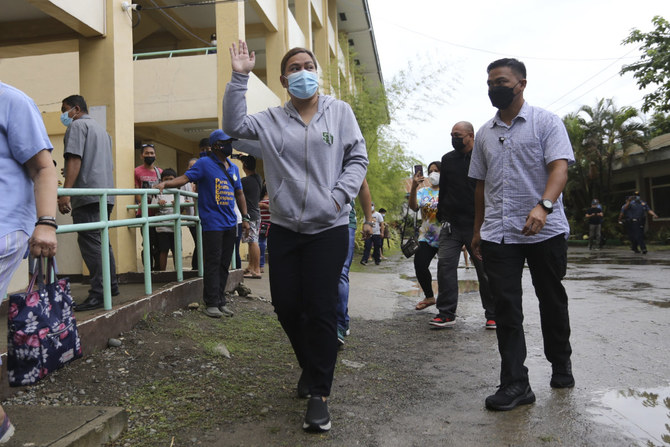
Vice presidential frontrunner Sara Duterte, the former mayor of Mindanao’s Davao City, told reporters she hoped voters would not end up “disenfranchised” as a result of the violence.
The son of former dictator Ferdinand Marcos is the favorite to win the presidential vote, which would return the clan to the pinnacle of political power.
Thousands of personnel from the police, armed forces and coast guard have fanned out across the archipelago to help secure polling stations and ballots, escort election officials and guard checkpoints.
As of Sunday, there had been 16 “validated election-related incidents” since January 9, including four shootings, said national police spokesman Brig.-General Roderick Alba.
That compares with 133 incidents during the 2016 presidential elections.

3 security guards shot dead at polling station in southern Philippines
https://arab.news/6sr3r
3 security guards shot dead at polling station in southern Philippines
Pakistan Embassy denies role in Kabul visa black market as Afghans turn to agents
- Arab News investigation earlier found how Afghans resort to tour agents, pay up to $1,800 to obtain Pakistani visas
- Any additional money charged by travel agents is ‘outside the purview’ of the embassy, spokesperson says
KABUL: The Pakistani Embassy in Kabul has rejected reports of knowledge of a black market for Pakistani visas, emphasizing its unwavering commitment to a fair and accessible visa system for Afghans.
An Arab News investigation published last month found Afghans resorting to tour agents and paying exorbitant prices to obtain Pakistani travel documents, with desperate applicants paying between $1,300 and $1,800 for visas that officially cost more than 50 times less.
In a rebuttal shared with Arab News, the Embassy of Pakistan in Kabul said it “has no official agents, intermediaries, or affiliated travel companies authorized to collect money” from visa applicants.
“The embassy’s official visa fee is published transparently and must be paid directly via credit card. We are aware that many applicants lack credit cards and often rely on local agents for assistance with the online payment,” Sayed Khizar Ali, the embassy’s press counsellor, said in a statement to Arab News.
“Our commitment to a transparent, fair, and accessible visa system for our Afghan brothers remains unwavering.”
Multiple travel agencies in Kabul and Nangarhar that earlier confirmed to Arab News that Pakistani visas are traded on the black market have maintained their statements.
“How can it be outside their control when we send applications and they come back approved within three days?” one manager of a travel agency who declined to be named told Arab News this week.
“The embassy stamps the visas. They know where they come from.”
He said his agency has been processing dozens of visas weekly since October, after tensions between Afghanistan and Pakistan rose following a week of deadly clashes at their shared border.
“The travel agencies that are registered with them, we are the only way. If you don’t go through us, you won’t get a visa,” he said.
Despite the embassy’s denial that it does not work through travel agents, public advertisements by several tour agents offering services for “guaranteed” medical and tourist visas can be seen both online and on their storefronts. Though prices are negotiated privately, many openly promise quick turnarounds of just a few days.
The Afghan Ministry of Interior and Ministry of Foreign Affairs did not respond to requests for comment, despite repeated attempts by Arab News.
Pakistan’s visa fee for Afghan nationals is approximately $25, paid through a fully digital online system. But applicants who attempt to follow this channel told Arab News the process often ends in silent rejection after months of waiting.
Asma, an Afghan national who has been trying to join her fiance in Switzerland, had to go through tour agents to obtain her and her father’s Pakistan visas.
“I applied online through the official channel. That was four months ago. I never heard anything back. No response, no explanation — just complete silence,” Asma told Arab News earlier.
The cost to obtain the travel documents was double for her, as her father also had to apply in order to accompany her due to Afghanistan’s strict travel rules for unmarried women.
“We heard from neighbors that some agencies in Kabul could get it done faster … We went there,” she said, adding that they received their visas on WhatsApp three days later — not through official channels but through a cousin’s contact.
One agency employee who agreed to speak anonymously earlier described a system organized around waiting lists and contacts at the Pakistani Embassy and consulates in Kabul, Nangarhar, Kandahar and Mazar-e-Sharif.
“We have lists. Each list works like seats on a plane. When one list is full, we start filling the next. Every day, a list goes out — meaning visas are issued daily,” he said.
“These days, no visa costs less than $1,300 and none exceed $1,800. This rate has been stable for over a month.”
However, the Embassy of Pakistan in Kabul maintained that these reports are “unfounded and most unfortunate.
“Any additional money these private agents may charge applicants is an illegal and unofficial practice that occurs entirely outside the purview and control of the embassy.”


