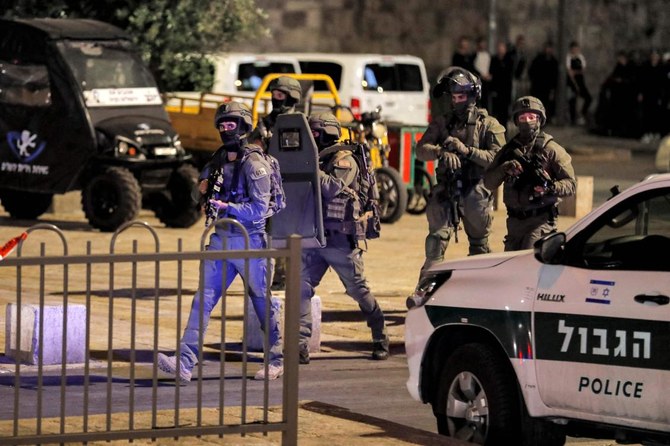
JERUSALEM: Israeli soldiers shot dead a Palestinian near the barrier with the occupied West Bank on Sunday, while in Jerusalem a Palestinian stabbed an Israeli border police officer, adding to an upsurge in violence that has raised fears of a slide back into a wider Israeli-Palestinian conflict.
The attacks came hours after Israeli forces caught two Palestinians who had snuck into Israel and killed three people in the ultra-Orthodox Jewish town of Elad on Israel’s Independence Day last Thursday.
Israel’s army said that the shooting of a Palestinian on Sunday occurred after “soldiers spotted a suspect who attempted to illegally cross the security fence” in the area of the West Bank town of Tulkarm.
“The soldiers operated to stop the suspect in accordance with standard operating procedures, using live fire,” according to an army spokesperson.
The Palestinian Health Ministry said the man was killed.
After the stabbing in Jerusalem on Sunday, police said border police officers at the scene shot the Palestinian attacker and that he and the victim were being treated for their wounds.
Separately, the killing of three people in Elad on Thursday had led to a three-day manhunt by Israeli forces for two axe-wielding assailants who had run through the town, some 15 km (nine miles) north of Tel Aviv.
The two men were captured on Sunday in a forest near Elad, the Israeli army said. They have been identified by Israel as residents of a village near the Palestinian city of Jenin in the West Bank.
Photos of the two, who appeared to be unhurt, and of Israeli security men with guns pointed at their hiding place, were carried by Israeli news websites after they were taken into custody.
Since March Palestinians and members of Israel’s Arab minority have killed 18 people, including three police officers and a security guard, in attacks in Israel and the West Bank that have mostly targeted civilians.
Israel has carried out arrest raids in Palestinian towns and villages which have often sparked clashes and brought the number of Palestinians killed by Israeli forces since the beginning of the year to at least 41.
The casualties include armed members of militant groups, lone assailants and bystanders.
Hamas, the group that controls Gaza, praised the Elad assault. It said the attack was a response to Israeli actions at Al-Aqsa Mosque compound in Jerusalem.
Over the past month, Palestinians and Israeli police have repeatedly clashed at the sensitive complex.
Palestinians and Jordan, the custodian of the site that is the third-holiest in Islam, accuse Israel of not doing enough to enforce a long-standing ban on non-Muslim prayer there, which Israel denies.
The compound is Judaism’s holiest site and the vestige of two ancient Jewish temples.
Israel captured the West Bank, Gaza and East Jerusalem in a 1967 Middle East War. Palestinians seek these territories for a future state.


Israeli forces kill Palestinian at West Bank barrier, officials say
https://arab.news/mcvnq
Israeli forces kill Palestinian at West Bank barrier, officials say

- In Jerusalem a Palestinian stabbed an Israeli border police officer
- Police said border police officers at the scene shot the Palestinian and that he and the victim were being treated


Arab Coalition announces ‘limited’ airstrike targeting two ships that smuggled weapons to Yemen
RIYADH: The Coalition to Support Legitimacy in Yemen on Tuesday said it conducted a “limited” airstrike targeting two ships that smuggled weapons and other military hardware into Mukalla in southern Yemen.
In a statement carried by the Saudi Press Agency (SPA), the Coalition Forces spokesman, Major General Turki Al-Maliki, said that two ships coming from the port of Fujairah in the United Arab Emirates entered the port of Mukalla without obtaining official permits from the Joint Forces Command of the Coalition.
“The crews of the two ships disabled the tracking systems of the two ships and unloaded a large quantity of weapons and combat vehicles to support the Southern Transitional Council forces in the eastern governorates of Yemen (Hadramawt, Al-Mahra) with the aim of fueling the conflict. This is a clear violation of imposing a truce and reaching a peaceful solution, as well as a violation of UN Security Council Resolution No. (2216) of 2015 AD,” said the spokesman.

Al-Maliki said the Coalition Forces acted on a request by Rashad Al-Alimi, the president of the Yemeni Presidential Leadership Council, “to take all necessary military measures to protect civilians in the governorates of Hadramawt and Al-Mahra.”
Al-Alimi, the president of the Yemeni Presidential Leadership Council, warned last week that unilateral actions by the STC were pushing the country toward a dangerous tipping point.
“Given the danger and escalation posed by these weapons, which threaten security and stability, the Coalition Air Forces conducted a limited military operation this morning targeting weapons and combat vehicles unloaded from the two ships at the port of Al-Mukalla. This was done after documenting the unloading, and the military operation was carried out in accordance with international humanitarian law and its customary rules, ensuring no collateral damage occurred,” spokesman Al-Maliki said on Tuesday.
READ MORE: Analysis: The risks of carving up Yemen
He affirmed the Coalition’s "continued commitment to de-escalation and enforcing calm in the governorates of Hadramawt and Al-Mahra, and to prevent any military support from any country to any Yemeni faction without coordination with the legitimate Yemeni government and the Coalition. This is aimed at ensuring the success of the Kingdom and the Coalition’s efforts to achieve security and stability and prevent the conflict from spreading.”
Disregarding previous agreements with the Coalition, the group calling itself Southern Transitional Council, or STC, launched a sweeping military campaign early in December, seizing the governorates of Hadramaut along the Saudi border and the eastern governorate of Al-Mahra in Yemen’s border with Oman.
The UAE-backed STC forces captured the city of Seiyun, including its international airport and the presidential palace. They also took control of the strategic PetroMasila oilfields, which account for a massive portion of Yemen’s remaining oil wealth.
This prompted Saudi Arabia to issue a firm demand for the STC to withdraw and hand over the seized areas to the National Shield Forces, a Saudi-backed unit.
The coalition warned that any military movements undermining de-escalation efforts would be dealt with immediately to protect civilians, according to the Saudi Press Agency.
On Dec. 26, the UAE issued a statement welcoming Saudi Arabia’s efforts to support security and stability in Yemen.
The statement carried by state news agency WAM praised Saudi Arabia’s constructive role in advancing the interests of the Yemeni people and supporting their legitimate aspirations for stability and prosperity.


