

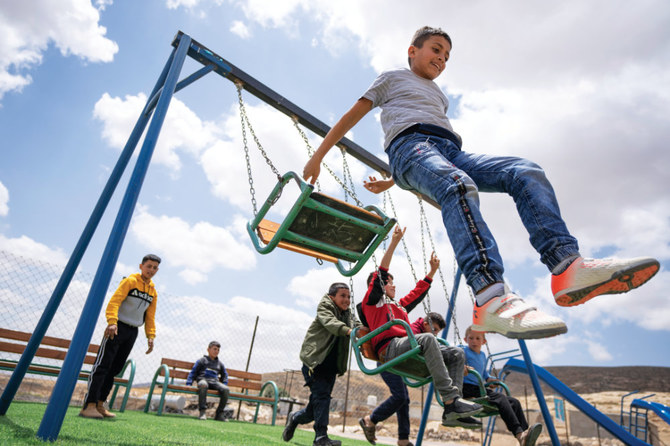

JINBA, West Bank: Everything here is makeshift, a result of decades of uncertainty. Homes are made from tin and plastic sheets, water is trucked in and power is obtained from batteries or a few solar panels.
The lives of thousands of Palestinians in a cluster of Bedouin communities in the southern West Bank have been on hold for more than four decades, ever since the land they cultivated and lived on was declared a military firing and training zone by Israel.
Since that decision in early 1981, residents of the Masafer Yatta region have weathered demolitions, property seizures, restrictions, disruptions of food and water supplies as well as the lingering threat of expulsion.
That threat grew significantly this week after Israel’s Supreme Court upheld a long-standing expulsion order against eight of the 12 Palestinian hamlets forming Masafer Yatta — potentially leaving at least 1,000 people homeless.
On Friday, some residents said they are determined to stay on the land. The verdict came after a more than two-decade-long legal struggle by Palestinians to remain in their homes. Israel has argued that the residents only use the area for seasonal agriculture and that they had been offered a compromise that would have given them occasional access to the land.
The Palestinians say that if implemented, the ruling opens the way for the eviction of all the 12 communities that have a population of 4,000 people, mostly Bedouin who rely on animal herding and desert agriculture.
The residents of Jinba, one of the hamlets, said on Friday that they have opposed any compromise because they have lived in the area long before Israel occupied the West Bank in the 1967 Middle East war.
Issa Abu Eram was born in a cave in the rugged mountainous terrain 48 years ago and has endured a tough life because building is banned here.
In the winter, he and his family members live in a cave. In the summer, they stay in caravans near the cave. His goats are a source of income, and on Friday, he had laid out dozens of balls of hardened goat milk yogurt on the roof of a shack to dry.
He said his children grew up with the threat of expulsion hanging over them. They are attending a makeshift school in Jinba, with the oldest son now in 12th grade.
“He did not live in any other place except Jinba. How are you going to convince him ... to live somewhere else?” he said.
The Palestinian leadership condemned the Israeli Supreme Court ruling, which was handed down on Wednesday — when most of Israel was shut down for the country’s Independence Day.
Nabil Abu Rdeineh, a spokesman for President Mahmoud Abbas, said the removal order “amounts to forced displacement and ethnic cleansing, in violation of international law and relevant UN Security Council resolutions.”
Also on Friday, Israel’s interior minister said Israel is set to advance plans for the construction of 4,000 settler homes in the occupied West Bank. If approved, it would be the biggest advancement of settlement plans since the Biden administration took office. The White House is opposed to settlement growth because it further erodes the possibility of a two-state solution to the Israeli-Palestinian conflict.


