

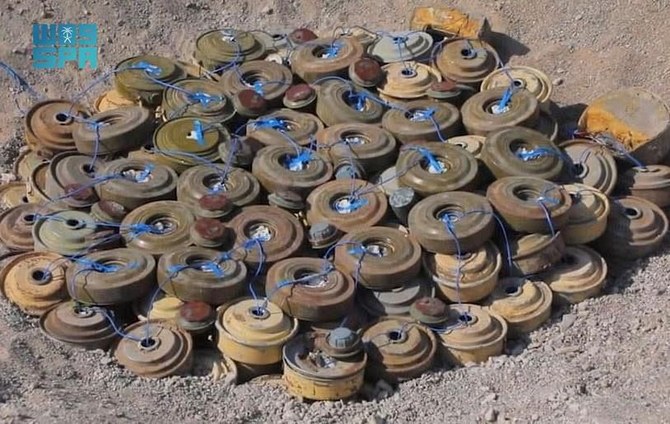
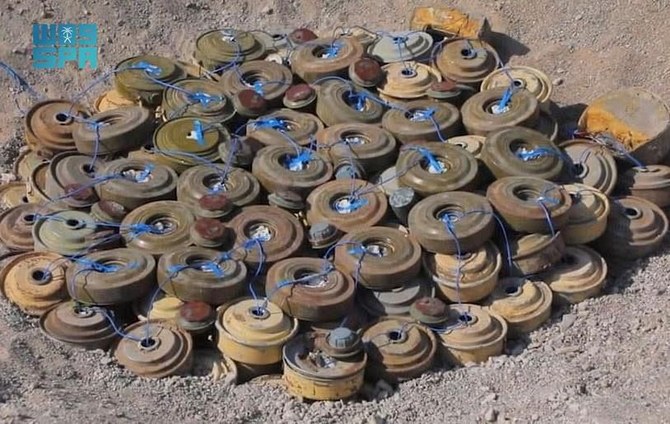
Nearly 1,000 mines cleared by Masam project across Yemen so far in May

Short Url
Updated 08 May 2022
Follow

Nearly 1,000 mines cleared by Masam project across Yemen so far in May

  • Since the launch of the Masam project, as many as 336,891 mines have been dismantled across Yemen

RIYADH: Nearly 1,000 mines planted by the Houthi militia in Yemen have been cleared by the King Salman Humanitarian Aid and Relief Center (KSrelief) de-mining project Masam so far in May, Saudi Press Agency (SPA) reported Sunday. 

Of the 998 explosive devices the de-mining team removed, 677 were anti-tank devices and 321 were unexploded ordnance.

Since the launch of the Masam project, as many as 336,891 mines have been dismantled across Yemen.

The Kingdom of Saudi Arabia, represented by KSrelief, seeks through the project to clear Yemeni lands of the mines that were randomly planted by the Houthi militia causing death and injury of innocent children, women, and the elderly, SPA said.


Internet blackout leaves anxious Iranians in the dark

Updated 8 sec ago
Follow

Internet blackout leaves anxious Iranians in the dark

PARIS: Iran’s internet is still “around 1 percent of ordinary levels,” monitor Netblocks said on Thursday, leaving most Iranians struggling to access independent news or communicate with the outside world.
Iranian authorities shut off internet access on Saturday after Israel and the US began air strikes, plunging the country into an information blackout.
“Iran’s internet blackout has now exceeded 120 hours with connectivity still flatlining around 1 percent of ordinary levels,” internet monitor Netblocks said in a message posted on social media platform X on Thursday.
Some Iranians are finding brief moments of the day when they are able to connect and send messages, while others have resorted to using illegal Starlink subscriptions. Calls to Iran from overseas to mobile phones or landlines are near-impossible.
“The internet speed is very slow,” a Tehran resident said by message, asking to remain anonymous for security reasons. “You can’t call and voice messages don’t get delivered. We can just text.”
Netblocks said that Iranian telecoms companies were now sending messages to “threaten users who try to connect to the global internet with legal action.”
“The internet situation here is abysmal,” a resident in Bukan in western Iran, said in a message. “It connects and disconnects. The connection is slow, so the VPNs don’t work.”
In normal circumstances, Iranians use VPNs to connect to Western internet services such as Instagram that are banned in Iran. 
Others with working internet connections are helping out others.
Shima, a 33-year-old in Tehran, said that she was helping friends by sending news of life in the capital, which has been hit by waves of missile and bombing strikes since Saturday.
“I need to call a lot of people, even strangers, on behalf of their families,” she said.