

Mumbai mosques turn volume down on call to prayer after Hindu’s demands

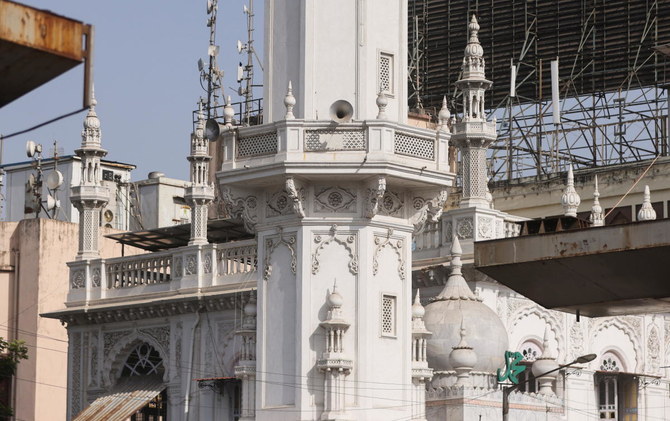
Loud speakers are seen at the Jama Masjid in Mumbai, India, May 6, 2022. (Reuters)
Short Url
Updated 08 May 2022
Follow

Mumbai mosques turn volume down on call to prayer after Hindu’s demands

  • Hindu leader calls for mosque loudspeakers to be turned down
  • Mosques in Mumbai comply with demands after police intervene

MUMBAI: Sitting in an office lined with books overlooking a giant prayer hall, Mohammed Ashfaq Kazi, the main preacher at the largest mosque in Mumbai, checked a decibel meter attached to the loudspeakers before he gave the call to worship.
“The volume of our azaan (call to prayer) has become a political issue, but I don’t want it to take a communal turn,” said Kazi, one of the most influential Islamic scholars in the sprawling metropolis on India’s western coast.
As he spoke he pointed to loudspeakers attached to the minarets of the ornate, sand-colored Juma Masjid in Mumbai’s old trading quarters.
Kazi and three other senior clerics from Maharashtra where Mumbai is located said more than 900 mosques in the west of the state had agreed to turn the volume down on calls to prayer following complaints from a local Hindu politician.
Raj Thackeray, leader of a regional Hindu party, demanded in April that mosques and others places of worship kept within allowed noise limits. If they did not, he said his followers would chant Hindu prayers outside mosques in protest.
Thackeray, whose party has just one seat in the state’s 288-member assembly, said he was merely insisting that court rulings on noise levels be enforced.
“If religion is a private matter then why are Muslims allowed to use loudspeakers all 365 days (of the year)?” Thackeray told reporters in Mumbai, India’s financial hub and capital of Maharashtra.
“My dear Hindu brothers, sisters and mothers come together; be one in bringing down these loudspeakers,” he said.
Leaders of India’s 200 million Muslims see the move, which coincided with the holy festival of Eid, as another attempt by hard-line Hindus to undermine their rights to free worship and religious expression, with the tacit agreement of the ruling Hindu nationalist Bharatiya Janata Party (BJP).
In recent weeks, a senior BJP leader began pushing for swapping marriage and inheritance laws based on religion with a uniform civil code, taking aim at rules that allow Muslim men, for example, to have four wives.
The BJP did not respond to a request for comment on Thackeray’s initiative. It denies targeting minorities, and says it wants progressive change that benefits all Indians.

POLICE STEP IN
At the Juma Masjid, Kazi said he complied with Thackeray’s demands in order to reduce the risk of violence between Muslims and Hindus.
Bloody clashes have erupted sporadically across India since independence, most recently in 2020 when dozens of people, mostly Muslims, were killed in Delhi following protests against a citizenship law that Muslims said discriminated against them.
While hard-line Hindu leaders were seeking to undermine Islam, Kazi said, “we (Muslims) have to maintain calm and serenity.”
The state took Thackeray’s initiative seriously.
Senior police officials met religious leaders including Kazi earlier this month to ensure microphones were turned down, as they feared clashes in Maharashtra, home to more than 10 million Muslims and 70 million Hindus.
On Saturday, police filed a criminal case against two men in Mumbai for using loudspeakers to recite the early morning azaan and warned workers of Thackeray’s party from gathering around mosques.
“Under no circumstances will we allow anyone to create communal tension in the state and the court’s order must be respected,” said V.N. Patil, a senior Mumbai police official.
A senior official for Thackeray’s party said the initiative was not designed to single out Muslims but aimed to reduce “noise pollution” created by all places of worship.
“Our party does not appease the minority community,” said Kirtikumar Shinde, adding that police had issued warnings to 20,000 party workers this month.
The issue of calls to prayer extends beyond Maharashtra. BJP politicians in three states asked local police to remove or limit the use of loudspeakers in places of worship.
The deputy chief minister of country’s most populous state, Uttar Pradesh, said over 60,000 unauthorized loudspeakers had been removed from mosques and temples.


Venezuelans await political prisoners’ release after government vow

Updated 6 sec ago
Follow

Venezuelans await political prisoners’ release after government vow

  • Rights groups estimate there are 800 to 1,200 political prisoners held in Venezuela

CARACAS: Venezuelans waited Sunday for more political prisoners to be freed as ousted president Nicolas Maduro defiantly claimed from his US jail cell that he was “doing well” after being seized by US forces a week ago.
The government of interim president Delcy Rodriguez on Thursday began to release prisoners jailed under Maduro in a gesture of openness, after pledging to cooperate with Washington over its demands for Venezuelan oil.
The government said a “large” number would be released — but rights groups and the opposition say only about 20 have walked free since, including several prominent opposition figures.
Rights groups estimate there are 800 to 1,200 political prisoners held in Venezuela.
Rodriguez, vice president under Maduro, said Venezuela would take “the diplomatic route” with Washington, after Trump claimed the United States was “in charge” of the South American country.
“Venezuela has started the process, in a BIG WAY, of releasing their political prisoners. Thank you!” Trump said in a post late Saturday on his Truth Social platform.
“I hope those prisoners will remember how lucky they got that the USA came along and did what had to be done.”
Maduro and his wife Cilia Flores were captured in a dramatic January 3 raid and taken to New York to stand trial on drug-trafficking and weapons charges, to which they pleaded not guilty.

Anxiety over prisoners

A detained police officer accused of “treason” against Venezuela died in state custody after a stroke and heart attack, the state prosecution service confirmed on Sunday.
Opposition groups said the man, Edison Jose Torres Fernandez, 52, had shared messages critical of Maduro’s government.
“We directly hold the regime of Delcy Rodriguez responsible for this death,” Justice First, part of the Venezuelan opposition alliance, said on X.
Families on Saturday night held candlelight vigils outside El Rodeo prison east of Caracas and El Helicoide, a notorious jail run by the intelligence services, holding signs with the names of their imprisoned relatives.
Prisoners include Freddy Superlano, a close ally of opposition figurehead Maria Corina Machado. He was jailed after challenging Maduro’s widely contested re-election in 2024.
“He is alive — that was what I was most afraid about,” Superlano’s wife Aurora Silva told reporters.
“He is standing strong and I am sure he is going to come out soon.”
Maduro meanwhile claimed he was “doing well” in jail in New York, his son Nicolas Maduro Guerra said in a video released Saturday by his party.
The ex-leader’s supporters rallied in Caracas on Saturday but the demonstrations were far smaller than Maduro’s camp had mustered in the past, and top figures from his government were notably absent.
The caretaker president has moved to placate the powerful pro-Maduro base by insisting Venezuela is not “subordinate” to Washington.

Pressure on Cuba

Vowing to secure US access to Venezuela’s vast crude reserves, Trump pressed top oil executives at a White House meeting on Friday to invest in Venezuela, but was met with a cautious reception.
Experts say Venezuela’s oil infrastructure is creaky after years of mismanagement and sanctions.
Washington has also confirmed that US envoys visited Caracas on Friday to discuss reopening their embassy there.
Trump on Sunday pressured Caracas’s leftist ally Cuba, which has survived in recent years under a US embargo thanks to cheap Venezuelan oil imports.
He urged Cuba to “make a deal” or face unspecified consequences, warning that the flow of Venezuelan oil and money to Havana would stop now that Maduro was gone.
Cuba’s President Miguel Diaz-Canel retorted on X that the Caribbean island was “ready to defend the homeland to the last drop of blood.”
“No one tells us what to do.”
Venezuela’s government in a statement called for “political and diplomatic dialogue” between Washington and Havana.
“International relations should be governed by the principals of international law — non-interference, sovereign equality of states and the right of peoples to govern themselves.”