Pakistan should renegotiate IMF bailout package, says influential leader of ruling PML-N party

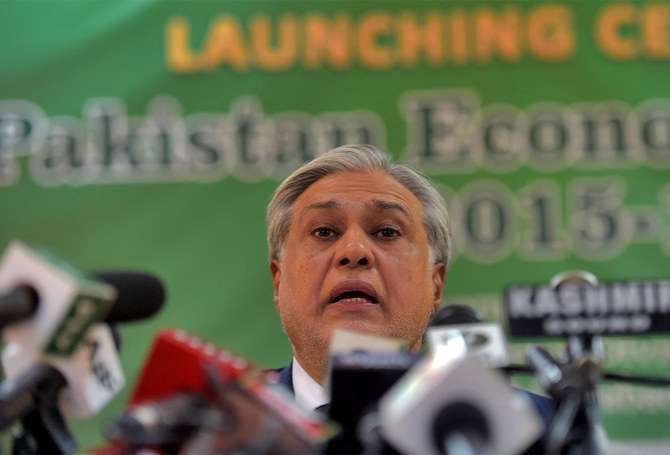
Pakistan's former finance Minister Ishaq Dar speaks after the launch of the economic survey in Islamabad, Pakistan, on June 2, 2016. (AFP/File)
Short Url
Updated 08 May 2022
Follow

Pakistan should renegotiate IMF bailout package, says influential leader of ruling PML-N party

  • Ishaq Dar, a close aide of ex-PM Nawaz Sharif, says everyone wants fresh elections in country
  • Government recently urged the IMF to increase the size and duration of its $6 billion loan program

ISLAMABAD: Pakistan’s former finance minister Ishaq Dar said on Saturday the government should renegotiate a $6 billion bailout package provided by the International Monetary Fund (IMF) to the country, saying it was putting extreme financial burden on the people of Pakistan.
Dar is a close aide of former prime minister Nawaz Sharif who is in self-exile in London. Sharif is the founding leader of the Pakistan Muslim League-Nawaz (PML-N) party which is currently leading the coalition government in the country.
The former finance minister told a local news channel that rising inflation and depreciation of Pakistan’s national currency were at the heart of the country’s prevailing economic problems since they were making it difficult for the government to address the financial problems of people.
Pakistan’s new finance minister Miftah Ismail recently met IMF officials in Washington and requested them to increase the size and duration of the $6 billion loan program. He also agreed to reverse oil and gas subsidies for the resumption of the IMF program which was stalled after the country’s previous administration announced a relief package of about $1.7 billion in February.
Dar, however, said the IMF loan in its current form had become detrimental to the country’s economic interests.
“We should have the spine to talk to them [the IMF] in national spirit,” he told Geo News, adding: “This program was onerous. It was very badly negotiated. Who are they [the IMF] to tell us where our currency should be? Who are they to tell us where our interest rate should be?”
Pakistan is currently facing significant economic challenges, as its fiscal deficit is expected to rise and its foreign currency reserves are running low.
The country’s former finance minister said the opposition had decided to bring a no-confidence motion against Imran Khan to fix the economic situation, though he warned it would not happen overnight.
“There is very limited time since [the parties in the new government] are committed to moving toward fresh elections after taking necessary steps,” he maintained. “I don’t think that any party – whether it’s the PML-N or its allies – has come to complete one and a half years in power. They are just there to do essential things such as electoral reforms etc. in national interest before moving toward elections.”
Asked why federal ministers from his own political party were saying the government would finish its tenure, he said the election commission had already said it could not hold the polls before October.
However, he emphasized it was everyone’s preference to hold new elections since all the political parties in the new administrative setup had been saying themselves that the last general elections were “stolen.”
Dar maintained the federal ministers who said the government was going to finish its tenure were presenting their own opinion, not the party policy.
In response to a question of what Nawaz Sharif wanted under the present circumstances, he said the founding leader of PML-N also hoped to move toward fresh elections as soon as possible.


‘Look ahead or look up?’: Pakistan’s police face new challenge as militants take to drone warfare

Updated 14 January 2026
Follow

‘Look ahead or look up?’: Pakistan’s police face new challenge as militants take to drone warfare

  • Officials say militants are using weapons and equipment left behind after allied forces withdrew from Afghanistan
  • Police in northwest Pakistan say electronic jammers have helped repel more than 300 drone attacks since mid-2025

BANNU, Pakistan: On a quiet morning last July, Constable Hazrat Ali had just finished his prayers at the Miryan police station in Pakistan’s volatile northwest when the shouting began.

His colleagues in Bannu district spotted a small speck in the sky. Before Ali could take cover, an explosion tore through the compound behind him. It was not a mortar or a suicide vest, but an improvised explosive dropped from a drone.

“Now should we look ahead or look up [to sky]?” said Ali, who was wounded again in a second drone strike during an operation against militants last month. He still carries shrapnel scars on his back, hand and foot, physical reminders of how the battlefield has shifted upward.

For police in the northwestern Khyber Pakhtunkhwa (KP) province, the fight against militancy has become a three-dimensional conflict. Pakistani officials say armed groups, including the Tehreek-e-Taliban Pakistan (TTP), are increasingly deploying commercial drones modified to drop explosives, alongside other weapons they say were acquired after the US military withdrawal from neighboring Afghanistan.

Security analysts say the trend mirrors a wider global pattern, where low-cost, commercially available drones are being repurposed by non-state actors from the Middle East to Eastern Europe, challenging traditional policing and counterinsurgency tactics.

The escalation comes as militant violence has surged across Pakistan. Islamabad-based Pakistan Institute for Conflict and Security Studies (PICSS) reported a 73 percent rise in combat-related deaths in 2025, with fatalities climbing to 3,387 from 1,950 a year earlier. Militants have increasingly shifted operations from northern tribal belts to southern KP districts such as Bannu, Lakki Marwat and Dera Ismail Khan.

“Bannu is an important town of southern KP, and we are feeling the heat,” said Sajjad Khan, the region’s police chief. “There has been an enormous increase in the number of incidents of terrorism… It is a mix of local militants and Afghan militants.”

In 2025 alone, Bannu police recorded 134 attacks on stations, checkpoints and personnel. At least 27 police officers were killed, while authorities say 53 militants died in the clashes. Many assaults involved coordinated, multi-pronged attacks using heavy weapons.

Drones have also added a new layer of danger. What began as reconnaissance tools have been weaponized with improvised devices that rely on gravity rather than guidance systems.

“Earlier, they used to drop [explosives] in bottles. After that, they started cutting pipes for this purpose,” said Jamshed Khan, head of the regional bomb disposal unit. “Now we have encountered a new type: a pistol hand grenade.”

When dropped from above, he explained, a metal pin ignites the charge on impact.

Deputy Superintendent of Police Raza Khan, who narrowly survived a drone strike during construction at a checkpoint, described devices packed with nails, bullets and metal fragments.

“They attach a shuttlecock-like piece on top. When they drop it from a height, its direction remains straight toward the ground,” he said.

TARGETING CIVILIANS

Officials say militants’ rapid adoption of drone technology has been fueled by access to equipment on informal markets, while police procurement remains slower.

“It is easy for militants to get such things,” Sajjad Khan said. “And for us, I mean, we have to go through certain process and procedures as per rules.”

That imbalance began to shift in mid-2025, when authorities deployed electronic anti-drone systems in the region. Before that, officers relied on snipers or improvised nets strung over police compounds.

“Initially, when we did not have that anti-drone system, their strikes were effective,” the police chief said, adding that more than 300 attempted drone attacks have since been repelled or electronically disrupted. “That was a decisive moment.”

Police say militants have also targeted civilians, killing nine people in drone attacks this year, often in communities accused of cooperating with authorities. Several police stations suffered structural damage.

Bannu’s location as a gateway between Pakistan and Afghanistan has made it a security flashpoint since colonial times. But officials say the aerial dimension of the conflict has placed unprecedented strain on local forces.

For constables like Hazrat Ali, new technology offers some protection, but resolve remains central.

“Nowadays, they have ammunition and all kinds of the most modern weapons. They also have large drones,” he said. “When we fight them, we fight with our courage and determination.”