

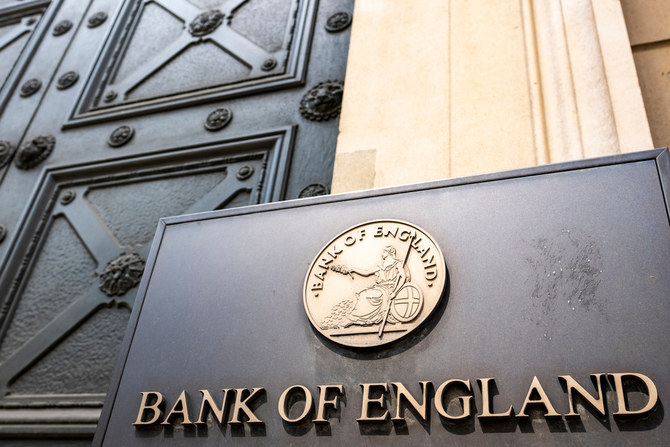

RIYADH: The central banks of the UK and Brazil have raised their rates by a full percentage point, following the US Fed’s half-point hike on Wednesday.
Saudi Arabia, the UAE, Qatar and Bahrain have also raised their key rates by 0.5 percentage points, while Kuwait's central bank increased its discount rate by 25 basis points.
Norway has resisted any rise, keeping its rates on hold, and the European Central Bank board member Fabio Panetta has also advised against a hike in rates.
Bank of England raises rates to 1 percent despite looming recession risk
The Bank of England raised interest rates to their highest since 2009 at 1 percent on Thursday to counter inflation now heading above 10 percent, as it sent a warning that Britain risks falling into recession.
The BoE’s nine rate-setters voted 6-3 for the quarter-point rise from 0.75 percent. But Catherine Mann, Jonathan Haskel and Michael Saunders called for a bigger increase to 1.25 percent to stamp out the risk of the inflation surge getting embedded in the economy.
Economists polled by Reuters had forecast a more dovish 8-1 vote to raise rates to 1 percent, with one policymaker opposing a hike.
The BoE’s move represented its fourth consecutive rate hike since December — the fastest increase in borrowing costs in 25 years — and it hardened its message about further increases, despite its worries about a sharp economic slowdown.
British consumer price inflation hit a 30-year high of 7 percent in March, more than triple the BoE’s 2 percent target, and the central bank revised up its forecasts for price growth to show it peaking above 10 percent in the last three months of this year.
It had previously said it expected inflation to peak at about 8 percent in April.
The BoE kept its forecast for economic growth this year at 3.75 percent, but slashed its forecast for 2023 to show a contraction of 0.25 percent from a previous estimate of 1.25 percent growth. It cut its growth projection for 2024 to 0.25 percent from a previous 1.0 percent.
Brazil central bank raises rates by 100 bps as expected
Brazil’s central bank on Wednesday raised interest rates by a full percentage point, due to persistent double-digit inflation and evidence of price expectations drifting further from official targets.
The bank’s rate-setting committee, known as Copom, raised its benchmark Selic interest rate to 12.75 percent, a five-year high. All 32 economists polled by Reuters had forecast the decision after policymakers made an increase of 100 basis points in March and signaled the same for this month.
Gulf central banks raise rates as Fed hikes by 50 bps
The central banks of Saudi Arabia, the United Arab Emirates, Qatar and Bahrain have raised their key rates by 50 bps.
The Central Bank of Kuwait said it increased its discount rate by 25 basis points to 2 percent, in a move less hawkish than the Fed’s.
All Gulf countries have their currencies pegged to the US dollar, except Kuwait, which pegs the Kuwaiti dinar to a basket of currencies that includes the dollar.
The Saudi Central Bank raised its repo rate and reverse repo rates by 50 bps each to 1.75 percent and 1.25 percent, respectively.
The Central Bank of the UAE said its base rate would increase by 50 basis points, which would take it to 2.25 percent, effective from Thursday.
The bank said it would maintain the rate on borrowing short-term liquidity from the CBUAE through all standing credit facilities at 50 bps above the base rate.
The Central Bank of Qatar said it would raise, effective on Thursday, its deposit and repo rates by 50 bps to 1.5 percent and 1.75 percent, respectively. Its lending rate will increase by 25 bps to 2.75 percent.
The Central Bank of Bahrain said it raised its key policy rate, on its one-week deposit facility, by 50 bps to 1.75 percent, in lockstep with the Fed’s hike.
The CBB also increased its overnight deposit rate and lending rates by 50 bps to 1.5 percent and 3 percent, respectively, and its four-week deposit rate was increased by 75 bps to 2.5 percent.
The Central Bank of Oman — the other member of the Gulf Cooperation Council — is widely expected to follow with a similar move.
Norway keeps rates on hold, remains on track for June hike
Norway’s central bank kept interest rates on hold on Thursday, as widely expected, and reiterated its plan to raise the cost of borrowing in June amid rapidly rising inflation.
Norges Bank’s monetary policy committee unanimously agreed to keep the rate on hold at 0.75 percent for now, as expected in a Reuters poll of economists.
ECB should not raise rates in July before Q2 GDP data: Panetta
The European Central Bank should not raise interest rates in July, even though the inflation outlook suggests it can gradually reduce support for the economy, ECB board member Fabio Panetta told Italian newspaper La Stampa.
While an increasing number of ECB policymakers are making the case for a rate hike at the July 21 policy meeting, Panetta pointed to the availability after it of data on the euro zone’s second-quarter economic growth.
“It would be imprudent to act without having first seen the hard numbers on GDP for the second quarter and to discuss further measures without a full understanding of how the economy could develop,” La Stampa on Thursday quoted Panetta as saying.
“It does not make much of a difference whether it is two or three months earlier or later,” he said in the interview with the newspaper.
Spain’s inflation peaked, to start falling in second half of 2022, minister says
Spain’s Economy Minister Nadia Calvino said on Thursday inflation has peaked in the country and is likely to start falling in the second half of this year.
The 12-month inflation rate in Spain had increased to a three-decade high of 9.8 percent in the period through March though the most recent data in April showed a slight decrease to 8.4 percent.
Calvino added her government had to prepare itself for an upcoming interest rate increase. She said her ministry has already reduced risks by extending the maturity of its outstanding debt to more than eight years.
Turkey’s inflation surges to 70 percent, putting Erdogan in bind
Turkey’s annual inflation jumped to a two-decade high of 69.97 percent in April, according to data on Thursday, fueled by the Russia-Ukraine conflict and rising energy and commodity prices after last year’s lira crash.
The surge in prices has badly strained households just over a year before presidential and parliamentary elections that could bring the curtain down on President Tayyip Erdogan’s long rule.
Erdogan first came to power as prime minister in 2003 before switching the country to a presidential system, and the unorthodox interest rate cuts made last year under pressure from him have been blamed for lighting a fire under inflation.
Month-on-month, consumer prices rose 7.25 percent, the Turkish Statistical Institute said, compared to a Reuters poll forecast of 6 percent. Annually, consumer price inflation was forecast to be 68 percent.
“It’s about food and energy price increases but also the spectacular failure of monetary policy in Turkey — and it’s about the abject and total failure of Erdogan’s unorthodox monetary policy,” said strategist Timothy Ash at Bluebay Asset Management.
Presidential and parliamentary elections are due by June 2023 and opinion polls show Erdogan’s support declining.
Swiss inflation rises to 2.5 percent in April
The Swiss consumer price index rose 0.4 percent in April versus March and advanced 2.5 percent year on year, the highest since 2008 and taking inflation further above the Swiss National Bank’s definition of price stability.
The 0.4 percent month-on-month increase reflected several factors including rising prices for heating oil, new cars and air transport, the Federal Statistics Office said.
China’s services activity falls at second sharpest rate on record — Caixin PMI
China’s services sector activity contracted at the second-steepest rate on record in April, as COVID curbs halted the industry, leading to sharper reductions in new business and employment, a private-sector survey showed on Thursday.
The Caixin services purchasing managers’ index stood at 36.2 in April, the second-lowest since the survey begun in November 2005 and down from 42 in March. The index hit a record low of 26.5 in February 2020 during the onset of the pandemic.
The 50-point mark separates growth from contraction on a monthly basis.
The pessimistic findings from the survey, which focuses more on small firms in coastal regions, are in line with the government’s official PMI, pointing to the fast deterioration in a key sector that accounts for about 60 percent of the economy and half of the urban jobs.
The Caixin PMI is compiled by S&P Global from responses to questionnaires sent to purchasing managers in China.


