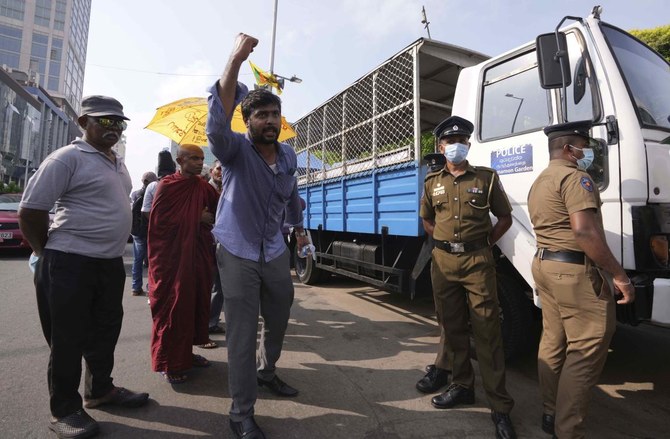
COLOMBO: Sri Lankan police used tear gas and a water canon on Friday to disperse student protesters who were camped outside Parliament criticizing lawmakers for not ousting President Gotabaya Rajapaksa and his government over the country’s worst economic crisis in recent memory.
The student-led protest began Thursday after a government-backed deputy speaker was elected in Parliament by a comfortable margin in what was seen a key victory for the ruling coalition. Separately, protesters have been occupying the entrance to the president’s office in the capital, Colombo, for 28 days demanding Rajapaksa and his powerful ruling family quit.
Shops, offices and schools closed across the country Friday and transport came to a near standstill amid widespread demonstrations against the government.
“People have been telling this government to go home for a month. They just didn’t wake up from sleep demanding it,” student leader Wasantha Mudalige said. “They have endured big problems that have led to this demand.”
“There are discussions going on inside this thieves’ den called Parliament, and none of the people’s issues are discussed there. So the people’s decision is that the Parliament does not reflect their sentiments,” Mudalige added.
Factories, banks and government offices were also closed, with employees demonstrating in front of them. Black flags were displayed at shops, heeding a call from trade unions and other civil organizations, and many protesters wore black T-shirts.
Protesters also hung undergarments by a road leading to Parliament and chanted: “This is all we are left with!”
The Indian Ocean island nation is on the brink of bankruptcy and has suspended payments on its foreign loans. Its economic woes have brought on a political crisis, with the government facing protests and a no-confidence motion in Parliament.
Sri Lanka was due to pay $7 billion of its foreign debt this year out of nearly $25 billion it must pay by 2026. Its total foreign debt is $51 billion.
Sri Lanka’s finance minister announced earlier this week that the country’s usable foreign reserves have plummeted below $50 million.
For several months, Sri Lankans have endured long lines to buy fuel, cooking gas, food and medicine, most of which come from abroad. Shortages of hard currency have also hindered imports of raw materials for manufacturing and worsened inflation, which surged to 18.7 percent in March.
As oil prices soar during the Russia-Ukraine conflict, Sri Lanka’s fuel stocks are running out. Authorities have announced countrywide power cuts extending up to 7 1/2 hours a day because they can’t supply enough fuel to power generating stations.
Protesters occupying the entrance to the president’s office have been demanding the president, his older brother Prime Minister Mahinda Rajapaksa and other powerful Rajapaksa family members quit. Similar protests have spread to other locations, with people setting up camps opposite the prime minister’s residence and other towns across the country.
So far, the Rajapaksa brothers have resisted calls to resign, though three Rajapaksas out of the five who were lawmakers stepped down from their Cabinet posts in mid-April.
Protesters who have crowded the streets since March hold Rajapaksa and his family— who have dominated nearly every aspect of life in Sri Lanka for most of the last 20 years — responsible for the crisis.
Sri Lanka has been holding talks with the International Monetary Fund to get an immediate funding facility as well as a long-term rescue plan but had been told its progress would depend on negotiations on debt restructuring with creditors.
Any long-term plan would take at least six months to get underway.


![]()

Sri Lankan police use tear gas on protesters near Parliament
Short Url
https://arab.news/c8way
Sri Lankan police use tear gas on protesters near Parliament


Latest updates


© 2026 SAUDI RESEARCH & PUBLISHING COMPANY, All Rights Reserved And subject to Terms of Use Agreement.