Private operators cannot collect advance payments from intending Pakistani Hajj pilgrims - ministry

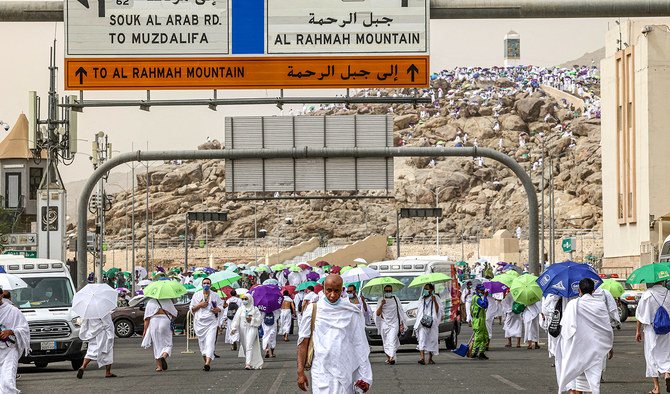
Hajj pilgrims gather around Mount Arafat, also known as Jabal al-Rahma (Mount of Mercy), in Makkah, Saudi Arabia on July 19, 2021. (AFP/File)
Short Url
Updated 06 May 2022
Follow

Private operators cannot collect advance payments from intending Pakistani Hajj pilgrims - ministry

  • Government says people willing to perform Hajj this year could submit online applications from May 1-13
  • Religion ministry says private operators illegally receiving money from people directly, through agents

ISLAMABAD: Pakistan’s religious affairs ministry said on Friday it had barred private tour operators and individuals from collecting money from intending Hajj pilgrims in advance.

After a hiatus of two years due to the COVID-19 pandemic, Saudi Arabia this year announced holding the annual Hajj pilgrimage for all Muslims across the globe.
Pakistan will be sending 81,132 pilgrims for this year’s Hajj, with 60 percent of the quota allocated to private Hajj operators. The maximum age limit for pilgrims this year is 65.

Last week, the Pakistan government announced people willing to perform Hajj this year could submit online applications from May 1 to 13, with token money of Rs50,000 ($270).

“The ministry observed that some private tour operators and individuals are receiving money from people directly or through their unrelated agents in the name of Hajj applications, registration,” religion ministry spokesperson Muhammad Umar Butt told Arab News on Friday adding that “this practice is totally illegal and an arrestable offense.”

“All such individuals and companies are strongly urged to refrain from this illegal activity. So far, the Ministry of Hajj has not allowed any tour operator to receive / register Hajj applications,” Butt added.

“Those who do not follow these instructions will be responsible for their own loss and the ministry's,” he said.

In 2020 and 2021, the kingdom held Hajj only for locals due to coronavirus restrictions.

Religious Affairs Minister Mufti Abdul Shakoor said on April 29 the per person cost of this year's Hajj could range from Rs700,000 ($3,770) to Rs1,000,000 ($5,386), owing to the increase in taxes and cost of other facilities in the kingdom.


Pakistan vaccinates over 26 million children amid declining polio cases

Updated 8 sec ago
Follow

Pakistan vaccinates over 26 million children amid declining polio cases

  • Pakistani authorities say polio cases dropped to 31 in 2025 from 74 a year earlier
  • Over 400,000 workers deployed as Pakistan, Afghanistan run simultaneous campaigns

KARACHI: Pakistan on Wednesday said its first nationwide polio vaccination drive of 2026 was continuing for a third day, with health workers having immunized more than 26.8 million children amid a decline in reported cases of the crippling disease.

The campaign, being conducted simultaneously in Pakistan and neighboring Afghanistan, comes after Pakistan reported 31 polio cases in 2025, a significant drop from 74 cases in 2024, which officials had described as alarming.

More than 400,000 polio workers are going door to door across the country to administer oral polio drops to children, the National Emergency Operations Center (NEOC) said.

“More than 26.8 million children have been vaccinated nationwide in the first two days of the campaign,” it said in an update, urging parents to cooperate with vaccination teams and ensure their children receive the drops.

According to the statement, more than 14.5 million children have been vaccinated in Punjab, 5.88 million in Sindh, 4.32 million in Khyber Pakhtunkhwa and around 1.28 million in Balochistan.

Vaccination figures also included nearly 294,000 children in Islamabad, more than 165,000 in Gilgit-Baltistan and 446,000 in Azad Jammu and Kashmir.

Health authorities warned that polio is an incurable disease that can cause lifelong paralysis, stressing that sustained immunization efforts were essential to prevent its spread.

Pakistan and Afghanistan are the only two countries in the world where polio remains endemic, and both have stepped up coordinated vaccination drives in recent years amid concerns about cross-border transmission.