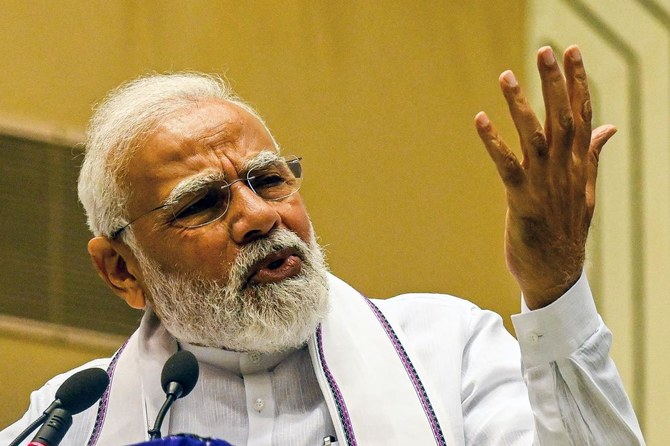
NEW DELHI: Indian Prime Minister Narendra Modi headed to Europe on Monday with New Delhi’s refusal to condemn Russia’s invasion of Ukraine set to be a key talking point in meetings with regional leaders.
India, which imports much of its military hardware from Russia, has long walked a diplomatic tightrope between the West and Moscow, and has called only for an immediate end to hostilities.
“My visit to Europe comes at a time when the region faces many challenges and choices,” Modi said in a statement released before his departure for Germany, Denmark and France.
The premier intended to “strengthen the spirit of cooperation” with European partners “who are important companions in India’s quest for peace and prosperity,” the statement added.
Modi was due to hold talks with German Chancellor Olaf Scholz in Berlin on Monday before heading to Copenhagen to join the prime ministers of Denmark, Iceland, Finland, Sweden and Norway at a two-day India-Nordic Summit from May 3.
He will then make a brief stopover in France to see President Emmanuel Macron to “share assessments on various regional and global issues and will take stock of ongoing bilateral cooperation,” the Indian statement said.
Germany’s Scholz was quoted by the Indian Express daily on Monday as saying the “attack on Ukraine by Russia is on the top of the agenda” in the discussions with Modi.
“The brutality of the Russian attack is shocking and appalling. Those responsible must be held accountable. I am confident that there is broad agreement between our countries on this,” the newspaper quoted Scholz as saying in an interview.
Scholz plans to invite Modi as a special guest to a Group of Seven (G7) leaders’ summit next month as part of an effort to forge a broader alliance against Russia, Bloomberg News reported Sunday.
Quoting unnamed sources, the report said Scholz was concerned over Modi’s refusal to condemn Russia and India’s increased fossil fuel imports from there, and was undecided on the invite until weeks ago.
India has significantly increased imports of Russian oil from March onwards, but has bristled at criticism of the move, saying Europe’s consumption of Russian energy commodities remains far higher.
In a media briefing on Sunday, Indian Foreign Secretary Vinay Kwatra said European countries “not only understand but also have deep appreciation” of India’s position on the conflict.
The principal focus of the visits and discussions is to strengthen bilateral partnership across a range of areas including trade, energy and sustainable development, Kwatra said.
With Russia reeling under Western sanctions, some 50 Indian food, ceramics and chemicals exporters will head to Moscow later this month after enquiries from Russian firms, the Times of India newspaper reported on Monday.
“Trade and financial sanctions imposed on Russia... have opened up numerous avenues for Indian businesses across various sectors,” the newspaper quoted Vivek Agarwal from lobby group the Trade Promotion Council of India, which is organizing the trip, as saying.
“Indian companies too are excited to tap the huge potential available for Indian products in Russia,” he told the newspaper.
The daily quoted unnamed government officials as suggesting that shipments would only start once the war in Ukraine ends.

Ukraine on agenda as Indian PM Narendra Modi heads to Europe
https://arab.news/v6c2x
Ukraine on agenda as Indian PM Narendra Modi heads to Europe
- India has long walked a diplomatic tightrope between the West and Moscow
China foreign minister blasts Middle East war, urges US to manage ties
- Wang Yi: ‘A strong fist does not mean strong reason. The world cannot return to the law of the jungle’
BEIJING: China’s top diplomat condemned on Sunday the war in the Middle East and urged the United States to iron out its differences with Beijing.
Foreign Minister Wang Yi told a press conference in the Chinese capital that the war, which was sparked by US and Israeli strikes on Iran, “should never have happened.”
“A strong fist does not mean strong reason. The world cannot return to the law of the jungle,” he told reporters.
He was speaking during China’s annual political gathering, which began this week, known as the “Two Sessions.”
The parallel meetings of China’s parliament and political consultative body are closely watched for clues as to the priorities of top leaders, in the face of a precarious geopolitical landscape
Wang addressed a range of issues, including a trade war with the United States, regional tensions in the South China Sea, as well as wars in the Middle East and Ukraine.
“This year is indeed a big year for Sino-US relations,” Wang said.
‘Manage differences’
Ties between China and the United States have been strained since US President Donald Trump returned to the White House last year, followed by a trade war that saw the two countries impose tit-for-tat tariffs on each other’s products.
“We observe certain country erecting tariff barriers and pursuing decoupling and supply chain disruption,” Wang said on Sunday.
“These actions are akin to trying to extinguish a fire with fuel. Ultimately, they will backfire and harm itself.”
While China and the United States “cannot change each other,” he said, “we can change the way we interact with each other.”
Wang urged both sides to “create a suitable environment, manage existing differences, and eliminate unnecessary interference.”
But a wide range of disagreements remain.
Beijing has blasted US and Israeli military strikes on Iran, with which it has diplomatic and trade ties.
It has in particular condemned the killing of the country’s supreme leader Ayatollah Ali Khamenei.
Wang also maintained that China’s relations with Moscow, which have been criticized by Western countries for sustaining the war in Ukraine, remained “steadfast and unshakeable.”
China ‘gym’
China has sought to profit off Trump’s volatile foreign policies, positioning itself as a reliable alternative to once traditional US allies.
Leaders from France, Canada, Finland and the United Kingdom, among others, have flocked to Beijing, recoiling from Trump’s bid to seize Greenland and tariff threats against fellow NATO members.
Wang welcomed the visits on Sunday, saying “we have noticed that more and more insightful Europeans agree that China is not a competitor, but a global partner.”
“We welcome our European friends to step out of the ‘small attic’ of protectionism and come to the ‘gym’ of the Chinese market, where they can strengthen their muscles and enhance their competitiveness,” he said.
In the spirit of warming relations, China has doled out visa-free travel agreements to around 50 countries including France, Germany, and the United Kingdom.
Beijing has also agreed to reduced tariffs with Ottawa and London in their exports to China.
Wang also addressed relations between China and Japan, which have been locked in a spat after comments by Prime Minister Sanae Takaichi in November that Tokyo could intervene militarily in any attack on self-ruled Taiwan.
Takaichi’s comments enraged Beijing, which views Taiwan as its territory and has not ruled out taking by force.
Wang emphasized on Sunday that Beijing “will never allow anyone or any force to separate Taiwan … from China once again.”
He warned Japan against “repeating the same disastrous mistakes,” adding that China “will never allow anyone to stand up for colonialism,” in an apparent reference to Tokyo’s actions during World War II.
The issue of Taiwan, he insisted, is “at the heart of China’s core interests” and “a red line that must not be crossed or trampled on.”


