

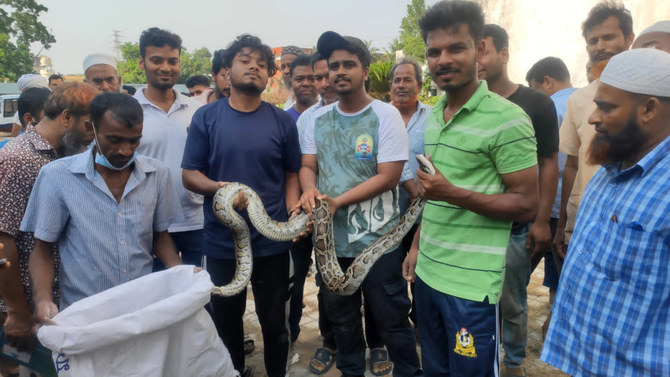


DHAKA: Whenever the call comes their way — which could happen several times a week — a group of snake rescuers in Bangladesh’s southeastern city of Chattogram immediately rush to save the reptiles.
Formed in January 2020, Snake Rescue Team Bangladesh, or SRTB, have rescued about 2,000 snakes from across Chattogram.
In the hilly region, located about 250 kilometers from the capital Dhaka, snake sightings are a common occurrence.
The 19-member team is on a mission to raise awareness of the vital role that the reptiles play in the ecosystem.
“Our aim is to create awareness over the importance of snakes for our biodiversity and the well-being of humans,” Farhadul Islam, 22, one of the five founding members of the team, told Arab News.
It is estimated that more than 710,000 snake bite incidents take place annually in rural Bangladesh, according to a 2010 study published in the science and medicine journal PLOS. The prevalence of such incidents means that many people in Bangladesh often kill snakes, including non-venomous species, on sight.
But Islam and his group, whose members have all been trained in rescuing snakes, are committed to changing the prevailing mindset.
“Nowadays, our farmers are losing more crops due to rats on the field. But the losses would have been minimal if there were enough snakes in nature, as rats are natural food for the snakes,” Islam said.
Snakes are also important for medical science, Islam added, as many antibiotics are prepared from snake venoms.
The group, comprising mostly college students in their early 20s, have been rescuing snakes voluntarily. While in some cases people give them money for transportation, SRTB mostly self-fund the work, which also involves treating injured snakes.
For some members, their passion for snakes started when they were much younger.
While most children grew up fearing snakes, as a boy Siddiqur Rahman Rabbi spent hours learning about serpents to understand how to capture them. He used to believe that the act was a thing of magic, but later learned that it simply requires technique.
“It took me five years to acquire the skill of capturing snakes,” Rabbi told Arab News, adding that he had watched a lot of television on the subject, including shows on Animal Planet and National Geographic, while also traveling to different parts of his hometown to learn from snake charmers.
“Finally, I gathered some like-minded youths through social media from my city who also wanted snakes to be allowed to live,” the 25-year-old, a founding member of SRTB, said.
“It’s a very risky job, because every moment you need to be watchful of the snake’s movements. When you lose attention for even a fraction of a second, it might take your life.”
SRTB’s efforts have since been recognized by officials in the region, with the local wildlife protection department referring all snake rescue calls to the group, Islam said.
In the last year, the group has rescued different snake species, from pythons to various types of cobras, using simple tools such as snake hooks and gloves in order to capture and later release them to the nearby forest reserve.
Last October, SRTB rescued 22 baby black cobras from the home of a government official, Mohammad Belal Hossain, in the Hathazari region, about 50 kilometers from Chattogram. The effort took them three days.
“It was a highly venomous snake and not very common in this area. But I noticed the snakes don’t harm people unless they are being attacked,” Hossain told Arab News.
The experience showed Hossain that maintaining coexistence with the serpents “is very important to maintain the ecological balance in nature.”
With limited resources and funds, the group remains bound to their hometown in Chattogram for the time being. But they believe that their work will have a ripple effect across the country.
“I believe, with the passing of time, our work will spread across the country and people will understand the necessity of saving nature and the serpents,” Islam said.


