

Egypt launches major religious tourism project in South Sinai

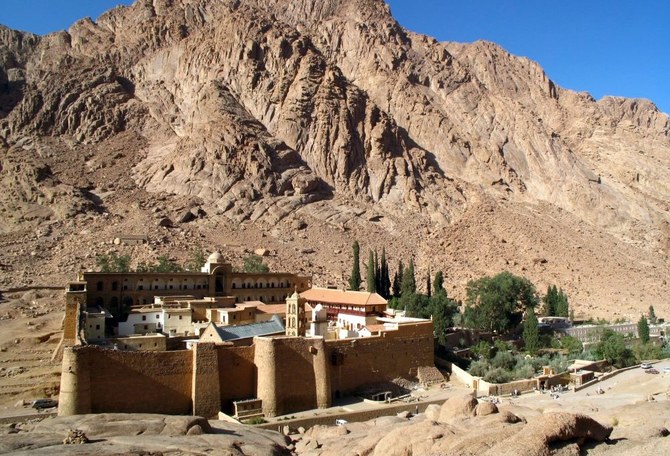
Saint Catherine's Monastery on the Sinai Peninsula in Egypt. (Wikimedia Commons)
Short Url
Updated 01 May 2022
Follow

Egypt launches major religious tourism project in South Sinai

  • The area is a sacred site for the world’s three major monotheistic religions and includes Saint Catherine’s Monastery as well as Mount Sinai
  • The project aims to establish a spiritual shrine above the mountains surrounding the Holy Valley, making it a destination for spiritual, healing and environmental tourism

CAIRO: Egypt is preparing to open one of the largest religious projects in the world, the “Great Transfiguration,” in the governorate of South Sinai, Gov. Maj. Gen. Khaled Fouda has said.

The area is a sacred site for the world’s three major monotheistic religions and includes Saint Catherine’s Monastery as well as Mount Sinai, where, according to the Bible, God spoke to Moses.

In an interview with the House of Representatives, Fouda said: “The Great Transfiguration project includes unique things and will completely change the city, and is being implemented within the framework of the political leaders’ interest in developing the tourism sector.”

The project aims to establish a spiritual shrine above the mountains surrounding the Holy Valley, making it a destination for spiritual, healing and environmental tourism worldwide. It also aims to provide recreational services for visitors while preserving local nature.

The Great Transfiguration will include the establishment of more than 14 projects in the mountains surrounding Wadi Towa in the South Sinai Governorate, with the aim of transforming the region into a major religious tourism hub.

The governor said that the project is being implemented in two phases at a cost of 4 billion Egyptian pounds ($216 million). The first phase will be completed in May and the second at the end of 2022.

Fouda said: “The world will witness the city of Saint Catherine’s in her new dress in just a year.”

He added that a new residential area in Zaytouna will be established, comprising 580 housing units. The project will also launch a new 216-room eco-lodge, the redevelopment of an existing eco-lodge, as well as the establishment of a desert garden and mountain hotel.

Fousa said that a “Darb Musa” walk will be established that replicates the historical path of Moses through Wadi Al-Raha to Mount Sinai.

A Peace Square will also be built as part of the Great Transfiguration project. The square includes a plaza for outdoor celebrations, a museum building, theater, conference hall, cafeteria and meeting rooms. A hotel and new administrative complex will also be constructed.

The area will also be developed through the establishment a commercial area with bazaars, a youth center and the redevelopment of the historic town center.


UN-sanctioned migrant smuggler killed in western Libya

Updated 58 min 5 sec ago
Follow

UN-sanctioned migrant smuggler killed in western Libya

  • Libyan authorities report that a notorious militia leader, Ahmed Oumar Al-Fitouri Al-Dabbashi, was killed in a raid by security forces on Friday
  • In 2018, the UN and US sanctioned him for controlling migrant departure areas and exposing migrants to fatal conditions

CAIRO: A notorious militia leader in Libya, sanctioned by the UN for migrant trafficking across the Mediterranean Sea, was killed on Friday in a raid by security forces in the west of the country, according to Libyan authorities.
Ahmed Oumar Al-Fitouri Al-Dabbashi, nicknamed Ammu, was killed in the western city of Sabratha when security forces raided his hideout. The raid came in response to an attack on a security outpost by Al-Dabbashi’s militia, which left six members of the security forces severely wounded, according to a statement issued by the Security Threat Enforcement Agency, a security entity affiliated with Libya’s western government.
Al-Dabbashi, who was also sanctioned by the US Treasury for trafficking, was the leader of a powerful militia, the “Brigade of the Martyr Anas Al-Dabbashi,” in Sabratha, the biggest launching point in Libya for Europe-bound African migrants.
Al-Dabbashi’s brother Saleh Al-Dabbashi, another alleged trafficker, was arrested in the same raid, added the statement.
In June 2018, the UN Security Council imposed sanctions on Al-Dabbashi, along with another five Libyan traffickers. At the time, the UN report said that there was enough evidence that Al-Dabbashi’s militia controlled departure areas for migrants, camps, safe houses and boats.
Al-Dabbashi himself exposed migrants, including children, to “fatal circumstances” on land and at sea, and of threatening peace and stability in Libya and neighboring countries, according to the same report.
Al-Dabbashi was also sanctioned by the US Treasury for the same reason.
Libya has been a main transit point for migrants fleeing war and poverty in Africa and the Middle East. The country was plunged into chaos following a NATO-backed uprising that toppled and killed longtime autocrat Muammar Qaddafi in 2011.
The country has been fragmented for years between rival administrations based in the east and the west of Libya, each backed by various armed militias and foreign governments.