

Twitter ‘censorship chief’ Gadde in tears, risks losing her $17 million salary after Musk takeover

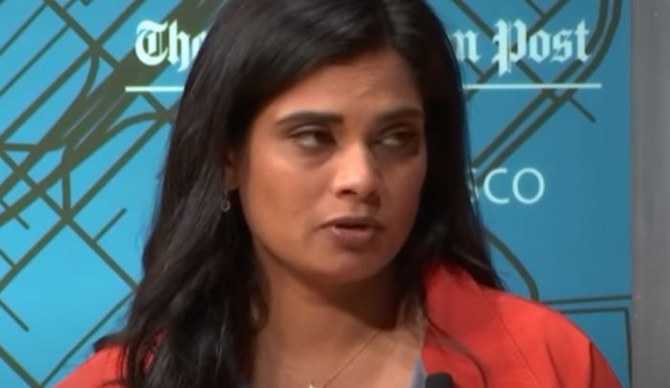
Twitter’s chief lawyer, who is seen as leading the microblogging site’s censorship of conservatives, is seen by many as first on the block - but not only for her policies. (Screenshot)
Short Url
Updated 30 April 2022
Follow

Twitter ‘censorship chief’ Gadde in tears, risks losing her $17 million salary after Musk takeover

  • If fired, however, Gadde stands to win a hefty severance package worth $12.5 million

DUBAI: Elon Musk, who earlier this week bought Twitter for $44 billion, has criticized some of the past actions of the social media giant - and so he’s coming in for a clean sweep.

Among those directly in the line of fire are censors, with Musk’s free speech absolutism seen as the driving force behind his takeover of the company. Twitter’s chief lawyer, who is seen as leading the microblogging site’s censorship of conservatives, is seen by many as first on the block - but not only for her policies.

Before the purchase, Vijaya Gadde received a roughly 130 percent pay raise in 2021, Bloomberg reported. Her total compensation in 2021 was almost $17 million — up from about $7.3 million in 2020.

A recent article surfaced that claimed that Gadde broke down in tears during a staff meeting about the impending takeover.

If fired, however, Gadde stands to win a hefty severance package worth $12.5 million that includes the accelerated vesting of a trove of Twitter shares she has accrued.

Gadde - who has been referred to as a ‘woke tyrant’ and a ‘censorship chief’ by many websites and social media commentators was also hit at by Musk online.

The Tesla tycoon tweeted a meme featuring Gadde and conservative journalist Tim Pool in a loop regarding left-wing bias and censorship.

Many worry that Twitter’s efforts to deal with harassment, misogyny and misinformation might take a backward step under Musk.

“Musk’s pursuit of his normal daily activities on Twitter exacerbate the worst aspects of the site and undercut the good work that folks at Twitter have been doing,” said Adam Conner, vice president for technology policy at the Center for American Progress.

While Musk’s activity on Twitter is attracting new scrutiny because of his deal on Monday to acquire the company, the world’s richest person is no stranger to controversy and criticism on the platform.

Last October, Musk criticized Missy Cummings, a Duke University professor who was hired by the US vehicle safety regulator as an adviser, in a tweet that was followed by personal attacks online on Cummings. A longtime critic of Tesla’s driver assistant software, Cummings subsequently deleted her Twitter account.

In 2018, Musk called a British diver “a pedo guy” after he downplayed Musk’s idea of using SpaceX’s mini-submarine to rescue a boys’ soccer team trapped in a cave in Thailand.

“If he proves incapable of tamping down the polarization, Twitter will slowly start to become less relevant because certain types of conversations will no longer be able to take place on it,” said David A. Kirsch, an associate professor of management and entrepreneurship at the University of Maryland.


Award winning Al Arabiya reporter recounts horrors of covering Sudan

Updated 16 February 2026
Follow

Award winning Al Arabiya reporter recounts horrors of covering Sudan

  • Almigdad Hassan describes his journey covering killings, hunger and disease
  • RSF continues onslaught as world fails to stop Sudan war

LONDON: When war erupted in Sudan in April 2023, Almigdad Hassan, a 27-year-old pharmacy graduate from the University of Khartoum, had just begun his first job at a pharmaceutical company.

Within days, the explosions that trapped him in the capital pushed him into frontline war reporting for Saudi Arabia broadcasters Al Arabiya and Al Hadath.

It was a decision that would later earn him an international free press award for courageous coverage of one of the world’s most underreported and inaccessible humanitarian catastrophes.

Front view of the University of Khartoum's Faculty of Pharmacy, where Almigdad Hassan earned his BS Pharmacy degree. (Supplied)

As most residents fled Khartoum, Hassan said he felt compelled to stay.

“Something inside me was driving me to stay, but I didn’t know what it was,” Hassan told Arab News after winning the Newcomer of the Year award from Free Press Unlimited, a Netherlands-based international press freedom organization.

“I just felt that this was my chance to use my talent in media to do something for my people and humanity.”

At the time, he took three days to accept Al Arabiya’s offer to become an official war correspondent, following a previous internship with the network.

He did not anticipate that the power struggle between the Sudanese Armed Forces and the Abu Dhabi-backed Rapid Support Forces would spiral into a protracted war — now nearing its third anniversary and widely described as the world’s worst humanitarian crisis.

“Things escalated so quickly in Khartoum. Main roads and bridges were blocked, armored vehicles and military checkpoints were seen everywhere,” Hassan said, referring to the RSF’s seizure of Khartoum International Airport, the presidential palace, and several military bases in April 2023.

“Every time I carried my equipment and stepped outside to report, I did not know whether I would reach my assignment or make it back home. Every decision put my life at risk.”

Sudan's Army chief Abdel Fattah al-Burhan (C) and paramilitary commander Mohamed Hamdan Daglo (2nd L) attend the signing of a peace deal in Khartoum on December 5, 2022, months before their factions started fighting. (AFP/file photo)

He shared harrowing testimonies from survivors in displacement camps in El-Obeid, North Kordofan, where residents had fled violence in the RSF-controlled towns of Kadugli and Dilling in South Kordofan before their liberation during a major SAF army breakthrough last fortnight.

“I heard more than 10 accounts of grave human rights violations, including mass killings, torture, widespread gang rape, and arbitrary imprisonment,” Hassan said of his reporting last December.

Hassan recounted 15 months of reporting from RSF-controlled Khartoum before the SAF retook the capital last March, describing it as “the darkest time of my life.”

“Khartoum was hell back then. It was the worst place in the world in terms of security and the violation of every basic human right to a level no one can imagine,” Hassan said.

He recalled that the most harrowing scenes he witnessed came within the first week of the war, when “bodies of residents lay decomposing in the streets and were eaten by dogs.”

“This was the moment I realized our humanity was being erased, just as those bodies were slowly vanishing,” Hassan said, “but it reinforced my belief that documenting these horrors was my mission, no matter the risks.”

People walk among scattered objects in the market of El Geneina, the capital of West Darfur in Sudan following weeks of fighting between the SAF and RSF, on April 29, 2023. (AFP)

He reported attacks involving killings, rape, and arbitrary kidnappings carried out inside private homes. He also pointed to unofficial mass graves hastily dug into residential streets to bury the dead, while some bodies were left to decompose inside houses.

“The armed men would celebrate killing residents because anyone living in army-controlled areas was seen as supportive of the army,” Hassan said.

“These are not only media narratives. It is a reality people lived.”

Since the war began, both the RSF and SAF have been accused of committing atrocities. However, the RSF has been accused of genocide against non-Arab groups such as the Masalit, Fur, and Zaghawa tribes in West Darfur. Abu Dhabi has been accused of backing the RSF.

Last year, a detailed report produced by Amnesty International provides evidence for the presence of UAE armored personnel carriers and infantry fighting vehicles in Sudan being used by the RSF in particular. Amnesty also accuses the RSF of war crimes. 

In August 2024, 15 months into the war, the UN-backed Famine Review Committee of the Integrated Food Security Phase Classification declared famine in North Darfur’s Zamzam displacement camp, which had been under RSF blockade — the committee’s first such determination in more than seven years.

Last November, the UN declared famine in RSF-controlled Al-Fasher, the capital of North Darfur, and Kadugli, the capital of South Kordofan, warning that a further 20 areas across Darfur and Greater Kordofan were at risk in what it described as “the world’s largest hunger crisis.”

Last fortnight, the global hunger monitor issued an alert saying famine thresholds for acute malnutrition had been surpassed in the contested North Darfur localities of Um Baru and Kernoi.

Hassan pointed to the lack of safety and severe movement restrictions in RSF-controlled areas, describing neighborhoods as “largely emptied of residents” and cut off, with no services or medical supplies.

Almigdad Hassan says the most harrowing scenes he witnessed came within the first week of the war, when “bodies of residents lay decomposing in the streets and were eaten by dogs.” (Supplied)

By autumn 2024, months before Khartoum was reclaimed by the army, residents in some neighborhoods were dying from diseases such as dengue fever, with no access to basic medical supplies or care.

Hospitals, he said, were reporting at least four deaths a day.

During the outbreak, which also infected some of his fellow journalists, Hassan said he relied on his training as a pharmacist to assess the risks but was still “scared for my life, knowing the risk was high and there was little protection.”

He said he felt a responsibility to document both the military and humanitarian dimensions of the war, particularly in the absence of any rule of law or effective security presence.

People, he noted, were entirely dependent on humanitarian support at a time when aid organizations were denied access.

“It was hard to witness this as a human being, let alone document it as a journalist,” he said. “Even enemies have basic human rights that need to be maintained, but unfortunately, what I saw was that fighters and armed militia got used to the act of killing in a horrific manner.”

The RSF, he said, engaged in direct clashes that killed civilians while also burning entire villages and looting livestock, shops, and property. Once-bustling roads in Khartoum had become deserted, unrecognizable corridors of destruction.

Almighdad Hassan said his work as a journalist allowed limited movement around Khartoum after complex security arrangements with both sides. (Supplied)

According to UN figures, the conflict has displaced roughly 14 million people and killed hundreds of thousands.

Hassan said his work as a journalist allowed limited movement around Khartoum after complex security arrangements with both sides — a privilege unavailable to most civilians.

“Yet, we were often caught in crossfire and at risk of being killed by the other warring party, which viewed us as siding with the enemy,” he said.

“As journalists, we relied on solar power to charge our equipment and stay connected, which gave us more access than ordinary citizens. Even then, once we left our office — often our only safe space — we were completely isolated. If something happened to you in the streets, no one would know.”

Beyond the devastating loss of human life, Hassan said the violations extended to Sudan’s cultural heritage and national history.

A picture shows a view of the damage at the Sudan National Museum in Khartoum on April 11, 2025, after the army recaptured the country's capital from RSF paramilitaries the previous month. (AFP/file photo)

Reporting from the aftermath of attacks on the presidential palace and the national museum, he said he witnessed the destruction and looting of artifacts tracing the country’s history since independence.

“I watched the country’s history being erased in front of my eyes,” he said, referring to damaged artifacts, gifts from earlier eras, and the destruction of classic cars once used by former presidents.

“I realized the brutality of this war when I saw people killing their own countrymen and destroying their own culture, heritage and history.”

Hassan described residents’ “hysterical happiness” in every area retaken by the army. Many, he said, likened life under RSF rule to “colonialism,” saying they were treated like foreigners rather than Sudanese.

Almigdad Hassan described ‘hysterical happiness’ in every area retaken from RSF. (Supplied)

Though both sides have been accused of violations, Hassan said people want a ruling authority that restores the basic dignity and human rights they lost.

In announcing the award, Free Press Unlimited said Hassan was recognized for his “dedication, courage, and ability to deliver compelling, accurate reporting under extreme conditions.”

Hassan said the recognition deepened his sense of responsibility toward humanity and strengthened his determination to continue reporting on the devastating war.

“With time, I understood the importance of what I do,” he said. “I realized how journalism can protect lives and deliver voices that would otherwise go unheard.”

He described the award as a shared responsibility with the international community. With his work now recognized globally, Hassan said his reach — and his mission — has only grown.

“It is no longer a job. It is my mission.”