

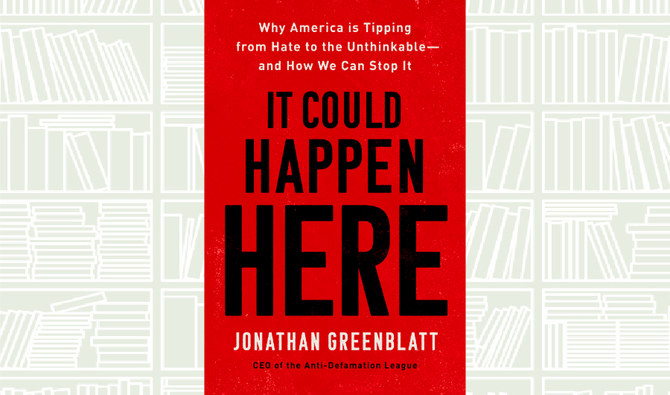
What We Are Reading Today: It Could Happen Here by Jonathan Greenblatt

Short Url
Updated 29 April 2022
Follow

What We Are Reading Today: It Could Happen Here by Jonathan Greenblatt

Jonathan Greenblatt’s It Could Happen Here is an impassioned argument about the terrifying path that America finds itself on today — and how we can save ourselves.

It’s almost impossible to imagine that unbridled hate and systematic violence could come for us or our families.

But it has happened in our lifetimes in Europe, the Middle East, Africa, and Asia. And it could happen here.

As CEO of the storied Anti-Defamation League, Greenblatt has made it his personal mission to demonstrate how antisemitism, racism, and other insidious forms of intolerance can destroy a society, taking root as quiet prejudices but mutating over time into horrific acts of brutality.

Drawing on ADL’s decades of experience in fighting hate, Greenblatt offers a bracing primer on how we — as individuals, as organizations, and as a society —can strike back against hate.

Just because it could happen here, he shows, does not mean that the unthinkable is inevitable.


What We Are Reading Today: The Correspondence

Photo/Supplied
Updated 02 February 2026
Follow

What We Are Reading Today: The Correspondence

  • During this period, Thoreau was well established as a writer and lecturer, and he continued to pursue the interests and activities that had occupied him earlier in the 1850s

Author: Henry David D. Thoreau

This is the third and final volume of the first full-scale scholarly edition of Thoreau’s correspondence in more than half a century. Together, the volumes present every known letter written or received by Thoreau, almost 650 in all, including more than 100 that have never been published before.

“Correspondence 3: 1857–1862” contains 239 letters, 121 written by Thoreau and 118 written to him. Sixty-seven letters are collected here for the first time; of these, 44 have not been published before, including five dated between 1837 and 1855 that are included in an addenda. 

During this period, Thoreau was well established as a writer and lecturer, and he continued to pursue the interests and activities that had occupied him earlier in the 1850s. 

Letters document the publication of “Chesuncook” (1858) and “An Address on the Succession of Forest Trees” (1860), as well as his preparations, a few months before his death, for the posthumous publication of “The Maine Woods “ and the essays “Walking,” “Autumnal Tints,” “Wild Apples,” and “Life without Principle.”