Kazakhstan says to ban Russian presenter over Ukraine tirade

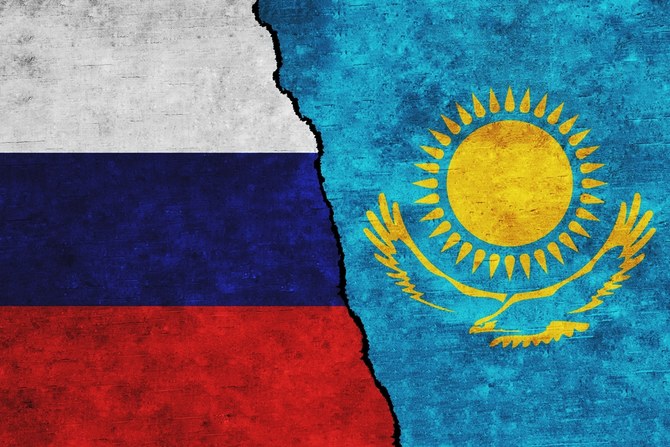
Kazakhstan's foreign ministry said comments made by Tigran Keosayan, Russian presenter, "poison the atmosphere of good neighbourly relations" between the two countries. (Shutterstock)
Short Url
Updated 28 April 2022
Follow

Kazakhstan says to ban Russian presenter over Ukraine tirade

  • A statement distributed by Kazakhstan's foreign ministry late Wednesday said comments made by Tigran Keosayan, Russian presenter, "poison the atmosphere of good neighbourly relations"
  • Keosayan made the comments in a video on his YouTube channel

NUR-SULTAN, Kazakhstan: Kazakhstan has admonished a pro-Kremlin television presenter after he unleashed a tirade against the ex-Soviet country over its perceived distancing from Moscow since Russian troops invaded Ukraine.
Central Asia’s richest country, Kazakhstan shares a land border with Russia, has a significant ethnic Russian minority and was forced to call in troops from a Russia-led bloc to quell unprecedented unrest in January.
But the country of 19 million has stayed neutral on Ukraine and is toning down commemorations of a holiday marking Soviet victory over Nazi Germany that holds strong symbolic importance for Russian leader Vladimir Putin.
A statement distributed by Kazakhstan’s foreign ministry late Wednesday said comments made by Tigran Keosayan, Russian presenter, film director and husband of Russia Today editor-in-chief Margarita Simonyan, “poison the atmosphere of good neighborly relations” between the two countries.
“I believe he will be included in the list of persons undesirable for entry into Kazakhstan,” the statement quoted foreign ministry spokesman Aibek Smadiyarov as saying.
Keosayan made the comments in a video on his YouTube channel, where he questioned responses to the invasion of Ukraine among former Soviet countries, including ally Kazakhstan.
“Kazakhs, brothers. What is with the non-gratitude?” asked Keosayan regarding news that Kazakhstan had ruled out holding an annual military parade on the May 9 holiday.
“Look at Ukraine carefully, think seriously,” he said.
“If you think you can continue to be such sly asses and there won’t be any consequences, you are mistaken,” Keosayan said before adding: “the train is leaving. You can still get aboard. In the last carriage.”
Kazakhstan’s foreign ministry said the comments “play into the hands of the opponents of the strategic partnership” between Kazakhstan and Russia.
AFP was unable to reach the foreign ministry Thursday to confirm if Keosayan had already been blacklisted.
Keosayan’s intervention echoes comments by wife Margarita Simonyan, who questioned why Russia had “saved” Kazakhstan by agreeing to send what the Collective Security Treaty Organization (CSTO) described as “peacekeepers” during deadly nationwide political unrest in January.
Simonyan’s February 22 Facebook post was in response to Kazakh foreign minister Mukhtar Tleuberdi’s assertion that Kazakhstan was not considering following Moscow’s lead in recognizing the independence of two separatist-led entities in eastern Ukraine.
Moscow’s bloody invasion of Ukraine began two days later.


Saudi Media Forum urges ethical coverage as crises redefine Arab journalism

Updated 04 February 2026
Follow

Saudi Media Forum urges ethical coverage as crises redefine Arab journalism

  • Raw news without context can mislead audiences and distort credibility, experts say

RIYADH: Arab media was born in crisis and shaped by conflict rather than stability, Malik Al-Rougi, general manager of Thaqafeyah Channel, said during the Saudi Media Forum in Riyadh on Wednesday.

Al-Rougi was speaking during a panel titled “Media and Crises: The Battle for Awareness and the Challenges of Responsible Coverage,” which examined how news organizations across the region navigated credibility and professional standards amid fast-moving regional developments.

“Today, when you build a media organization and invest in it for many years, a single crisis can destroy it,” he said.

Referring to recent events, Al-Rougi said that he had witnessed news channels whose credibility “collapsed overnight.”

“In journalistic and political terms, this is not a process of news production. It is a process of propaganda production,” he said. “The damage caused by such a post … is enormous for an institution in which millions, perhaps billions, have been invested.”

When a media outlet shifts from professionalism and credibility toward “propaganda,” he added, it moves away from its core role. 

Saudi media leaders, journalists, and experts gathered at the Saudi Media Forum in Riyadh to discuss credibility, ethics, and innovation. (AN photo by Huda Bashatah/Supplied)

“A crisis can work for you or against you,” Al-Rougi added. “When, in the heart of a crisis, you demonstrate high credibility and composure, you move light-years ahead. When you fail to adhere to ethical standards, you lose light-years as well.”

Abdullah Al-Assaf, professor of political media studies at Imam Muhammad bin Saud Islamic University, said that in many crises across the Arab world, agendas and directives had often prevailed over professionalism.

“Credibility was buried,” he added.

Hasan Al-Mustafa, writer and researcher at Al-Arabiya channel, said that raw information could be subject to multiple interpretations if not placed within a proper political, security, historical or geographical context.

He added that such an approach was urgently needed during periods of political and security volatility in the Middle East. 

When, in the heart of a crisis, you demonstrate high credibility and composure, you move light-years ahead. When you fail to adhere to ethical standards, you lose light-years as well.

Malik Al-Rougi Thaqafeyah, Channel general manager

“This objectivity, or this reliability, is a great responsibility,” Al-Mustafa said. “It is reflected not only in its impact on the audience, but also on the credibility of the content creator.”

Al-Mustafa warned against populism and haste in coverage, saying that they risked deepening crises rather than providing informed public perspectives.

He also said that competition with social media influencers had pushed some traditional outlets to imitate influencer-driven models instead of strengthening their own professional standards.

“Our media has been crisis-driven for decades,” he said, describing much of the region’s coverage as reactive rather than proactive.

During a separate panel titled “The Official Voice in the Digital Age: Strategies of Influence,” speakers discussed how rapid technological and social changes were reshaping the role of institutional spokespersons.

Abdulrahman Alhusain, official spokesperson of the Saudi Ministry of Commerce, said that the role was no longer limited to delivering statements or reacting to events.

“Today, the spokesperson must be the director of the scene — the director of the media narrative,” he said.

Audiences, he added, no longer accept isolated pieces of information unless they were presented within a clear narrative and structure.

“In the past, a spokesperson was expected to deliver formal presentations. Today, what is required is dialogue. The role may once required defense, but now it must involve discussion, the exchange of views, and open, candid conversation aimed at development — regardless of how harsh the criticism may be.”

He said that spokespersons must also be guided by data, digital indicators and artificial intelligence to understand public opinion before speaking.

“You must choose the right timing, the right method and the right vocabulary. You must anticipate a crisis before it happens. That is your role.”

Abdullah Aloraij, general manager of media at the Riyadh Region Municipality, said that the most important skill for a spokesperson today was the ability to analyze and monitor public discourse.

“The challenge is not in transferring words, but in transferring understanding and impact in the right way,” he said.