


Bangladeshi scientists launch IsDB-funded eco-friendly homes in Rohingya camps

Rohingya refugees gather at Jamtoli refugee camp in Ukhia district near Cox’s Bazar, Bangladesh. (AFP/File)
Short Url
Updated 28 April 2022
Follow

Bangladeshi scientists launch IsDB-funded eco-friendly homes in Rohingya camps

  • Research on introducing jutin housing to Cox’s Bazar financed with $100k grant

DHAKA: Bangladeshi scientists have introduced eco-friendly housing to Rohingya refugee camps in Cox’s Bazar using a new durable material developed in a project financed by the Jeddah-based Islamic Development Bank.

Bangladesh hosts more than 1.1 million Rohingya who fled neighboring Myanmar during a military crackdown in 2017. Most of them live in Cox’s Bazar district, a coastal region in the country’s east, which with the arrival of Rohingya, became the world’s largest refugee settlement.

The location, climate and topography of Cox’s Bazar make it vulnerable to natural hazards and extreme weather events such as cyclones, landslides and flash floods. The Rohingya crisis has increased the size of the population, creating new environmental risks due to deforestation and infrastructure pressure.

The construction of sustainable housing based on jutin — a combination of jute fiber and resin — has been spearheaded in Cox’s Bazar by the Dhaka-based ICDDR,B (formerly known as the International Centre for Diarrhoeal Disease Research, Bangladesh), one of the world’s leading global health research institutes that also undertakes environmental intervention work. 
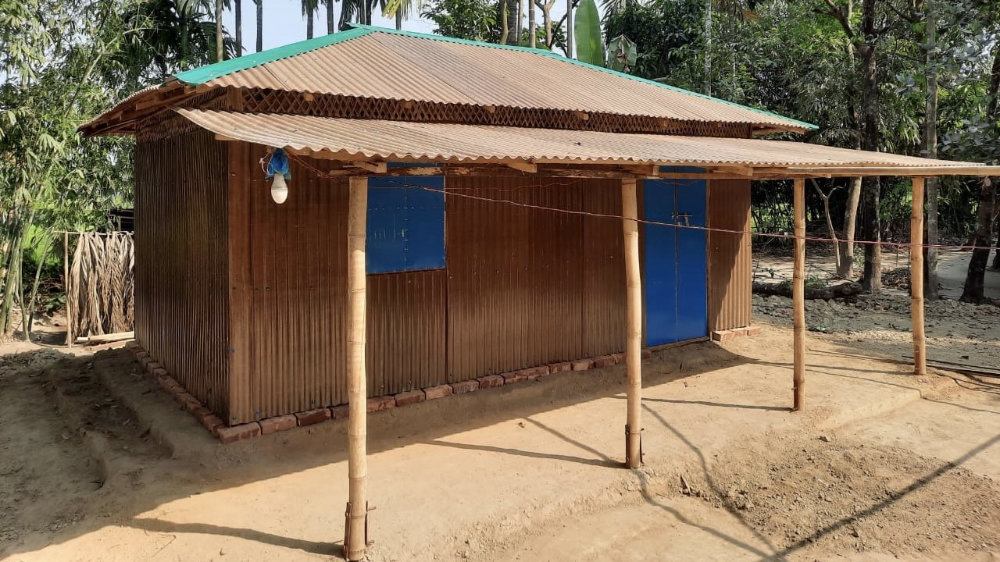
“The houses made of jutin are heat resistant, which means people will feel significantly cooler temperatures while living in these houses compared with outside temperatures,” project coordinator Dr. Mohammad Mahbubur Rahman told Arab News earlier this week.

In a pilot project, the ICDDR,B has built six jutin houses in Cox’s Bazar. Two of them are expected to be handed over to Rohingya refugees and another four will host communities in the area next month.

“Our research is still underway,” Rahman added. “We are now collecting data on these houses in different conditions, like the changes of temperature between day and night, and in different seasons.”

Jutin was invented by Bangladeshi scientist Dr. Mubarak Ahmad Khan, who patented the material in 2008. 
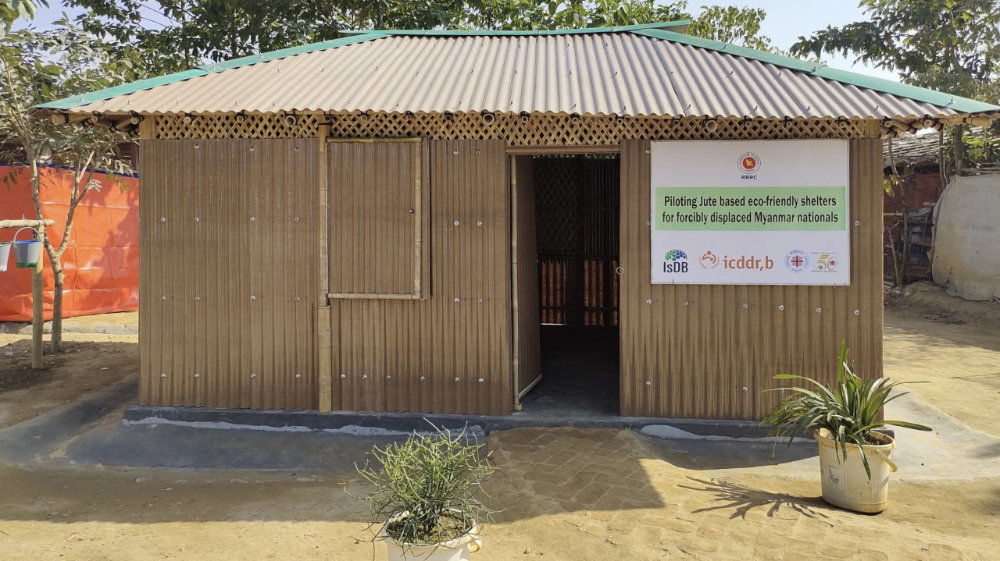
Lightweight, durable, bio-acceptable, heat and saline water-resistant, jutin has been developed as an alternative housing material in disaster-prone coastal areas of Bangladesh. According to Khan, it is four times stronger than tin, which is traditionally used in small house construction.

“Jutin is mainly a housing material which can be used instead of wood. It also has uses in the electric appliance and car-making industry,” Khan said. “In the cyclone-prone areas, sometimes people get injured when tin from the roofs flies away due to gusty winds.”

ICDDR,B research on introducing jutin to the camp areas of Cox’s Bazar was financed with an $100,000 grant under IsDB’s “Transform Innovation” initiative.

It costs about $1,000 to build one 14-square-meter jutin house measuring 2.6 meters in height.

Dr. Farjana Jahan, principal investigator of the jutin house pilot project, said that makeshift houses for Rohingya refugees are mainly made from plastic that is replaced every six months.

“Jutin houses are much more durable and last up to 60 years,” she told Arab News. “Jutin can be considered as a climate smart solution for addressing the shelter issues in the Rohingya camps.

“These jutin houses are fully environment friendly, free from chemical exposure, have enough ventilation and daylight facilities, and can be dismantled easily during an emergency. It will also reduce the concern with fire incidents, which is a big issue in the highly congested camp areas.”


US military boards sanctioned oil tanker in Indian Ocean

Updated 55 min 16 sec ago
Follow

US military boards sanctioned oil tanker in Indian Ocean

  • Tanker tracking website says Aquila II departed the Venezuelan coast after US forces captured then-President Nicolás Maduro
  • Pentagon says it 'hunted' the vessel all the way from the Caribbean to the Indian Ocean

WASHINGTON: US military forces boarded a sanctioned oil tanker in the Indian Ocean after tracking the ship from the Caribbean Sea, the Pentagon said Monday.
The Pentagon’s statement on social media did not say whether the ship was connected to Venezuela, which faces US sanctions on its oil and relies on a shadow fleet of falsely flagged tankers to smuggle crude into global supply chains.
However, the Aquila II was one of at least 16 tankers that departed the Venezuelan coast last month after US forces captured then-President Nicolás Maduro, said Samir Madani, co-founder of TankerTrackers.com. He said his organization used satellite imagery and surface-level photos to document the ship’s movements.
According to data transmitted from the ship on Monday, it is not currently laden with a cargo of crude oil.


The Aquila II is a Panamanian-flagged tanker under US sanctions related to the shipment of illicit Russian oil. Owned by a company with a listed address in Hong Kong, ship tracking data shows it has spent much of the last year with its radio transponder turned off, a practice known as “running dark” commonly employed by smugglers to hide their location.
US Southern Command, which oversees Latin America, said in an email that it had nothing to add to the Pentagon’s post on X. The post said the military “conducted a right-of-visit, maritime interdiction” on the ship.
“The Aquila II was operating in defiance of President Trump’s established quarantine of sanctioned vessels in the Caribbean,” the Pentagon said. “It ran, and we followed.”
The US did not say it had seized the ship, which the US has done previously with at least seven other sanctioned oil tankers linked to Venezuela.
A Navy official, who spoke on condition of anonymity to discuss military operations, would not say what forces were used in the operation but confirmed the destroyers USS Pinckney and USS John Finn as well as the mobile base ship USS Miguel Keith were operating in the Indian Ocean.
In videos the Pentagon posted to social media, uniformed forces can be seen boarding a Navy helicopter that takes off from a ship that matches the profile of the Miguel Keith. Video and photos of the tanker shot from inside a helicopter also show a Navy destroyer sailing alongside the ship.
Since the US ouster of Maduro in a surprise nighttime raid on Jan. 3, the Trump administration has set out to control the production, refining and global distribution of Venezuela’s petroleum products. Officials in President Donald Trump’s Republican administration have made it clear they see seizing the tankers as a way to generate cash as they seek to rebuild Venezuela’s battered oil industry and restore its economy.
Trump also has been trying to restrict the flow of oil to Cuba, which faces strict economic sanctions by the US and relies heavily on oil shipments from allies like Mexico, Russia and Venezuela.
Since the Venezuela operation, Trump has said no more Venezuelan oil will go to Cuba and that the Cuban government is ready to fall. Trump also recently signed an executive order that would impose a tariff on any goods from countries that sell or provide oil to Cuba, primarily pressuring Mexico because it has acted as an oil lifeline for Cuba.